19th Century, Architecture, History, Intercession, Judgment & Counter-Judgment Cycle, Labor, Minnesota, omnipresent history

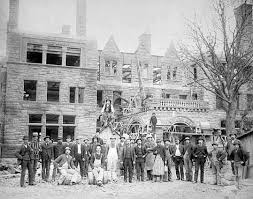
James J. Hill House Completed

unknown

1891

“Rugged stone, massive scale, fine detail, and ingenious mechanical systems recall the powerful presence of James J. Hill, builder of the Great Northern Railway. Completed in 1891, the red sandstone residence was the setting of the public and private lives of the Hill family.” *

Lord, what is the importance of home construction in Your economy?  Albeit this is an impressive home, but why does it matter now? Will You guide my heart and mind toward Your thoughts on the matter?

Eternal Father, a commencement thought; our home reflects our character. Mr. Hill spent much his life on the epic tasks of building a railway. His home reflects a willingness to solve difficult problems: custom shaping stones, miles of board feet of trim, and making a castle comfortable enough to live in Minnesota’s weather extremes. 

So I want to bless the heritage of Mr. Hill’s patience, long-range planning, and tenacity to face both expected and unexpected problems.I want to bless the myriad of workmen who truly put their sweat and soul into their trades to make this home exceptional. Will You bless them and all their generations of tradesmen in the present? Will You help us view the trades as an act of worship?

I’m reminded that my Messiah chose to be a carpenter, and apprenticed under His earthly father. (Joseph) Will You help us, especially men, see that worship is not just obscure and ancient songs and rituals in a church, but in fitting pipes, framing walls, running electrical lines, and every kind of working with our hands? May all who labor in tasks that go unseen and unnoticed be blessed this day in Jesus’ name! 

Another idea that attaches to character; we can build to serve a function, or build to impress others. Lord, I will not condemn this man for the pursuit of greatness. I think You get the credit when we succeed at exceptional endeavors, I think a fractal of the light of Your character shines through any human who dares to do what they love.

But Lord hear this prayer, our lives are often like homes! We build for ‘curb appeal’. We erect lovely facades. We spend considerable time and effort on the way things look to the detriment of the way things are. We already possess the favor of the King of the Universe, but how we work for the favor of our fellow human beings?! 

Will You forgive James J. Hill the past sins of empire building? Will You release his heritage, our state, and even the ground that those objects of empire occupy from separations past, present, and future? Will You forgive us for the empire building in our hearts? Will You forgive us for maintaining facades we build to our own greatness? Will You help us humbly acknowledge the efforts others have spent in our successes? Father, have mercy! Christ, have mercy! Counselor, have mercy!

* http://www.mnhs.org/about/dipity_timeline.htm


Standard
19th Century, Architecture, History, Intercession, Minnesota, Mississippi River, omnipresent history, railroad, Transportation

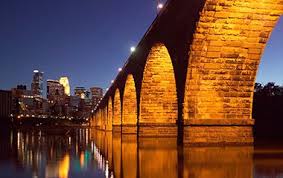
Stone Arch Bridge Opens 1883

images

November 23, 1883

“The Stone Arch Bridge spans the Mississippi below St. Anthony Falls. Once called “Jim Hill’s Folly,” the bridge provides a crossing for trains and becomes a Minneapolis landmark.”

First, I need to confess my bias against the railroad barons based on my reading in college to You. Will You forgive my assumption that Hill was a “Robber Baron” like many of his peers; captains of industry synonymous with trains? The rails in this era often made choices that yielded pain for the Midwestern farmer, manufacturer, or anyone who wasn’t in partnership with them. (They gained sweetheart deals for themselves and their allies, and charged exorbitant prices to the farmer whose harvest would spoil if they waited for better. I do not abhor competition, but bristle when I sense oligarchic or monopolistic control.) 

Digging into my assumptions, I found that I had wrongly placed all capitalists of this epoch in the same camp, but this is inaccurate. May I elaborate? Market capitalism is based on building a better product, and selling it at a voluntarily determined price. State capitalism twists the arm of government to sell an inferior product at an involuntary price. 

Clearly, Hill belonged more to the former camp than the latter according to Loyola economics professor Thomas J. DiLorenzo. Here lies evidence of Hill’s opposition to the state capitalism of the “Robber Barons”.

“Hill’s rates fell steadily, and when farmers began complaining about the lack of grain storage space, he instructed his company managers to build larger storage facilities near his rail depots. He refused to join in attempts at cartel price fixing and in fact “gloried in the role of rate-slasher and disrupter of [price-fixing] pooling agreements,” writes historian Burton Folsom. After all, he knew that monopolistic pricing would have been an act of killing the goose that lays the golden egg.” **

Additionally, the following quote of Professor DiLorenzo hints at why Hill’s competitors mocked the Stone Arch Bridge as “folly”, and his own internal motives.

 “In building his transcontinental railroad, from 1886 to 1893, Hill applied the same strategy that he had in building the St. Paul, Minneapolis, and Manitoba: careful building of the road combined with the economic cultivation of the nearby communities. He always built for durability and efficiency, not scenery, as was sometimes the case with the government-subsidized railroads. He did not skimp on building materials, having witnessed what harsh Midwest winters could do to his facilities and how foolish it was for the NP (Northern Pacific Railroad – his competitor) to have ignored this lesson. The solid granite arch bridge that Hill built across the Mississippi River was a Minneapolis landmark for many years.” ***

G-d, did I have it all wrong! I find myself humbled to discover that Hill is a good man, who built a better railroad. Will You honor those like him, who love their work, and offer it back to You and society as an act of worship?!

Will You free those of us harboring bitterness towards the state capitalists, and towards this spirit in man that is willing to use the law in self service? Will You free us from the admonition “Good enough for government work”? Will You lift this spirit of the slacker: up, out, and onto the Cross of Christ?

Lord, quite honestly, I hate the heritage of price fixing and theft! I abhor the curse that these judgment’s have put on our state, its’ people, our freedom of travel, and all lands that were granted, bought or stolen by the railroad lines. I  despise how the rails withheld the good that they could have chosen to perform for their fellow man, and still yielded a generous profit!

Yet, I am a man of mixed motives just like them. I withhold from doing the good I know I can do, and sin against my brother in my heart. I judge them. I think evil of them in my thoughts. I harbor resentment. Lord Jesus, King of the Universe, have mercy on me a sinner for my judgments!

Will You bring blessing to every rail, every piece of land, every train, every rail employee, and all the cargo that enters or exits this state of Minnesota? Will You profoundly bless the Stone Arch bridge, and esteem its’ symbolism? Will You be the bridge and span this rift between free-market entrepreneurs and fixed-market magnates? Amen!

* http://www.mnhs.org/about/dipity_timeline.htm

** DiLorenzo, Thomas J. “The Truth About the “Robber Barons”” excerpt of Chapter 7 “How Capitalism Saved America”. Internet. MIses Institute. 11/01/2017. https://mises.org/library/truth-about-robber-barons

*** DiLorenzo citing Burton W. Folsom Jr., “Entrepreneurs vs. the State: A New Look at the Rise of Big Business in America”, 1840 — 1920 (Herndon, VA: Young America’s Foundation, 1987

**** Read more about these lovely arches? https://www.minneapolisparks.org/parks__destinations/historical_sites/stone_arch_bridge/#group_2_150339

Standard