
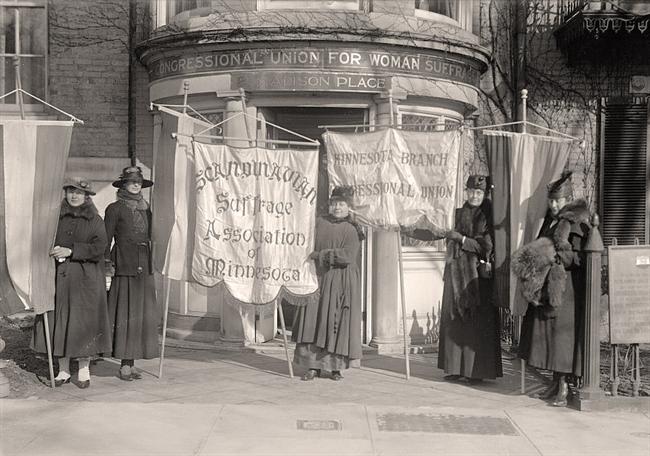
August 26, 1919
“The state legislature ratifies the nineteenth amendment to the Constitution of the United States, granting women the right to vote.” *
“The right of citizens of the United States to vote shall not be denied or abridged by the United States or by any State on account of sex.” 19th amendment of the U.S. Constitution
“In 1881, the Minnesota Woman Suffrage Association (MWSA) was founded in Hastings. Prior to 1881, the campaign for suffrage in Minnesota was splintered and loosely organized, yet advances were made. In 1875 a constitutional amendment passed that allowed Minnesota women the right to vote in school elections (Laws 1875, Chapter 2). But two years later, a temperance-related suffrage constitutional amendment was defeated (Laws 1877, Chapter 2). That amendment proposed that women could vote on a ‘question of selling, or restraining the sale, or licensing the selling, or the manufacture of intoxicating liquors.’ In 1877, an interesting clarification of election law was passed by the Legislature, requiring separate ballots and separate ballot boxes for women voting in local elections, as they could only vote for ‘officers of public schools’ but not other officers of the village or city (Laws 1877, Chapter 74, Sec. 14).
As the national movement for suffrage gained strength, so did Minnesota’s movement for suffrage. Minnesota suffragists began to use new tactics such as parades, rallies, advertising, and promotional tours in newly purchased automobiles. They even had female stunt pilots put on aerial shows in support of suffrage. Clara Ueland served as MWSA President from 1914-1919, when the suffrage campaign in Minnesota gained significant momentum. In 1919, the Legislature passed a law allowing women to vote for presidential electors (Laws 1919, Chapter 89), and later in the year ratified the national amendment ensuring universal suffrage. Other prominent organizers for suffrage in Minnesota included Sarah Burger Stearns, Julia Bullard Nelson, Ethel Edgerton Hurd, Emily Haskell Bright, Bertha Berglin Moller, Emily Gilman Noyes, and Nellie Griswold Francis.
Though suffrage granted all women in the United States the right to vote, certain populations were not allowed to become full citizens which denied the women of these populations the right to vote. For example, Native Americans were not granted citizenship until the Indian Citizenship Act of 1924. And despite passage of that law, states still could decide whether or not Native Americans could vote.”**
Below is a common argument given in opposition to suffrage by J.B. Sandford. Note that he is the Chairman of the Democratic Caucus in California and not a Minnesota politician.
“Woman suffrage has been proven a failure in states that have tried it. It is wrong. California should profit by the mistakes of other states. Not one reform has equal suffrage effected. On the contrary, statistics go to show that in most equal suffrage states, Colorado particularly, that divorces have greatly increased since the adoption of the equal suffrage amendment, showing that it has been a home destroyer. Crime has also increased due to lack of the mothers in the home.
Woman is woman. She can not unsex herself or change her sphere. Let her be content with her lot and perform those high duties intended for her by the Great Creator, and she will accomplish far more in governmental affairs that she can ever accomplish by mixing up in the dirty pool of politics. Keep the home pure and all will be well with the Republic. Let not the sanctity of the home be invaded by every little politician that may be running up and down the highway for office. Let the manly men and the womanly women defeat this amendment and keep woman where she belongs in order that she may retain the respect of all mankind.”***
So here we begin our prayer today Lord, we have judged Your image within male and female. Suffragettes have judged the males and male leadership of this era and found it wanting. Their opponents have judged the females and female leadership roles and found them wanting. Will You forgive both of these schools of judgment?
Wise Judge, will You parse and expose the motives of women who were submitted to abusive men? Will You forgive these men their false forms of leadership based on the letter of Your law but missing its Spirit? Your example, Messiah, was to love Your bride, serve Your bride, and lay down your life for hers. Will You forgive the unwillingness to love in this kind of male, and his progeny? We have loved our male image and missed Your incarnation in the female image. Have mercy!
This leads me to the question; where did these misbeliefs come from regarding male leadership? Certainly it’s not of Your word or of Your example. Will You show us what Your example looked like, Kind Master?
“According to New Testament scholar Dr. Frank Stagg and classicist Evelyn Stagg, the synoptic Gospels of the canonical New Testament contain a relatively high number of references to women. Evangelical Bible scholar Gilbert Bilezikian agrees, especially by comparison with literary works of the same epoch. :p.82 Neither the Staggs nor Bilezikian find any recorded instance where Jesus disgraces, belittles, reproaches, or stereotypes a woman. These writers claim that examples of the manner of Jesus are instructive for inferring his attitudes toward women and show repeatedly how he liberated and affirmed women. Starr writes that of all founders of religions and religious sects, Jesus stands alone as the one who did not discriminate in some way against women. By word or deed he never encouraged the disparagement of a woman.Karen King concludes, based on the account of Jesus’ interaction with a Syrophoenician woman in Mark 7:24-30 and Matthew 15:21-28, that “an unnamed Gentile woman taught Jesus that the ministry of God is not limited to particular groups and persons, but belongs to all who have faith.”
We give You praise for this example of women gaining their participation in the decisions of Minnesota, and the United States. We thank You for the examples of: Sarah Burger Stearns, Julia Bullard Nelson, Ethel Edgerton Hurd, Emily Haskell Bright, Bertha Berglin Moller, Emily Gilman Noyes, and Nellie Griswold Francis. Will You rmember them in this era, and bless their figurative and literal children?
Will You shield them from recreating the excesses of male leadership of this era, and cause us to rely on both male and female forms of leadership? We thank You for the honest opposition to suffrage in men like J.B. Sandford. Will You help male leadership to speak the truth in love, and banish law made in fear of female authority? Will You shield men from becoming passive in reaction to these past errors, and recoiling from proper leadership in shame? Will You forgive us both our denials?
We praise You that our rights in Your kingdom cannot be broken! We thank You that our self-worth and value is not based on the fickle winds of human politics and law! We thank You that Your law points out our separations in relationships with You and our neighbors, yet You have removed its power to convict and have become our restitution; the perfect blood sacrifice! We belong because You took our death sentence and criminality to the Cross. You, the Forgiver of All Defilements have stated for all eternity that we have become Your family! You have removed our sufferings and given us eternal suffrage! Amen!
* http://www.mnhs.org/about/dipity_timeline.htm
**https://www.leg.state.mn.us/lrl/womenstimeline/details?recid=2
***Full text of J.B. Sandford’s letter “Argument Against Women’s Suffrage”. https://sfpl.org/pdf/libraries/main/sfhistory/suffrageagainst.pdf
****https://en.wikipedia.org/wiki/Jesus’_interactions_with_women
 praythroughhistory