20th Century, Boys, Girls, History, Immigration, Intercession, Israel, Jews, Judgment & Counter-Judgment Cycle, Minnesota, omnipresent history

Neighborhood House: Camp for Immigrant Children 1919

GV8.2 r141

1919

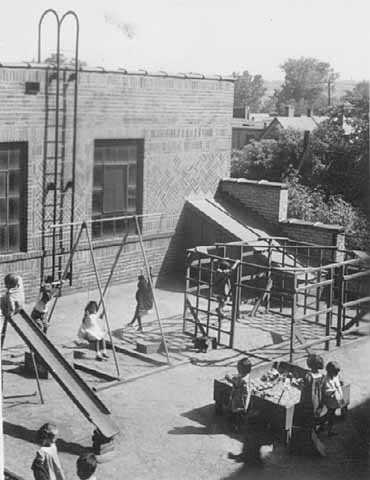
“Neighborhood House on St. Paul’s West Side expands its sports and recreation program. Camp Owendingo on Carver Lake in Woodbury provides wholesome outdoor activities for the children of recent immigrants.” *

“Led by Sophie Wirth, the classes grew into an industrial school. Girls and boys learned home and industrial arts. They took English language and American citizenship classes. In 1897 the industrial school grew into Neighborhood House, a full-service settlement house located at 153 Robertson Street. Still led by Wirth, and supervised by Mount Zion’s rabbis, Neighborhood House added recreational activities, dental and baby clinics, and programs for adults.

People of all religions and ethnic groups flocked to Neighborhood House. In 1903 it reorganized, evolving from a purely Jewish social effort into a non-sectarian one. In 1921 the population of the Flats was two and a half times greater than it had been in 1915. This led to crowding and housing shortages.

Under Constance Currie, who became head resident in 1918, Neighborhood House added playgrounds and camping activities. Most notable was the Sophie Wirth Day Camp in White Bear Lake. The Northern Pacific Railway provided free transportation to the camp for five years after its founding in 1919. The service gave hundreds of mothers and children a rare day of leisure.”**

“We praise Thee, O G-d, and thank Thee for all the blessings of the week that is gone; for life, health, and strength; for home love and friendship; for the disciplines of our trials and temptations; for the happiness of our success and prosperity. Thou hast commanded us: Six days shalt thou labor and do all thy work, but the seventh day is a Sabbath unto the Lord thy G-d. Thou hast ennobled us, O G-d, by the blessings of work, and in love and grace sanctified us by the blessings of rest.” ***

Jesus, I praise You for the work of Sophie Wirth, and all who contributed to the Neighborhood House! Thank You for the inspiration and practical training this community center provided to West Saint Paul. Thank You for making a place for Russian Jewry, and that their place of Shabbat spilled over so much and blessed their neighbors!

How good and pleasant it is when brothers, and sisters, live together in unity. Thank you for the Sabbath of this day camp! Thank You that charity begets charity, and that the Northern Pacific Railway joined in to provide free rides.

I can’t imagine the reasons of judgments of Russian Jews, but by faith I acknowledge to You that we as human often fail each other in this way. Will You forgive any transference and judgments from Minnesotans’ towards this group of immigrants? Will You take any bitterness up, out, and onto the Cross?

Conversely, will You forgive the judgments that the Neighborhood House may have held towards its neighbors? Will You forgive any judgments towards Saint Paul, and the state of Minnesota? Will You forgive any bitter roots against the predominant Catholic faith?

We ask that You bless the heritage of Sophie Wirth in the community, her family, and her spiritual ancestry. May You continue to provide our State with those who have a heart for others! May You forever bless Minnesota through Your people Israel, specifically all Jews from Russia, and may they forever be welcomed here and endowed with Your Divine favor and protection. Amen!

* http://www.mnhs.org/about/dipity_timeline.htm

**http://www.mnopedia.org/group/jewish-roots-neighborhood-house-st-paul

*** Union Prayer Book II, (New York, NY: Central Conference of American Rabbis, 1973) p.36


Standard
19th Century, Architecture, History, Intercession, Minnesota, Mississippi River, omnipresent history, railroad, Transportation

Stone Arch Bridge Opens 1883

images

November 23, 1883

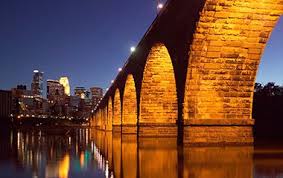
“The Stone Arch Bridge spans the Mississippi below St. Anthony Falls. Once called “Jim Hill’s Folly,” the bridge provides a crossing for trains and becomes a Minneapolis landmark.”

First, I need to confess my bias against the railroad barons based on my reading in college to You. Will You forgive my assumption that Hill was a “Robber Baron” like many of his peers; captains of industry synonymous with trains? The rails in this era often made choices that yielded pain for the Midwestern farmer, manufacturer, or anyone who wasn’t in partnership with them. (They gained sweetheart deals for themselves and their allies, and charged exorbitant prices to the farmer whose harvest would spoil if they waited for better. I do not abhor competition, but bristle when I sense oligarchic or monopolistic control.) 

Digging into my assumptions, I found that I had wrongly placed all capitalists of this epoch in the same camp, but this is inaccurate. May I elaborate? Market capitalism is based on building a better product, and selling it at a voluntarily determined price. State capitalism twists the arm of government to sell an inferior product at an involuntary price. 

Clearly, Hill belonged more to the former camp than the latter according to Loyola economics professor Thomas J. DiLorenzo. Here lies evidence of Hill’s opposition to the state capitalism of the “Robber Barons”.

“Hill’s rates fell steadily, and when farmers began complaining about the lack of grain storage space, he instructed his company managers to build larger storage facilities near his rail depots. He refused to join in attempts at cartel price fixing and in fact “gloried in the role of rate-slasher and disrupter of [price-fixing] pooling agreements,” writes historian Burton Folsom. After all, he knew that monopolistic pricing would have been an act of killing the goose that lays the golden egg.” **

Additionally, the following quote of Professor DiLorenzo hints at why Hill’s competitors mocked the Stone Arch Bridge as “folly”, and his own internal motives.

 “In building his transcontinental railroad, from 1886 to 1893, Hill applied the same strategy that he had in building the St. Paul, Minneapolis, and Manitoba: careful building of the road combined with the economic cultivation of the nearby communities. He always built for durability and efficiency, not scenery, as was sometimes the case with the government-subsidized railroads. He did not skimp on building materials, having witnessed what harsh Midwest winters could do to his facilities and how foolish it was for the NP (Northern Pacific Railroad – his competitor) to have ignored this lesson. The solid granite arch bridge that Hill built across the Mississippi River was a Minneapolis landmark for many years.” ***

G-d, did I have it all wrong! I find myself humbled to discover that Hill is a good man, who built a better railroad. Will You honor those like him, who love their work, and offer it back to You and society as an act of worship?!

Will You free those of us harboring bitterness towards the state capitalists, and towards this spirit in man that is willing to use the law in self service? Will You free us from the admonition “Good enough for government work”? Will You lift this spirit of the slacker: up, out, and onto the Cross of Christ?

Lord, quite honestly, I hate the heritage of price fixing and theft! I abhor the curse that these judgment’s have put on our state, its’ people, our freedom of travel, and all lands that were granted, bought or stolen by the railroad lines. I  despise how the rails withheld the good that they could have chosen to perform for their fellow man, and still yielded a generous profit!

Yet, I am a man of mixed motives just like them. I withhold from doing the good I know I can do, and sin against my brother in my heart. I judge them. I think evil of them in my thoughts. I harbor resentment. Lord Jesus, King of the Universe, have mercy on me a sinner for my judgments!

Will You bring blessing to every rail, every piece of land, every train, every rail employee, and all the cargo that enters or exits this state of Minnesota? Will You profoundly bless the Stone Arch bridge, and esteem its’ symbolism? Will You be the bridge and span this rift between free-market entrepreneurs and fixed-market magnates? Amen!

* http://www.mnhs.org/about/dipity_timeline.htm

** DiLorenzo, Thomas J. “The Truth About the “Robber Barons”” excerpt of Chapter 7 “How Capitalism Saved America”. Internet. MIses Institute. 11/01/2017. https://mises.org/library/truth-about-robber-barons

*** DiLorenzo citing Burton W. Folsom Jr., “Entrepreneurs vs. the State: A New Look at the Rise of Big Business in America”, 1840 — 1920 (Herndon, VA: Young America’s Foundation, 1987

**** Read more about these lovely arches? https://www.minneapolisparks.org/parks__destinations/historical_sites/stone_arch_bridge/#group_2_150339

Standard
19th Century, Agriculture, Business, farming, Food, History, Intercession, Minnesota, State Government

Bonanza Farms 1875

423478855

1875
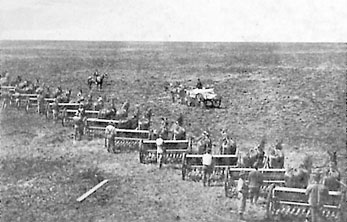
“Investors grow wheat on a grand scale in the Red River Valley. Their “bonanza farms” cover thousands of acres and are harvested by huge crews and the latest machinery.
A financial panic in 1873 stopped the construction of the Northern Pacific Railroad to the Red River Valley. In order to pay back its Eastern investors, the bankrupt company allowed its investors to exchange their bonds for land. As a result, large urban investors immediately became owners of thousands of acres of land (unlike homesteaders who had to live on the land for five years to get 160 acres). The new owners turn the land into large-scale commercial farms run by hired managers with cheap labor and expensive machinery.” *

Lord, You hate corruption of any sort in any relationship. “The LORD detests dishonest scales, but accurate weights find favor with him.” Proverbs 11:1** This Panic of 1873, again at the hands of the railroads under federal authority, really stole land from the homesteaders. (The principle of sowing and reaping? The homesteaders just years before may have been party to land being swindled from the Dakota.) Anyway, we are people capable of both sharing and defrauding land from our neighbors.

Will You forgive us this debt? Will You cause restoration and repentance to grow in the heart of this State and Nation? Will You forgive Minnesotans’ resentments against the Federal Government? Will You forgive the Railroads for manipulating the Panic of 1873 to their benefit? Will You remove this curse from our land, skies, waters, and hearts? Thank you that You deal with us in such a generous manner!

http://www.mnhs.org/about/dipity_timeline.htm
**http://biblehub.com/proverbs/11-1.htm


Standard