Author Archives: PrayThroughHistory
Dear friends, my book is done! “Pray Through History” now available on Amazon:Books!
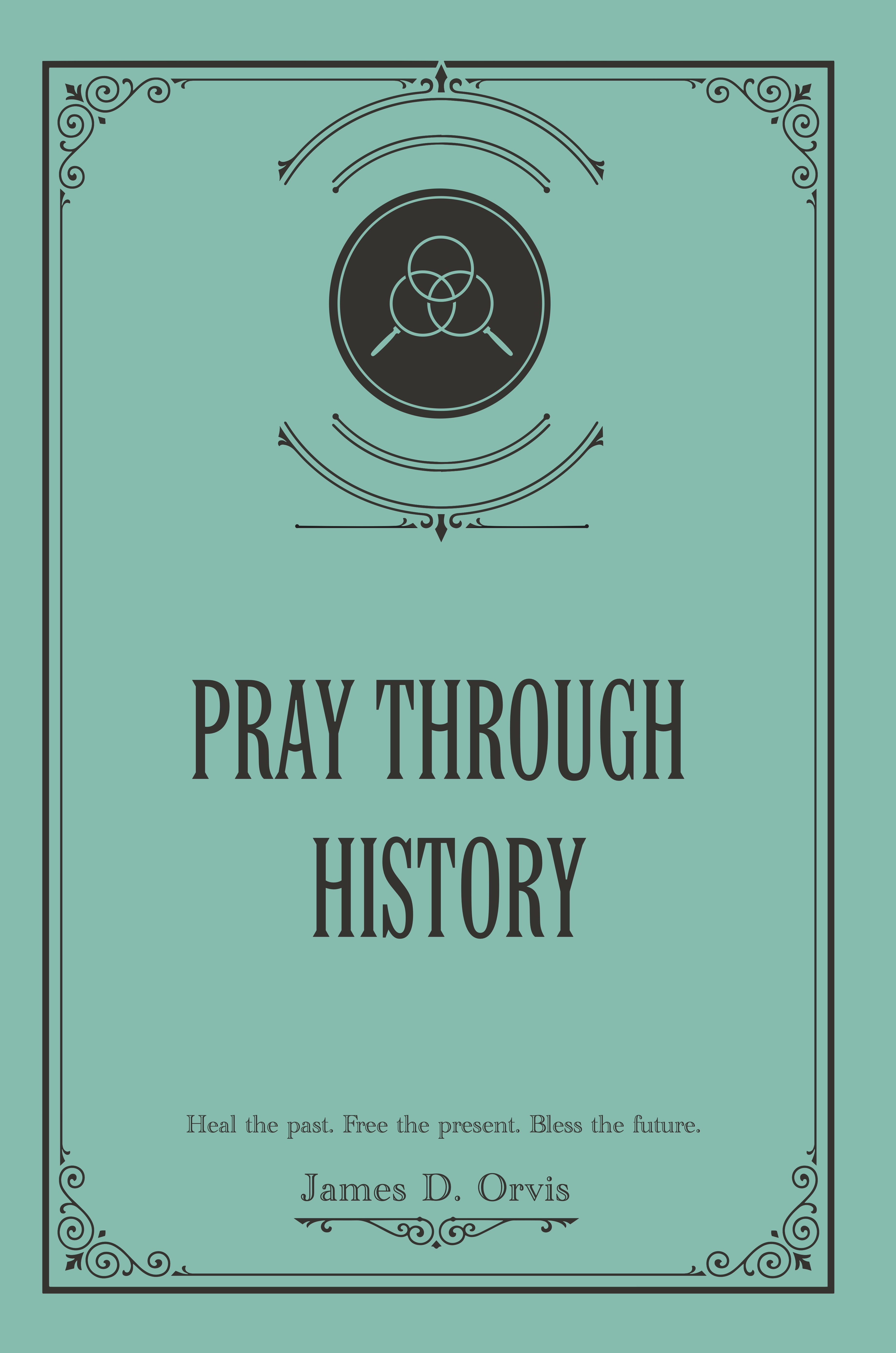
Pray Through History is one man’s humble attempt to see history from a God’s-eye-view. The author shares a bit of history, amplifies it, and then asks, “Father, where’s the grace and truth in this conflict?”
Narrative histories can sometimes reinforce our culture’s schisms. By viewing the events of Minnesota through conversational prayer with the Eternal One, our stories become “prayer-natives”! They acknowledge our historical points of separation, our offences to each other and the Lord, and invite His healing and blessing into the storyline of our State!
This book seeks to bring together our hearts and our heads. Knowing what happened engages our heads. Pondering why our ancestors chose the path they did engages our hearts. Furthermore, these stored memories can engage present and future Minnesotans as we consider how similar we are to our forebears. It ponders how the past either throws shadows or light on our current conflicts, and how we can choose to “give worth” to those who oppose us in the future.
Join author James D. Orvis in this adventure in “research intercession.” As more and more people pray over our beloved Minnesota, we’ll marvel together as God heals the past, frees the present, and blesses the future!
Intrigued? Follow the link and consider ordering your copy today!
Borlaug Receives Nobel Prize
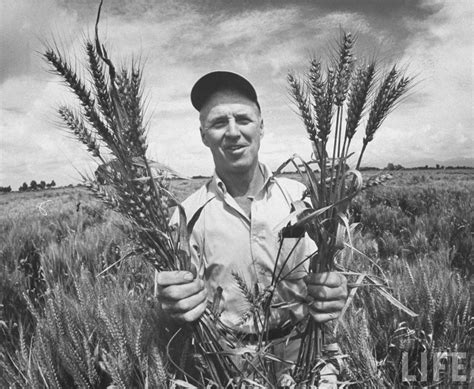
December 10, 1970
Norman Borlaug, a graduate of the University of Minnesota, wins the Nobel Peace Prize. A leader in the fight against world hunger, Borlaug has developed a new high-yield, disease-resistant strain of wheat that greatly improves the crops of poorer countries.*
Norman Ernest Borlaug was born March 25, 1914 in northeast Iowa to father Henry and mother Clara (Vaala) Borlaug. Howard County and the nearby town of Saude were comprised of mostly Norwegian-Americans. His family tree is typical of the area in that the Borlaug and Vaala branches both came from Norway circa 1850 and settled on a simple farm that maintained a bread and butter existence. **
His youth could be encapsulated in a few key events that seem extreme to modern ears, but suffering was not lost on his generation. As a kindergarten student, he got stranded in a winter storm and had to be rescued from a snowbank by his cousin Sina. He loves working with grandfather Nels, and becomes his “shadow”. (This same cousin, Sina, pushed his parents to educate Norm beyond the 7th grade and not keep him on the farm. “She states that Norm might not become a great scholar but he has great promise and he has grit.” He witnesses the Spanish flu pandemic of 1918-1920, and brings food to the sick with his mother. All work on the farm is done with draft horses or human power until 1929 when they get their first tractor.**
Again, it seems Borlaug’s direction was shaped by the timely intervention of a friend; this time it was none other than star Minnesota Gopher running back George Champlin ca. 1931-34. George actually drove out to the Borlaug farm and talked him into the educational and athletic opportunity of the University of Minnesota: as a student, as a strong wrestler, and as a hopeful for the football program. In those days, when outstate tuition was $25 per quarter and rent $5/month, a student with a job could truly pay their own way. **
If we fast forward thirty five years to Dr. Borlaug’s award of the Nobel Peace Prize of 1970, we find an article, (printed entirely) that validates his choice in education and vocation.
“A central figure in the “green revolution”, Norman Ernest Borlaug (born March 25, 1914) was born on a farm near Cresco, Iowa, to Henry and Clara Borlaug. For the past twenty-seven years he has collaborated with Mexican scientists on problems of wheat improvement; for the last ten or so of those years he has also collaborated with scientists from other parts of the world, especially from India and Pakistan, in adapting the new wheats to new lands and in gaining acceptance for their production. An eclectic, pragmatic, goal-oriented scientist, he accepts and discards methods or results in a constant search for more fruitful and effective ones, while at the same time avoiding the pursuit of what he calls “academic butterflies”. A vigorous man who can perform prodigies of manual labor in the fields, he brings to his work the body and competitive spirit of the trained athlete, which indeed he was in his high school and college days.
After completing his primary and secondary education in Cresco, Borlaug enrolled in the University of Minnesota where he studied forestry. Immediately before and immediately after receiving his Bachelor of Science degree in 1937, he worked for the U.S. Forestry Service at stations in Massachusetts and Idaho. Returning to the University of Minnesota to study plant pathology, he received the master’s degree in 1939 and the doctorate in 1942.
From 1942 to 1944, he was a microbiologist on the staff of the du Pont de Nemours Foundation where he was in charge of research on industrial and agricultural bactericides, fungicides, and preservatives.
In 1944 he accepted an appointment as geneticist and plant pathologist assigned the task of organizing and directing the Cooperative Wheat Research and Production Program in Mexico. This program, a joint undertaking by the Mexican government and the Rockefeller Foundation, involved scientific research in genetics, plant breeding, plant pathology, entomology, agronomy, soil science, and cereal technology. Within twenty years he was spectacularly successful in finding a high-yielding short-strawed, disease-resistant wheat.
To his scientific goal he soon added that of the practical humanitarian: arranging to put the new cereal strains into extensive production in order to feed the hungry people of the world – and thus providing, as he says, “a temporary success in man’s war against hunger and deprivation,” a breathing space in which to deal with the “Population Monster” and the subsequent environmental and social ills that too often lead to conflict between men and between nations. Statistics on the vast acreage planted with the new wheat and on the revolutionary yields harvested in Mexico, India, and Pakistan are given in the presentation speech by Mrs. Lionaes and in the Nobel lecture by Dr. Borlaug. Well advanced, also, is the use of the new wheat in six Latin American countries, six in the Near and Middle East, several in Africa.
When the Rockefeller and Ford Foundations in cooperation with the Mexican government established the International Maize and Wheat Improvement Center (CIMMYT), an autonomous international research training institute having an international board of trustees and staff, Dr. Borlaug was made director of its International Wheat Improvement Program. In this capacity he has been able to realize more fully a third objective, that of training young scientists in research and production methods. From his earliest days in Mexico he has, to be sure, carried on an intern program, but with the establishment of the Center, he has been able to reach out internationally. In the last seven years some 1940 young scientists from sixteen or so countries (the figures constantly move upward) have studied and worked at the Center.
Dr. Borlaug is presently participating in extensive experimentation with triticale, a man-made species of grain derived from a cross between wheat rye that shows promise of being superior to either wheat or rye in productivity and nutritional quality.
In addition to the Nobel Peace Prize, Dr. Borlaug has received extensive recognition from universities and organizations in six countries: Canada, India, Mexico, Norway, Pakistan, the United States. In 1968 he received an especially satisfying tribute when the people of Ciudad Obregon, Sonora, Mexico, in whose area he did some of his first experimenting, named a street in his honor.” ***
But now we turn to give You honor, Lord of the Harvest, the Emancipator of Ecology, and the Seed of All Life! We sit humbly and wait for Your yield. You balance the cosmos better than any scale. You prompt the “instincts” of every form of creaturely life in precise time. And this astounds us further; it is not for Your benefit, (Your contentment and confidence endures forever), that all this cultivation occurs. All the growing, sowing, and reaping in this universe are to benefit we creatures!?!
Yes, You are the greatest! The King of the Universe! Yet You only ask that we bring a tithe of all You give us. (For those unfamiliar with this notion, it’s as if a stranger gave you $100, and then asked if you could pay forward or share $10 in gratitude.) I.e. Proverbs 19:17 “Whoever is generous to the poor lends to the Lord, and he will repay him for his deed.”
But our benevolent King is even more generous than this; He loves those who give lavishly out of joy and trust. Perhaps this is the implied meaning in the story of Cain and Abel? These, the first brothers of the earth’s first family, bought the first fruits of their first harvest, or did they? Abel gave “fat portions from some of the firstborn of his flock”. Cain did not, but gave of his crops “in the course of time”. G-d accepted Abel’s first fruits, but rejected Cain’s. Lord, was this because Cain gave You his leftovers instead of his best? He seemed to give after he was sure he would have a surplus, and perhaps, out of duty rather than exuberant gratitude and trust of the Grower of All Things. Only You know, but again we see a hint of Your heart in Hebrews 11:4 from the pen of Paul.
“By faith Abel brought God a better offering than Cain did. By faith he was commended as righteous, when God spoke well of his offerings. And by faith Abel still speaks, even though he is dead.”
Can we move with You now, Spirit of Life, to contemplate the history of Mr. Borlaug? Let’s begin with relish, shall we? Help us remember, and commend to You, the Council of Heaven, and the ekklesia things great and small that You have done to shape Norman’s life!
We cheer his connection with his grandfather! How nurturing and honoring it is when young men are patiently listened to and taught by their male elders. We remember the input of Grandpa Nels and the impact of his teaching on young Norman. We see echoes of this in Borlaug’s joy in teaching, mentoring, and co-working with “dirty hands scientists” a.k.a. applied agricultural research and production students. ****
Applause to You, Sovereign, for the nurturing female friendship of his cousin Sina. Where would he be without her bravery that rescued him from the blizzard? Who would advocate for his intellect were it not for her recognizance of Your spark in him? Thank You that Sina truly appreciated the tenacity and grit that would propel him through future intellectual blockades as well as physical obstacles.
Again, we commend Your name and abilities to shape a life, Eternal Father! Mr. Borlaug learned how to respond to a pandemic from the example of his mother Clara. He gained a heart of compassion through caring for the sick who could not even feed themselves! What nurse is better than the neighbor who knows us and our our home?
In the end, we think of the perpetual motion of his father Henry. It was his arms and legs that were the tractors that powered the farm. His guts and determination raised the level of their survival, in spite of losing his son’s labor during the school year. We remember his kinetic energy and commitment to the survival and betterment of the Borlaug family.
Next we look at the transformative events of Dr. Borlaug’s educational years with You at the University of Minnesota. The first of these is not academic, but competitive and relational in nature. What role did this tremendous school and its students play in Borlaug’s life?
Were it not for the persistence of the athletic George Champlin, and his commitment to drive out to meet Norman in person, would this exceptional human being have attended teachers college in Iowa? Once there, would he have studied forestry, plant pathology, and microbiology? Would his character and physical man be hardened by wrestling and enjoyment of football? Lord, it seems sure the course of Norman’s life was steered by this; another significant relationship. We thank You that Mr. Champlin was able to encourage young Norman to choose a different mountain to climb! We praise You that his academic and sporting years at the University of Minnesota pointed him to discover Your vision of what he could possibly achieve!
How can we credit the impact of a single speech on a young adult? Borlaug’s pathway shifted after attending the Sigma Xi lecture by the innovative Elvin Charles Stakman. Dr. Borlaug credits Stakman with convincing him to invest his future in plant pathology instead of forest pathology. Later, it is Stakman that offers him a chance to impact hunger as a geneticist in Mexico and eschewing the security of a career with Du Pont. * We pause to remember that through Stakman, Norman heard Your “bat kol”; which means “daughter of voice, sound, and resonance” in Hebrew.
We also thank You for the controversies and even sharp professional differences of his life. A major thread of his work life is termed the “Borlaug hypothesis”. This position argues that by maximizing crops yields through responsible fertilization and insecticides (including DDT), we ultimately best protect our ecosystem. How? When agricultural lands are productive, then we don’t have deforestation or other habitats being converted to farm lands.
This core belief was a point of disagreement in an otherwise mostly positive relationship with Rachel Carson. He argued with the famed author of “Silent Spring” that we don’t have to sacrifice our ecosystems or human life. We can feed the world, and protect the environment at the same time. Lord, we remember with You this bone of contention, but also thank You that we are sharpened and refined by our adversaries.
Now, we turn to ask and intercede in this moment of history. What will You bring to our spirit? What points of separation need addressing as illustrated in in Dr. Borlaug’s life 1914 through 1970?
We remember the covenant and committed relationships of our family and friends. Let’s use each as a point of repentance and blessing:
Grandfather Nels – Norman received a sense of being and curiosity from his grandad. Will You forgive us our glossing over the stories and lessons they are constantly trying to teach us? Will You forgive our offense of closing our ears to their wisdom? Will You bless Minnesota with renewed connection between grandpa and grandkids?
Sina – Sometimes, it is a woman who rescues a man! We praise You for our aunts and cousins. Forgive us from closing our minds to her insights. When we reject her, we have rejected You. Will You forgive us this offense? We have rejected Your Spirit spoken through them and have offended You. Will You reverse this curse and leave us with a blessing of women who will face the blizzard in Minnesota?
Buddy George – Messiah, how grateful we are for true friends! We remember the life altering chat Champlin had with Norman. What if he didn’t listen to Your voice that day? But he did! Jesus, we thank You so much for new life we get from a real friend. Will You forgive us when we fail our friends by fearing to offer a challenge to their point of view? We trust so little in the power of friendship. In this, we deeply offend You, and block so much love, goodness, and connectedness from our lives. Will You heal us to put ourselves out for the blessing of others when it is in our power to do so?
Clara – Master, we acknowledge to You the compassion taught to Norman through this good woman! It’s just like You to enable us to feed and heal others, and especially so when it is truly a danger of getting sick ourselves. Where we haven’t taken in the compassion of our mothers, will You forgive us? We have denied You when we ignore Mom’s big heart. Will You bless Minnesota with Clara’s brand of selfless healing, and willingness to just plain help our neighbors?
Henry – Holy One, we see You in Norman’s dad Henry. We can feel the Norwegian stoicism that never gave in to pity or stopped working to bless his family. Will You give us honor for our fathers who work too hard? Will You bless Minnesotan’s to lighten his load, and pay our respects to dad? Will You bless our future with such men who live to better the next generation? Where we ignore them, we have ignored You. Forgive us as we forgive our fathers!
Lord, why are we a people so full of judgment? Here is man who quite possibly and quite literally lived up to his press; “The man who fed a billion people.” Yet, he is both loved and hated to this day. Will You hear us as we repent for these further points of prayerful discussion?
For our first flow chart, we see that Stakman led Borlaug into genetics, which led to CIMMYT (Centro Internacional de Mejoramiento de Maíz y Trigo), which resulted in astounding crops yields 50, 60, or 70x their original yields, and millions of Mexicans fed. (Later, millions of Indians, and Africans would be fed through similar programs.) What began in the past as cross polinization, can now entail changes to a species DNA or mRNA. Though this technology offers us dazzling possibilities, it’s critics argue that we may permanently alter individual species and cause ripple effects through the ecosystem.
To these conflicts past and their lingering echoes present we plead to the Lord, will You first heal us from our judgments? Will You forgive Borlaug’s critics past, present, and future of their bitter judgments of his awe-inspiring work to advance food science and environmental science? We, his beneficiaries, can go off half-cocked!
We can often criticize with so little accurate information as to the depths of human suffering he fought to alleviate. What would we do if we could attempt a cure for hunger knowing full well that we may fail? Isn’t learning from that observable failure the very heart of science? Perhaps, this explains Borlaug’s admiration for “dirty handed scientists”; at some point theoretical science must be left behind. Someone must make a brave decision to make a valiant experiment, or abandon progress. Where we have judged this scientist, we have judged You. Where Borlaug judged his detractors, he appears to have judged You. Will You forgive the North Star state and bless us as agricultural scientists in the future?
Lastly, we face the dilemma of the food scientist versus environmental scientist. Wise Judge, will You hear the pain in the face-off between the man who longs to ease human suffering, Norman Borlaug, and the woman who longed to end the suffering of ecosphere, Rachel Carson? We can see much more accurately in hindsight that they both had profound overlap and admiration for each other as scientists. We also can accept that they simply had differing professional opinions. Yet, what could explain these schisms that have grown between the farmer and the ecologist?
Perhaps it could come down to the locus of their study? Was Carson, as environmentalists are prone to do, viewing the world as collection of interdependent systems? Could this explain that she saw hunger through an external, macrocosmic lens? Was she a theoretic scientist, or one with dirty hands?
Conversely, Borlaug in his genetic studies, perhaps, saw the world through a microcosmic lens. His focus on making minute, internal changes that would manifest in the next generation. He answered one question at a time, and led thousands of others in similar experiments. He seemed to only theorize when a hypothesis failed.
Eternal Father, will You balance us so that we can contribute, like Dr. Borlaug, to right the imbalance of food resources on this planet? Will You give us the grace, like Carson, to dare to ask huge systemic questions? Will You give both types of researchers the humility to restrain themselves to evidence-based science? We have greatly offend Our Father where we judged our neighbor on these points. Will You bless us to see your Creation as sufficient? Will You make us wise to create proper boundaries around genetics? May we also feed our prideful hunger for significance, and accept that You already have spoken inalienable worth into every life? How we love You, and need You to survive!
“The recognition that hunger and social strife are linked is not new, for it is evidenced by the Old Testament passage, ‘and it came to pass that when they shall be hungry they shall fret themselves, and curse their King and their God.” Norman Borlaug quoting Isaiah 8:21 in his Nobel Peace Prize 1970 acceptance speech.
Matthew 13-37-43 ESV
“He answered, “The one who sows the good seed is the Son of Man. The field is the world, and the good seed is the sons of the kingdom. The weeds are the sons of the evil one, and the enemy who sowed them is the devil. The harvest is the close of the age, and the reapers are angels. Just as the weeds are gathered and burned with fire, so will it be at the close of the age. The Son of Man will send his angels, and they will gather out of his kingdom all causes of sin and all law-breakers, …”
P.T.H. cites timeline formerly at this URL: mnhs.org/about/dipity_timeline.htm
** College of Food, Agricultural and Natural Resource Sciences. Internet. https://borlaug.cfans.umn.edu/about-borlaug/child
*** Norman Borlaug – Biographical. NobelPrize.org. Nobel Prize Outreach AB 2022. Mon. 7 Mar 2022. https://www.nobelprize.org/prizes/peace/1970/borlaug/biographical/
From Nobel Lectures, Peace 1951-1970, Editor Frederick W. Haberman, Elsevier Publishing Company, Amsterdam, 1972
**** Internet. Iowa State University. Library. Curation Services. Norman Borlaug – Revolutionary. Created 1971. Posted December 12, 2018. https://www.youtube.com/watch?v=DkCTV2S3jZo
University of Minnesota. 2005.”Borlaug and the University of Minnesota”. Archived from the original on March 10, 2005. Retrieved June 18, 2005.
* Borlaug, Norman E. Mankind And Civilization At Another Crossroad (Speech). UN FAO (Food and Agriculture Organization of the United Nations). 7th McDougall Memorial Lecture.
Supreme Court Justices
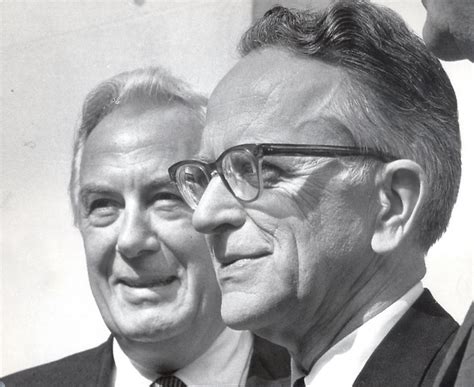
1970
Friends since their childhoods in St. Paul, Warren Burger and Harry Blackmun are reunited on the U.S. Supreme Court. Chief Justice Burger presides over a turbulent era of Constitutional issues, including Blackmun’s landmark 1973 opinion in Roe v. Wade, which establishes a woman’s right to abortion.*
Minnesotan Chief Justice Warren E. Burger took the oath as the chief justice of the United States Supreme Court June 23rd of 1969. Approximately a year later Justice Harry Blackmun would join him on the U.S. Supreme Court. Over time, they would drift apart in their interpretation of the law much like John Adams and Thomas Jefferson; both men clearly loved the law, but differed in its interpretation. **
Burger, personally, was considered a conservative and a Constitutional constructionist or originalist, meaning he interpreted our laws according to the original intent of our framers. (See his influence on cases such as Miliken v. Bradley.) So, what was his influence as Chief Justice? Two pillars of his tenure were a strengthened separation of powers in our government, and limiting the exclusionary rule, which throws out illegally-obtained evidence from court. ***
Conversely, Blackmun tended towards pragmatism and stare decisis (following rules and precedents based on previous decisions) in his interpretations of our laws. Harry met Warren in kindergarten at Van Buren School on Dayton’s Bluff, St. Paul, MN and remained friends with Burger for most of his life. After graduating from Harvard Law School in 1934, his private practice kept him in the metro area until 1950, and in Rochester Minnesota as legal counsel to Mayo Clinic until 1959.
Federal appointments guided the following decades of his life. His first appointment to the Eighth district Court of Appeals in St. Louis by President Eisenhower. His performance there caught the attention of President Richard Nixon, who tapped him to become a Supreme Court justice on June 9th, 1970. Blackmun’s commitment to the principles of pragmatism and precedent were severely tested in his privilege of writing the opinion on the landmark abortion case of Roe v. Wade. ****
Let’s go to the primary sources of their opinions written at the time of the January 22, 1973 decision. Shall we compare and contrast how these two old friends, though looking at the elephant from different angles and through different lenses, came to support each other in this decision? These quoted opinions, it is the author’s hope, will show a window into the logic, mind, and heart of these old friends as well as the dissenting opinion of Justice Rehnquist.
MR. JUSTICE BLACKMUN delivered the opinion of the Court.
“ To summarize and to repeat:
- A state criminal abortion statute of the current Texas type, that excepts from criminality only a life-saving procedure on behalf of the mother, without regard to pregnancy stage and without recognition of the other interests involved, is violative of the Due Process Clause of the Fourteenth Amendment.
(a) For the stage prior to approximately the end of the first trimester, the abortion decision and its effectuation must be left to the medical judgment of the pregnant woman’s attending physician.
(b) For the stage subsequent to approximately the end of the first trimester, the State, in promoting its interest in the health of the mother, may, if it chooses, regulate the abortion procedure in ways that are reasonably related to maternal health.
(c) For the stage subsequent to viability, the State in promoting its interest in the potentiality of human life [410 U.S. 113, 165] may, if it chooses, regulate, and even proscribe, abortion except where it is necessary, in appropriate medical judgment, for the preservation of the life or health of the mother. - The State may define the term “physician,” as it has been employed in the preceding paragraphs of this Part XI of this opinion, to mean only a physician currently licensed by the State, and may proscribe any abortion by a person who is not a physician as so defined.
In Doe v. Bolton, post, p. 179, procedural requirements contained in one of the modern abortion statutes are considered. That opinion and this one, of course, are to be read together. 67
This holding, we feel, is consistent with the relative weights of the respective interests involved, with the lessons and examples of medical and legal history, with the lenity of the common law, and with the demands of the profound problems of the present day. The decision leaves the State free to place increasing restrictions on abortion as the period of pregnancy lengthens, so long as those restrictions are tailored to the recognized state interests. The decision vindicates the right of the physician to administer medical treatment according to his professional judgment up to the points where important [410 U.S. 113, 166] state interests provide compelling justifications for intervention. Up to those points, the abortion decision in all its aspects is inherently, and primarily, a medical decision, and basic responsibility for it must rest with the physician. If an individual practitioner abuses the privilege of exercising proper medical judgment, the usual remedies, judicial and intra-professional, are available.
XII
Our conclusion that Art. 1196 is unconstitutional means, of course, that the Texas abortion statutes, as a unit, must fall. The exception of Art. 1196 cannot be struck down separately, for then the State would be left with a statute proscribing all abortion procedures no matter how medically urgent the case.
Although the District Court granted appellant Roe declaratory relief, it stopped short of issuing an injunction against enforcement of the Texas statutes. The Court has recognized that different considerations enter into a federal court’s decision as to declaratory relief, on the one hand, and injunctive relief, on the other. Zwickler v. Koota, 389 U.S. 241, 252 -255 (1967); Dombrowski v. Pfister, 380 U.S. 479 (1965). We are not dealing with a statute that, on its face, appears to abridge free expression, an area of particular concern under Dombrowski and refined in Younger v. Harris, 401 U.S., at 50 .
We find it unnecessary to decide whether the District Court erred in withholding injunctive relief, for we assume the Texas prosecutorial authorities will give full credence to this decision that the present criminal abortion statutes of that State are unconstitutional.
The judgment of the District Court as to intervenor Hallford is reversed, and Dr. Hallford’s complaint in intervention is dismissed. In all other respects, the judgment [410 U.S. 113, 167] of the District Court is affirmed. Costs are allowed to the appellee. (The party against whom an appeal is filed.)
It is so ordered.”
MR. CHIEF JUSTICE BURGER, concurring*
“I agree that, under the Fourteenth Amendment to the Constitution, the abortion statutes of Georgia and Texas impermissibly limit the performance of abortions necessary to protect the health of pregnant women, using [410 U.S. 208] the term health in its broadest medical context. See United States v. Vuitch, 402 U.S. 62, 71-72 (1971). I am somewhat troubled that the Court has taken notice of various scientific and medical data in reaching its conclusion; however, I do not believe that the Court has exceeded the scope of judicial notice accepted in other contexts.
In oral argument, counsel for the State of Texas informed the Court that early abortion procedures were routinely permitted in certain exceptional cases, such as nonconsensual pregnancies resulting from rape and incest. In the face of a rigid and narrow statute, such as that of Texas, no one in these circumstances should be placed in a posture of dependence on a prosecutorial policy or prosecutorial discretion. Of course, States must have broad power, within the limits indicated in the opinions, to regulate the subject of abortions, but where the consequences of state intervention are so severe, uncertainty must be avoided as much as possible. For my part, I would be inclined to allow a State to require the certification of two physicians to support an abortion, but the Court holds otherwise. I do not believe that such a procedure is unduly burdensome, as are the complex steps of the Georgia statute, which require as many as six doctors and the use of a hospital certified by the JCAH.
I do not read the Court’s holdings today as having the sweeping consequences attributed to them by the dissenting Justices; the dissenting views discount the reality that the vast majority of physicians observe the standards of their profession, and act only on the basis of carefully deliberated medical judgments relating to life and health. Plainly, the Court today rejects any claim that the Constitution requires abortions on demand.” [410 U.S. 209]
MR. JUSTICE REHNQUIST, dissenting.
“The Court’s opinion brings to the decision of this troubling question both extensive historical fact and a wealth of legal scholarship. While the opinion thus commands my respect, I find myself nonetheless in fundamental disagreement with those parts of it that invalidate the Texas statute in question, and therefore dissent.
I
The Court’s opinion decides that a State may impose virtually no restriction on the performance of abortions during the first trimester of pregnancy. Our previous decisions indicate that a necessary predicate for such an opinion is a plaintiff who was in her first trimester of pregnancy at some time during the pendency of her law-suit. While a party may vindicate his own constitutional rights, he may not seek vindication for the rights of others. Moose Lodge v. Irvis, 407 U.S. 163 (1972); Sierra Club v. Morton, 405 U.S. 727 (1972). The Court’s statement of facts in this case makes clear, however, that the record in no way indicates the presence of such a plaintiff. We know only that plaintiff Roe at the time of filing her complaint was a pregnant woman; for aught that appears in this record, she may have been in her last trimester of pregnancy as of the date the complaint was filed.
Nothing in the Court’s opinion indicates that Texas might not constitutionally apply its proscription of abortion as written to a woman in that stage of pregnancy. Nonetheless, the Court uses her complaint against the Texas statute as a fulcrum for deciding that States may [410 U.S. 113, 172] impose virtually no restrictions on medical abortions performed during the first trimester of pregnancy. In deciding such a hypothetical lawsuit, the Court departs from the longstanding admonition that it should never “formulate a rule of constitutional law broader than is required by the precise facts to which it is to be applied.” Liverpool, New York & Philadelphia S. S. Co. v. Commissioners of Emigration, 113 U.S. 33, 39 (1885). See also Ashwander v. TVA, 297 U.S. 288, 345 (1936) (Brandeis, J., concurring).
II
Even if there were a plaintiff in this case capable of litigating the issue which the Court decides, I would reach a conclusion opposite to that reached by the Court. I have difficulty in concluding, as the Court does, that the right of “privacy” is involved in this case. Texas, by the statute here challenged, bars the performance of a medical abortion by a licensed physician on a plaintiff such as Roe. A transaction resulting in an operation such as this is not “private” in the ordinary usage of that word. Nor is the “privacy” that the Court finds here even a distant relative of the freedom from searches and seizures protected by the Fourth Amendment to the Constitution, which the Court has referred to as embodying a right to privacy. Katz v. United States, 389 U.S. 347 (1967).
If the Court means by the term “privacy” no more than that the claim of a person to be free from unwanted state regulation of consensual transactions may be a form of “liberty” protected by the Fourteenth Amendment, there is no doubt that similar claims have been upheld in our earlier decisions on the basis of that liberty. I agree with the statement of MR. JUSTICE STEWART in his concurring opinion that the “liberty,” against deprivation of which without due process the Fourteenth [410 U.S. 113, 173] Amendment protects, embraces more than the rights found in the Bill of Rights. But that liberty is not guaranteed absolutely against deprivation, only against deprivation without due process of law. The test traditionally applied in the area of social and economic legislation is whether or not a law such as that challenged has a rational relation to a valid state objective. Williamson v. Lee Optical Co., 348 U.S. 483, 491 (1955). The Due Process Clause of the Fourteenth Amendment undoubtedly does place a limit, albeit a broad one, on legislative power to enact laws such as this. If the Texas statute were to prohibit an abortion even where the mother’s life is in jeopardy, I have little doubt that such a statute would lack a rational relation to a valid state objective under the test stated in Williamson, supra. But the Court’s sweeping invalidation of any restrictions on abortion during the first trimester is impossible to justify under that standard, and the conscious weighing of competing factors that the Court’s opinion apparently substitutes for the established test is far more appropriate to a legislative judgment than to a judicial one.
The Court eschews the history of the Fourteenth Amendment in its reliance on the “compelling state interest” test. See Weber v. Aetna Casualty & Surety Co., 406 U.S. 164, 179 (1972) (dissenting opinion). But the Court adds a new wrinkle to this test by transposing it from the legal considerations associated with the Equal Protection Clause of the Fourteenth Amendment to this case arising under the Due Process Clause of the Fourteenth Amendment. Unless I misapprehend the consequences of this transplanting of the “compelling state interest test,” the Court’s opinion will accomplish the seemingly impossible feat of leaving this area of the law more confused than it found it. [410 U.S. 113, 174]
While the Court’s opinion quotes from the dissent of Mr. Justice Holmes in Lochner v. New York, 198 U.S. 45, 74 (1905), the result it reaches is more closely attuned to the majority opinion of Mr. Justice Peckham in that case. As in Lochner and similar cases applying substantive due process standards to economic and social welfare legislation, the adoption of the compelling state interest standard will inevitably require this Court to examine the legislative policies and pass on the wisdom of these policies in the very process of deciding whether a particular state interest put forward may or may not be “compelling.” The decision here to break pregnancy into three distinct terms and to outline the permissible restrictions the State may impose in each one, for example, partakes more of judicial legislation than it does of a determination of the intent of the drafters of the Fourteenth Amendment.
The fact that a majority of the States reflecting, after all, the majority sentiment in those States, have had restrictions on abortions for at least a century is a strong indication, it seems to me, that the asserted right to an abortion is not “so rooted in the traditions and conscience of our people as to be ranked as fundamental,” Snyder v. Massachusetts, 291 U.S. 97, 105 (1934). Even today, when society’s views on abortion are changing, the very existence of the debate is evidence that the “right” to an abortion is not so universally accepted as the appellant would have us believe.
To reach its result, the Court necessarily has had to find within the scope of the Fourteenth Amendment a right that was apparently completely unknown to the drafters of the Amendment. As early as 1821, the first state law dealing directly with abortion was enacted by the Connecticut Legislature. Conn. Stat., Tit. 22, 14, 16. By the time of the adoption of the Fourteenth [410 U.S. 113, 175] Amendment in 1868, there were at least 36 laws enacted by state or territorial legislatures limiting abortion. 1 While many States have amended or updated [410 U.S. 113, 176] their laws, 21 of the laws on the books in 1868 remain in effect today. 2 Indeed, the Texas statute struck down today was, as the majority notes, first enacted in 1857 [410 U.S. 113, 177] and “has remained substantially unchanged to the present time.” Ante, at 119.
There apparently was no question concerning the validity of this provision or of any of the other state statutes when the Fourteenth Amendment was adopted. The only conclusion possible from this history is that the drafters did not intend to have the Fourteenth Amendment withdraw from the States the power to legislate with respect to this matter.
III
Even if one were to agree that the case that the Court decides were here, and that the enunciation of the substantive constitutional law in the Court’s opinion were proper, the actual disposition of the case by the Court is still difficult to justify. The Texas statute is struck down in toto, even though the Court apparently concedes that at later periods of pregnancy Texas might impose these selfsame statutory limitations on abortion. My understanding of past practice is that a statute found [410 U.S. 113, 178] to be invalid as applied to a particular plaintiff, but not unconstitutional as a whole, is not simply “struck down” but is, instead, declared unconstitutional as applied to the fact situation before the Court. Yick Wo v. Hopkins, 118 U.S. 356 (1886); Street v. New York, 394 U.S. 576 (1969).
For all of the foregoing reasons, I respectfully dissent.”
[ Footnote 1 ] Jurisdictions having enacted abortion laws prior to the adoption of the Fourteenth Amendment in 1868:
- Alabama – Ala. Acts, c. 6, 2 (1840).
- Arizona – Howell Code, c. 10, 45 (1865).
- Arkansas – Ark. Rev. Stat., c. 44, div. III, Art. II, 6 (1838).
- California – Cal. Sess. Laws, c. 99, 45, p. 233 (1849-1850).
- Colorado (Terr.) – Colo. Gen. Laws of Terr. of Colo., 1st Sess., 42, pp. 296-297 (1861).
- Connecticut – Conn. Stat., Tit. 20, 14, 16 (1821). By 1868, this statute had been replaced by another abortion law. Conn. Pub. Acts, c. 71, 1, 2, p. 65 (1860).
- Florida – Fla. Acts 1st Sess., c. 1637, subc. 3, 10, 11, subc. 8, 9, 10, 11 (1868), as amended, now Fla. Stat. Ann. 782.09, 782.10, 797.01, 797.02, 782.16 (1965).
- Georgia – Ga. Pen. Code, 4th Div., 20 (1833).
- Kingdom of Hawaii – Hawaii Pen. Code, c. 12, 1, 2, 3 (1850).
- Idaho (Terr.) – Idaho (Terr.) Laws, Crimes and Punishments 33, 34, 42, pp. 441, 443 (1863).
- Illinois – Ill. Rev. Criminal Code 40, 41, 46, pp. 130, 131 (1827). By 1868, this statute had been replaced by a subsequent enactment. Ill. Pub. Laws 1, 2, 3, p. 89 (1867).
- Indiana – Ind. Rev. Stat. 1, 3, p. 224 (1838). By 1868 this statute had been superseded by a subsequent enactment. Ind. Laws, c. LXXXI, 2 (1859).
- Iowa (Terr.) – Iowa (Terr.) Stat., 1st Legis., 1st Sess., 18, p. 145 (1838). By 1868, this statute had been superseded by a subsequent enactment. Iowa (Terr.) Rev. Stat., c. 49, 10, 13 (1843).
- Kansas (Terr.) – Kan. (Terr.) Stat., c. 48, 9, 10, 39 (1855). By 1868, this statute had been superseded by a subsequent enactment. Kan. (Terr.) Laws, c. 28, 9, 10, 37 (1859).
- Louisiana – La. Rev. Stat., Crimes and Offenses 24, p. 138 (1856).
- Maine – Me. Rev. Stat., c. 160, 11, 12, 13, 14 (1840).
- Maryland – Md. Laws, c. 179, 2, p. 315 (1868).
- Massachusetts – Mass. Acts & Resolves, c. 27 (1845).
- Michigan – Mich. Rev. Stat., c. 153, 32, 33, 34, p. 662 (1846). [410 U.S. 113, 176] 20. Minnesota (Terr.) – Minn. (Terr.) Rev. Stat., c. 100, 10, 11, p. 493 (1851).
- Mississippi – Miss. Code, c. 64, 8, 9, p. 958 (1848).
- Missouri – Mo. Rev. Stat., Art. II, 9, 10, 36, pp. 168, 172 (1835).
- Montana (Terr.) – Mont. (Terr.) Laws, Criminal Practice Acts 41, p. 184 (1864).
- Nevada (Terr.) – Nev. (Terr.) Laws, c. 28, 42, p. 63 (1861).
- New Hampshire – N. H. Laws, c. 743, 1, p. 708 (1848).
- New Jersey – N. J. Laws, p. 266 (1849).
- New York – N. Y. Rev. Stat., pt. 4, c. 1, Tit. 2, 8, 9, pp. 12-13 (1828). By 1868, this statute had been superseded. N. Y. Laws, c. 260, 1-6, pp. 285-286 (1845); N. Y. Laws, c. 22, 1, p. 19 (1846).
- Ohio – Ohio Gen. Stat. 111 (1), 112 (2), p. 252 (1841).
- Oregon – Ore. Gen. Laws, Crim. Code, c. 43, 509, p. 528 (1845-1864).
- Pennsylvania – Pa. Laws No. 374, 87, 88, 89 (1860).
- Texas – Tex. Gen. Stat. Dig., c. VII, Arts. 531-536, p. 524 (Oldham & White 1859).
- Vermont – Vt. Acts No. 33, 1 (1846). By 1868, this statute had been amended. Vt. Acts No. 57, 1, 3 (1867).
- Virginia – Va. Acts, Tit. II, c. 3, 9, p. 96 (1848).
- Washington (Terr.) – Wash. (Terr.) Stats., c. II, 37, 38, p. 81 (1854).
- West Virginia – See Va. Acts., Tit. II, c. 3, 9, p. 96 (1848); W. Va. Const., Art. XI, par. 8 (1863).
- Wisconsin – Wis. Rev. Stat., c. 133, 10, 11 (1849). By 1868, this statute had been superseded. Wis. Rev. Stat., c. 164, 10, 11; c. 169, 58, 59 (1858).
Eternal Father we now bow to You as we review this chapter: in the history of our state, in the history of our nation, and in the personal history of these men. We sit patiently and listen to the Chief Justice of All; what wisdom will You bring for us? How does the Host of Heaven, (Hebrew tzeva hashamayim), mentioned 8889 times in Your Word view this event in the lives of our Judgers Warren Burger and Harry Blackmun? Will You speak and reason with Your ekklesia as You do with our elders in heaven?
“Micaiah continued, “Therefore hear the word of the LORD: I saw the LORD sitting on His throne, and all the host of heaven standing by Him on His right and on His left. And the LORD said, ‘Who will entice Ahab to march up and fall at Ramoth-gilead?’ And one suggested this, and another that. ” I Kings 22:19-20 Berean Study Bible
You have shown us this give and take conversation; will let us reflect on the decision of Roe vs. Wade with You today?
My first question is based on the premise that while the Law is of utmost importance in the Books of Moses, it is only fulfilled by the eternal chesed (right relationship G-d to man, and man to man) of the Messiah. As we practice the Law, we learn of our total depravity to perfectly follow it in letter and spirit. As You have forever shown us, Your only Son that is loved by our Good Father fulfills both the Spirit and the Letter of the law.
Indulge my extrapolations, Dear One? Instead of analyzing Roe v. Wade on the scale of law, medicine, or science, what if we placed it on the scale seemingly most used in heaven; that of right relationship?
Since the inception of this judgment, 63, 459,781 babies are no more. *
Each of these abortions includes the choice of the mother, most would also include the tacit agreement of the father, and conservatively the approval of at least one parent or trusted friend. It would seem that at least three human relationships are affected forever by each of these terminations: mother to child, father to child, and extended family to child. With out judgment as to why these choices were made, we see that 190,379,781 primary human relationships are neutralized.
But is that the actual sum of negated relationships, True One? Do not we also have to account for the inverse and reverse of these relationships: father to mother, father to family or friend, mother to father, and mother to family or friend? If we account for this relational cost, we see that 571, 138, 029 primary human relationships are forever changed or neutralized.
Yet this not does not accurately sum up the effect on our world because it doesn’t even dent the relationships unformed or under formed with the three roles, or for the sake of argument, the three relationships present within Your Deity. Wouldn’t we also have to account for these changes since January 22, 1973? While we don’t have visual evidence of these connections, perhaps we can perceive and feel the absence of these affiliations with our hearts: 571,138,029 less relationships with Our Father (Adonai), 571,138,029 less relationships with the Son (Messiah), and 571,138,029 disrupted relationships with the Holy Spirit (Ruach Ha’Kodesh)? Perhaps we now see a cost in terms of creature to Creator as 1,713,440,087 unfulfilled connections in primary covenantal relationships!
Lastly, we haven’t received the echo of approval back from G-d which cements our primary relationships, and helps us understand them. Lord, forgive these humble examples, but allow me to elaborate… again. If we never engage as a parent, how will we understand the agony of a parent that loses an only child? If we never engage as a child, from what father and mother will we learn the basic trust necessary for all committed relationships? If we never experience unconditional love, how do we pass that gift on to others and heal our world?
In Your mercy, hear our prayer: We took this law into our hearts and into our relationships. We terminated at least 1.7 billion chances to more humanize our nation! We chose “no” relationship to these siblings, parents, families and friends, and Eternal Family rather than “know” relationship! Will You forgive us this rejection and abandonment of these aborted lives? Will You annul our nullification of their potential relationships and connection to fathers, mothers, families, and friends? Will You forgive us our offenses against these unborn that are continuations of our own trauma? Lord, we wound others when we lose hope! G-d, we self-suicide when we believe we are alone with our pain! Master, we deny the Imago Dei (Image of God) of others when we can’t see Your reflection or are unaware of Your Beauty and Eternal Light within us! Will You have mercy?
Now we come in gratitude to reflect on the lives of Warren E. Burger and Harry A. Blackmun. We remember two friends who pursued their dreams and achieved such epic goals within their lifespan. We remember two men who loved the Constitution and the Law with whole being. (May we also be merciful to our “old friends” with whom we intellectually disagree.)
We thank You that, whether we agree with their interpretation of the Law or not, they routinely engaged such weighty decisions as Supreme Court Justices. We applaud their bravery to tackle such eternal challenges to justice. Will You bless their progeny, their property, and their legal influence by the authority of Jesus Christ where they participated with Your Eternal Standards of Justice? Will You cut off their progeny, property, and influence in so far as they have opposed your Eternal Standards of Justice by the Cross of Christ, the Blood of Christ, and the Resurrection of Christ?
As Your Adopted Son, I bring these questions and observations to You seeking Your Justice for this and future generations of Minnesota, the American Nation, and Your Ekklesia.
Will You honor the intent of Chief Justice Burger to “allow a State to require the certification of two physicians to support an abortion”?
Will You refine the intent of Justice Blackmun to redefine “the abortion decision in all its aspects is inherently, and primarily, a medical decision, and basic responsibility for it must rest with the physician”? Father, though this case is heralded as a landmark for “women’s rights”, this quote seems too say that Blackmun believed more in “Doctor’s rights”. Further, he advocated and articulated that women retained a Fourth Amendment Right to Privacy, which protects citizens against unreasonable searches and seizures. While this implies a human right to privacy, was it the intent of the authors of the Constitution as it applies to human reproduction? Father, will You remove these unbeliefs and misbeliefs from the letter of the Law, and give Minnesotans as well as Americans an empathy and blessing for the rights of future generations?
Will You refine the decision of Roe v. Wade 1973 in Your Courts? If they are to be judged on the scale of “stare decisis”, then they surely seem to be found wanting!
Look at the primary source evidence of precedent brought by dissenting Justice Rehnquist. “By the time of the adoption of the Fourteenth [410 U.S. 113, 175] Amendment in 1868, there were at least 36 laws enacted by state or territorial legislatures limiting abortion.” So, to make this clear, our Supreme Court decided against 79 years of established law before the 14th Amendment was invented in 1868. Then they found an additional precedent of a women’s and doctor’s right to privacy 105 years later in 1973? Dear Father, doesn’t it seem that the argument Justices Burger and Blackmun supported as “stare decisis” was and is at least 184 years too late in their era?
We appeal to heaven to bring consistency and justice to this alleged misapplication of judicial precedent! Will You judge these Justices according to Your Eternal principles? Though incredible men of learning, they fall short, perhaps, because they measure the law intellectually staying with the safe playgrounds of their minds. Yet, while You never negate our minds, You call us to the wisdom of law that has travelled through the brain, and has made it down deep into our heart. We obey the law not only because we “should” or solely out of “duty”. We obey the law because we love our neighbor and want to do right by him. We practice following the law, from the belly, because Our Good Judge has shown us that mercy triumphs over judgment in Minnesota.
P.T.H. cites timeline formerly at this URL: mnhs.org/about/dipity_timeline.htm
** https://libguides.mnhs.org/burger
*** https://www.mnopedia.org/event/january-17-1907
**** Nelson, Paul. “Blackmun, Harry A. (1908–1999).” MNopedia, Minnesota Historical Society. http://www.mnopedia.org/person/blackmun-harry-1908-1999 (accessed January 17, 2022). https://www.mnopedia.org/person/blackmun-harry-1908-1999
United States Supreme Court ROE v. WADE(1973) No. 70-18 Argued: December 13, 1971 Decided: January 22, 1973 https://caselaw.findlaw.com/us-supreme-court/410/113.html
* https://biblehub.com/1_kings/22-20.htm
* https://www.lifenews.com/2022/01/07/63459781-babies-have-been-killed-in-abortions-since-roe-v-wade-in-1973/
AIM (American Indian Movement) Founded
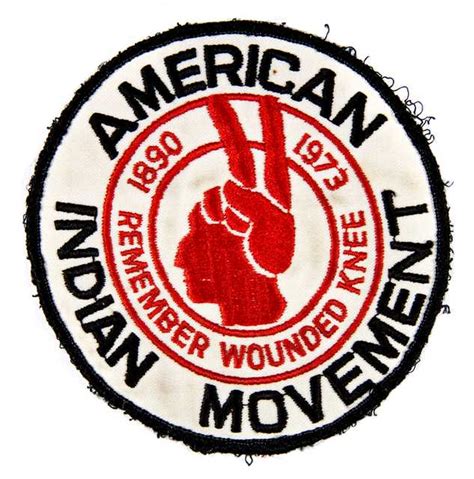
July 28, 1968
Two prisoners, Clyde Bellecourt and Eddie Benton-Banai, met in Stillwater State Penitentiary about 1962. These new friends formed the Indian Folklore Club to improve the stay for each other and their fellow Native inmates. After meeting Dennis Banks and Russell Means six years later, the trio form the heart of the American Indian Movement. This pan-Indian, anti-imperialist, and anti-racist organization sought to improve the civil rights of Native Americans in Minneapolis, Minnesota. *
Though it may be a bit shocking to the modern liberal Minneapolitan, many young Indians were introduced to the city only as recently as fifty years ago. Two fairly obscure laws passed about a dozen years before created their incentive to come to town. Public Law 959 a.k.a. the Indian Relocation Act of 1956 was intended to encourage their young tribal members to leave the reservations and assimilate into large cities. ** Public Law 280 proposed to move entire tribes that were farther down the path of assimilation from the umbrella of Federal Law and under the jurisdiction of State law. **
Much of AIM’s leadoff efforts were to assist the new urban members of their tribal branches with their legal questions.
These folks were often thought of as “transnationals” in that they were simultaneously members of First Nations (tribes) and American citizens. Quickly they began AIM Patrol,*** a citizen watch group to challenge police brutality against Natives. Further, they played a pivotal role in the creation of the Legal Rights Center of Minneapolis, a resource that provides free legal aid to the poor. ****
Actus, in Latin, is the root word for activist meaning ‘doing’, ‘a driving force’, or ‘an impulse’. Such a broad word is apropos for AIM and the energy of its charter members.
Look at the impact on the early 1970’s in the following timeline of its’ various actions and events.
November 1969 – Occupation of Alcatraz
This point of action by AIM greatly impacted U.S. government’s decision to abandon they policy of Termination and Relocation.
October 1972 – Trail of Broken Treaties
Cross country traveling protest birthed the “Twenty Point” portion paper which defined points of treaties protestors believed the U.S. government had failed to fulfill.
(A few examples.)
“Restore terminated rights of Native Nations.
Repeal state jurisdiction on Native Nations (Public Law 280).
Provide Federal protection for offenses against Indians.
Abolish the Bureau of Indian Affairs.
Create a new office of Federal Indian Relations.
Remedy breakdown in the constitutionally prescribed relationships between the United States and Native Nations.
Ensure immunity of Native Nations from state commerce regulation, taxes, and trade restrictions.
Protect Indian religious freedom and cultural integrity.Recognize the right of Indians to interpret treaties.” *
February 27, 1973 – Pine Ridge – Wounded Knee Incident
For 71 days, the town of Wounded Knee, South Dakota was occupied by AIM while they battled U.S. officials.This site was chosen because it was significant to the Wounded Knee Massacre in 1890. Two U.S. officials were seriously wounded, a civil rights activist disappeared, and two Native Americans died.
For most of our North Star citizens it came as a shock that things were so bad for Native Minnesotans that they would take up arms. Perhaps, no event in the 20th century did more to underscore the dysfunctional relationships and mistrust between our State and Federal governments and America’s First Nations. Further, our laws seem to not be the best vehicle to convey the complexities of the human heart and emotional intelligence. Hear, if you can, the words of one of AIM’s most potent members.
“Being is a spiritual proposition. Gaining is a material act. Traditionally, American Indians have always attempted to be the best people they could. Part of that spiritual process was and is to give away wealth, to discard wealth in order not to gain.” Russell Means
And so we turn from this moment in history to the face of the Eternal One. Dear Father, how we need You to come and stand between us; the Native American Minnesotan, and the Adopted Minnesotan. Can we sit in Your circle and wait on You together? We remember, right now, that we are all co-members of Your Creation, and that all who turn to You will be saved from our narcissism past, present, and future. Blessed are You, King of the Universe, who gives us the omnipotence and omnipresence of the Messiah!
We begin our prayer journey with gratitude for G-d ordained meetings. Only You could have known how Clyde Bellecourt and Eddie Benton – Banai would become friends and allies, (in prison no less), and cast a vision for the Indian Folklore Club. We thank You for their vision for a movement that would include all tribes protecting the future from imperialism through the present practice of human rights and civil rights. We thank You for the strong rope made when the cords of Dennis Banks and Russell Means were added to the founders. (Bind us together Lord! Colossians 3:14) Will You bless them, the land of Minnesota, and their ascendants by the authority of the Lord Jesus?
Lord, we acknowledge to You the incompleteness of our laws, and their flaccid lack of power to fulfill the aims of the law. Our laws, too often, force compliance of new outcomes rather than taking the painful, yet relationally honest path of persuasion! In this case, we remember to You Public Law 959 and Public Law 280. We see the positive outcomes that the legislators hoped for; a Native Population not isolated from the growth and opportunities of our society through remaining landlocked on their tribal grounds or reservations. Lawmakers, it appears, wanted young Indians to also see their version of the American dream; not remain shut-ins of their Res.
Lord, we need You to forgive the judgments of the proponents of Law 959 and Law 280 towards Native Minnesotans. Where they have judged our Native brothers and sisters, they have offended Your Image. Will You forgive us this sin so recognized by the American Indian Movement?
Conversely, will You forgive the judgements of those opponents of Laws 959 and 280? Where Native Minnesotans have judged our Adopted Minnesotan family, they too have offended Your Image. Will You forgive us this sin committed against detractors past and present?
We acknowledge the Spirit of Force and the Spirit of Compliance present in laws made far away from the communities they most effect. Though centuries after the fact, the force of such laws echo more of the ring of aristocracy than democracy. Could our Native neighbors felt the transference of centuries of the Canon Laws of the Vatican City, the Napoleonic Code, the Kings Bench, and Court of Chancery within our legal system? Free One, will You take this “force of law” up, out, and onto the Cross of Christ? Will You create the chesed within our legal system, both present and future, to emulate the trust and just and heartfelt compliance of Your Court in heaven? How much we need, invite, and desire the Justice of a Holy Father who is faithful and true in his judgments towards all creation! How we yearn for You to come and make us all one under Your good and right legal system!
As a finale, we consider what happens to a nation which has a worship dysfunction.
When Your Chosen Ones had seasons of disrupted worship, they split their anointed heritage into the tribes of Israel and Judah. Let’s see what Mr. Bellecourt observed as a bitter root cause necessitating AIM. “We were prohibited from practicing our spirituality. It was illegal to be in our country. The Movement changed all that.” —from Bellecourt’s 2016 memoir, “The Thunder Before the Storm”
In a similar vein, I would posit that many of the greatest failures of our Republic stem from a representative class that has morphed into a ruling class. When those making the law fail to acknowledge Adonai, they forget that they too are subjects under judgment. This lack of humility, in large part, is responsible for laws and mandates that have broken faith and relationship between government and the citizenry. Is this why Your Kingdom commands worship? Is this why the Great Ones and Elders of Heaven routinely remove their crowns and prostrate themselves in a state of total respect and awe of Your Justice?
No more “Wounded Knees” Lord unless they be in adoration! Let us be a people who bow together! Let us be a people of humility! Let us remember the cost of our tribe’s freedom today in gratitude! You took the rap for every nation so that we could reign in honesty and innocence!
“And they sang a new song, saying: “You are worthy to take the scroll and to open its seals, because you were slain, and with your blood you purchased for God persons from every tribe and language and people and nation. You have made them to be a kingdom and priests to serve our God, and they will reign on the earth.”” Revelation 5:9,10
P.T.H. cites timeline formerly at this URL: mnhs.org/about/dipity_timeline.htm or https://www.mnopedia.org/group/american-indian-movement-aim
** Matthiessen, Peter (1980). In the Spirit of Crazy Horse. New York: The Viking Press. pp. 28–29.
*** Wilson, Brianna. AIM Patrol, Minneapolis. Minnesota Historical Society. December 28, 2016. Internet. https://www.mnopedia.org/group/aim-patrol-minneapolis
**** Internet. https://www.legalrightscenter.org
http://www.aimovement.org (Much of the “Twenty Points” strategy is credited to activist Hank Adams.)
* https://aimovement.weebly.com/timeline.html
* https://www.brainyquote.com/quotes/russell_means_582021
** Bellecourt, Clyde and Lurie, Jon. The Thunder Before the Storm. Minnesota Historical Society Press; 1st edition (November 1, 2016)
Minnesota North Stars First Game
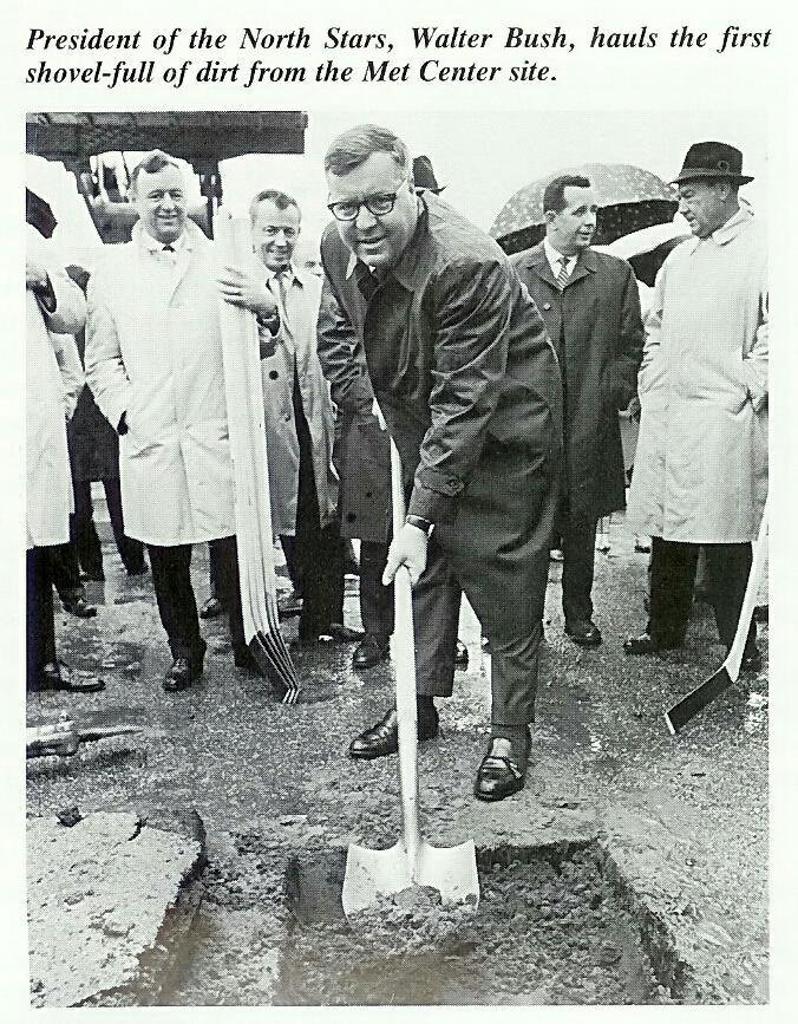
October 11, 1967
The Minnesota North Stars debut as a National Hockey League expansion team. The home of the North Stars, Metropolitan Sports Center in Bloomington, was built in 12 months (October 3, 1966, groundbreaking to October 25, 1967, first home game).*
Long before the age of modern ice hockey, with its’ leagues and franchises, Europeans enjoyed similar competitive games. Even authoritative Canadian sources, like the 2019 article by author Jean-Patrice Martel on the “Origins of Ice Hockey”, tip their hat to these bridge-building ancestors.
“Hockey developed from stick-and-ball games played in the British Isles, particularly hurling (Ireland), shinty (Scotland) and bandy (England). These games shared a very similar basic structure and have been documented from the 14th century.
But what about hockey itself? Unlike bandy, hurling and shinty, the term “hockey” is relatively recent. Its oldest known use is in the 1773 book Juvenile Sports and Pastimes, written by Richard Johnson. Chapter XI of the book is titled “New Improvements on the Game of Hockey,” which suggests that the name had been in use for some years already. The chapter details the game in over 800 words, using the term “hockey” to designate not the stick, but rather the object with which it is played: a “cork-bung,” or barrel plug.” **
Moving us closer to home, what clues to find to the development of ice hockey as sport in the North Star state during the 19th and early 20th centuries? Author and expert ice hockey historian Rodger A Godin states the following synopsis as Minnesota’s deep rooted attachment to the sport in his stellar book, “Before the Stars” (Minnesota Historical Society Press).
“In the early twentieth century, before the National Hockey League had established a presence in the United States, a team from St. Paul played at the highest levels of hockey in the country. Sports historian Roger A. Godin resurrects the story of the St. Paul Athletic Club team—the AC’s—and argues they were instrumental in turning Minnesota into one of the nation’s first hockey hotbeds and gave birth to what is now known as the “State of Hockey.” ***
Let’s explore the final iterations of farm teams and the foundations of Minnesota’s first professional hockey franchise. Two pivotal local teams caught the eye of Walter Brown, owner of the Boston Bruins; first, the Minneapolis Bruins, and second, the Saint Paul Rangers. This attention, along with the friendship of Minneapolis attorney and hockey booster Walter Bush Jr, cemented the viability of the Twin Cities in the minds of those seeking to expand the NHL brand while increasing TV revenues.
To this end, Bush applied for the expansion, and sought investors that could supply the contractually-necessary 13 thousand seat arena. A St Paul team of investors nearly clinched the deal using the existing Roy Wilkins Arena, but the funds to expand the facility required a public vote which cost too much time. Shortly after this failure, the two factions of owners, (from Minneapolis and St. Paul), decided to to go in together and build a new site for hockey in Bloomington; the Metropolitan Sports Center. This groundbreaking crew October 23, 1966 comprised the new ownership: John Ordway Jr., Walter Bush Jr., Gary Mc Neely Jr., Robert Mc Nulty, John Driscoll, Gordon Ritz, Robert Ritter. These locals paid approximately $2 million to the National Hockey League to add their franchise. *
But where did the first team of North Stars hail from; where did they assemble this first team, seemingly out of thin air? The short answer? They were enlisted from existing NHL teams. See the chart below:
Player Team
Caesar Maniago New York
Dave Balon Montreal
Jean Guy Talbot Montreal
Ray Cullens Detroit
Parker Mac Donald Detroit
Bob Woytowich Boston
Wayne Connelly Boston
Bill Goldsworthy Boston
Andre Boudrias Montreal
Mike Mc Mahon Montreal
Bill Masterton Montreal
Elmer “Moose” Vasko Chicago
“The North Stars played their first game on the road against the St. Louis Blues on October 11, 1967. It ended in a tie. On October 21, the North Stars hosted their first home game against the California/Oakland Seals—which ended with the North Stars’ first win. However, tragedy soon struck the team. Bill Masterson, a center, hit his head in a legal check on January 13, 1968, at the Met Center. His injury was severe, and he died of his injuries two days later in a hospital. His death is the only direct death resulting from gameplay in the NHL. It precipitated regulations for mandatory helmets, though they weren’t required until 1979. Even with this tragedy, the North Stars ended their inaugural season with a trip to the playoffs, losing to St. Louis in the semifinals.”
Now, dear Father, we turn to You to reflect and pray on this history. What will we learn if we remain in Your Presence, and just think about the importance of hockey to Minnesota? How did this beginning of a much-loved sports team change the course of Minnesota? Before that, we remember the Master who created winter, ice, and the people groups who were designed to thrive in the cold. We remember that the Ancient of Days is the author of sport, and its underlying causes: to severely prove one’s ability, to test intensely one’s skills without risk of death, and to learn what Cain and Abel did not. For all these things, we adore You!
One thought that comes to mind is how perfectly hockey is suited to the Northern regions of North America in the last few centuries. We, at least historically, come from tribes and nations that are ready made to thrive in the snow. We remember that You conditioned the first hockey players and fans to play in the snow: Canadians, First Nations (Inuits, Nunavuts, Metis, Algonquians to name a few), and recent American immigrants from mostly Northern European origins: Norwegians, Swedes, Finns, Russians, etc.
Let’s put ourselves in their shoes as hockey leagues grew over 100 years ago, shall we? What kind of entertainment suits our very rugged ancestors who spent all day in a frozen logging camp, mining camp, railroad camp, or just homesteading a new farm in the wilderness? Would they relish tennis racquets, cricket bats, and white pants or a fast-paced, high-attention battle that could change at a moments notice, and wind up with blood on the ice? Lord, I guess I’m just pondering if our ancestors who day in and day out did high risk, cold, and dangerous work influenced them to enjoy the battle on ice which is hockey?
Under Your Authority and with agreement with the Council of Heaven, we remember all these formational years before hockey was a professional sport. We are grateful for those who built North America, in the bone-chilling winter, and did not lose their sense of play, but handed this game down to us and the world. Will You bless those of us in high risk professions to be faithful in our work, and vent our combative urges with the good sportsmanship of hockey?
Let’s add to the list of gratitude these specific things; dear Councilor of Heaven:
We remember to You the excitement created by the Saint Paul Athletic Club team of about 100 years ago!
We thank You for Walter Brown, the Boston Bruins, and the Minnesota Bruins!
We applaud the efforts and significant investment of these early hockey boosters:
John Ordway Jr., Walter Bush Jr., Gary Mc Neely Jr., Robert Mc Nulty, John Driscoll, Gordon Ritz, and Robert Ritter.
We thank You for the risk and enthusiasm of our first players:
Caesar Maniago, Dave Balon, Jean Guy Talbot, Ray Cullens, Parker Mac Donald, Bob Woytowich, Wayne Connelly, Bill Goldsworthy, Andre Boudrias, Mike Mc Mahon, Bill Masterton, and Elmer “Moose” Vasko.
We remember the contributions of the city of Bloomington, and all those who worked on the Metropolitan Sports Center.
Will You bless these names, spoken or unspoken, and their generations who contributed to Minnesota hockey? Will You forgive them their judgments of their detractors in roughly the 1920’s to the 1960’s, and those Minnesotans who judged them and failed to see the promises of professional hockey?
We thank You for at least two generations of young men and women who were inspired by the North Stars? We thank You for the impact these moments, whether playing the sport of hockey or participating as a fan, have strengthened the resolve of Minnesotans! So many of us have seen, at least in part, the lessons of an all-out battle, yet with rules!
We thank for the lessons portrayed in the game of hockey and in the North Stars franchise; it made our state better! We thank You that it taught what our ancestor Cain had not caught; we fight our life’s battle according to the rules of the game, and because our competition is made in G-d’s own image, we do not kill, but walk off the field of battle to shake hands with our brother. Is this not the heart of sportsmanship and brotherly love?
Conversely, forgive us Lord where we have prohibited our men and boys from sporting battles like hockey. How does one learn his limits as a man unless he has faced his own battles? Where will men be affirmed in their strength, valor, and leadership if they do not experience even a controlled danger?
Our current culture, dear Father, struggles to parse the meaning of masculinity. We rightly recognize that men need to temper their testosterone. There is something right when a hard as nails block layer holds his daughter’s hand like a butterfly! There’s something of Your efficiency in the moment an executive clears his schedule to give 100% attention and focussed time to his son!
Yet, we have failed to recognize that within ordinary men there is a hero because Your brave nature is in them! Who will fight those men who fight civilization? Who will oppose evil with good if men aren’t taught to sacrifice their safety for others? What is the lesson that Cain and Abel failed to teach us? Is it that the same wild and explosive masculine powers unleashed in the Creation of the Universe are the same masculine powers of self-control that sent our Messiah to the Cross?
A mature man is one who exhibits the self-control of his Eternal Father, his dad, and his coach. A fierce and effective hockey player is the man who retains both the wildest of his wild nature with discipline. What better image of power under control than a star? We thank You, the Most Dominant One of the Universe, for Your gift of the North Star, and the team that is its’ namesake! Let us deeply take in this image of exceeding power under control. Will You make us a State and people who neither fail to recognize Your Greatness in wild, masculine power, or Your Greatness to discipline that power through self-control! Amen!
“He who is slow to anger is better than the mighty,
And he who rules his spirit, than he who captures a city.”
Proverbs 16:32
Source: https://bible.knowing-jesus.com/topics/Control
- P.T.H. cites timeline formerly at this URL: mnhs.org/about/dipity_timeline.htm
** Martel, Jean- Patrice. “Origins of Ice Hockey” Internet. The Canadian Encyclopedia. February 6, 2019. https://www.thecanadianencyclopedia.ca/en/article/origins-of-ice-hockey
*** Godin, Roger A. “Before the Stars Early Major League Hockey and the Saint Paul Athletic Club Team”. Minnesota Historical Society Press, October 4, 2004.
Want to go way deeper? Watch this incredible video series on the formation of ice hockey as an internationally acclaimed sport.
Internet. “Hockey: A Peoples History”. https://www.imdb.com/title/tt0818640/
**** https://shop.mnhs.org/products/stars?variant=31803020509280
Dan Whenesota. YouTube. “The North Star State – Part 1: A Star is Born” September 7, 2020. https://www.youtube.com/watch?v=3Mz-bB7MeUc&t=1575s
* Tieberg, Alex. “Minnesota North Stars”. January 6, 2020. https://www.mnopedia.org/group/minnesota-north-stars
The Unrestful Night on Plymouth Avenue
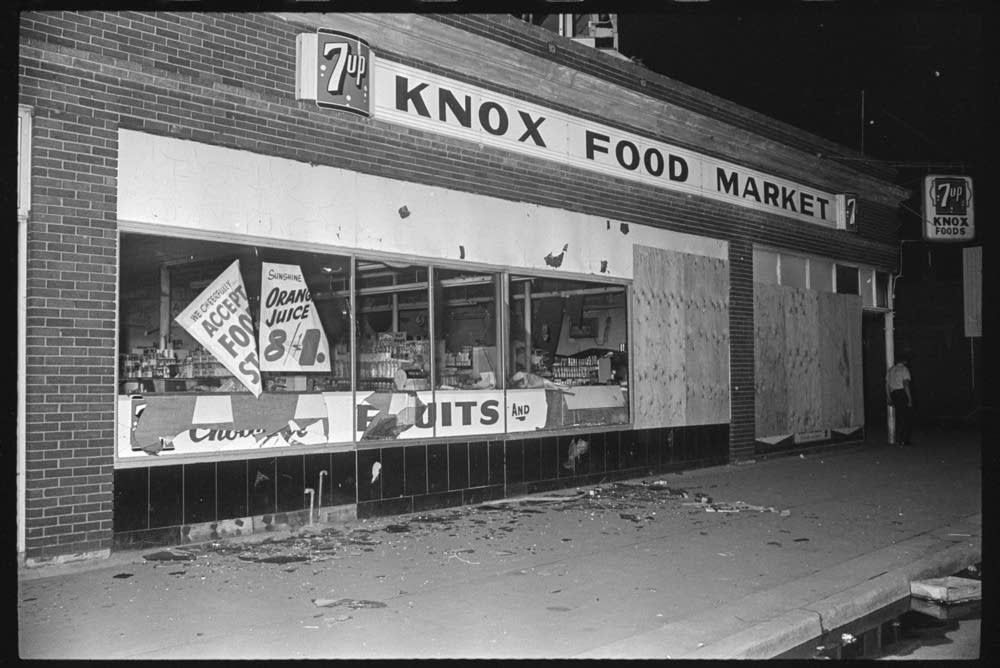
On the night of July 19, 1967, racial tension in North Minneapolis erupted along Plymouth Avenue in a series of acts of arson, assaults, and vandalism. The violence, which lasted for three nights, is often linked with other race-related demonstrations in cities across the nation during 1967’s “long hot summer.” *
For those in the hippie or peace movements, 1967 represented the “Summer of Love”. Simultaneously, black Americans living in the centrums of the great cities of the United States had much different experiences alleging: chronic unemployment, unlawful detainments by their local police, and poor housing demonstrated uneven enforcement and application of the law. The hope created in the Civil Rights movement met the reality of deferred and disrupted implementation. These unmet expectations spilled over in 159 racial riots across our nation during the months of June and July of this year in: Atlanta, Buffalo, Cambridge, Cincinnati, Portland, Riviera Beach, Saginaw, Tampa, Detroit, Birmingham, Chicago, New York City, Milwaukee, Minneapolis, New Britain, Rochester, Plainfield, Toledo, and Newark. **
But what were the local effects of the “Long, Hot Summer” of 1967? Susan Marks, in her article for the online MNopedia of the Minnesota Historical Society provides us an outline to put this event in proper context. ***
“Chronology
1950s
Unequal housing and job opportunities strain previously friendly relationships between the Northside’s black and Jewish communities. Though many Jewish people move out of the neighborhood, several Jewish-owned businesses remain open on Plymouth Avenue.
1965
African Americans make up 4 percent of Minnesota’s population. A large number of newly arrived immigrants settle on the “Near North Side.”
August 1966
After incidents of looting and arson in North Minneapolis, Mayor Arthur Naftalin meets with representatives of the black community and promises to help improve local conditions.
1966
The Way Opportunities Unlimited, Inc. (The Way) opens in North Minneapolis. It attempts to empower the black community and provide economic opportunities.
Summer 1967
Opportunities for black citizens in North Minneapolis remain poor.
July 19, 1967
Violence erupts on Plymouth Avenue just before 11:30 p.m. Knox Food Market, a Jewish-owned business, is set on fire.
11:30 p.m.
Molotov cocktails are thrown at the home of Minneapolis Fifth Ward Alderman Joe Greenstein.
11:48 p.m.
Riot police arrive in North Minneapolis to restore order.
July 20, 1967
At 12:15 a.m., a crowd moves toward the Homewood Theater, a Jewish-owned venue. Police make several arrests.
11:30 p.m.
Alderman Greenstein’s garage is set on fire, but saved.
July 21, 1967
Samuel Simmons, an African American man, is shot at Wayne’s Bar at 12:30 AM.
12:30 a.m.
Silver’s Food Market and Country House Market—two Jewish-owned businesses— are set on fire.
1:05 a.m.
Police arrive and form a skirmish line.
9:15 a.m.
National Guardsmen arrive.
July 22, 1967
The unrest ends. National Guardsmen continue to occupy North Minneapolis for one week.”
We find another outstanding primary source of information on these nights of unrest in North Minneapolis from the archives of ABC News, as cited by Hezakya Newz. This original newscast, about 25 minutes long, is a plethora of interviews of locals and their take on what happened, how it happened, and why it happened. The most compelling interview, in the opinion of the author, is found at 11:52 – 13:58 of local Civil Rights leader; Mr. Harry S. Davis. Please read the transcript below.
“Q: Mr. Davis, how do you size up what happened here last night?
A: It started, because, for about three weeks now rumors have been flying around through the power structure, for one, that there was going to be a riot.
…For instance, the police had a riot control training program just Tuesday of this week…
Now, understanding the emotions of men, especially policemen, who are on the police force for a number of reasons, and the slightest little thing that would happen would force them into doing something, and this is what happened last night.
Two girls got into an argument; a fight. The police, one of the fellas was trying to separate them, the police saw this thing, they were ready and armed, and they started knocking, pushing, hitting people, and they (the people) began to retaliate.”
Q: Do you blame this on the police then? Is that it?
A: I blame this on the temperament of the power structure for alarming the community to the point that this thing had to happen.
Q: What do you mean by power structure? I mean from the governor on down to the lowest man within the system that makes decisions.
Q: They were predicting riots?
A: Right! They were predicting riots.” ****
In sum, we arrive at these general truths: there existed a nation-wide expression of dissent, locally, we find a historical trail that led us to the Plymouth Avenue riots, and a prominent witness of the anticipation of city and state governments of riotous conditions.
Since the advent of televised reporting in this era, we see some evidence of the democratization of outrage; local events sparking nation-wide acts of empathetical protest. We see in local history that when representative government “kicks the can down the road”, (fails to respond to the present), the result is often multiplied and intensified towards uninvolved third parties “getting their can kicked”! Maybe Plymouth Avenue is an example of predictive programming? What happens when locals no longer trust the law and the good faith of authorities, but find only policies to punish disagreement? Or did this event expose the hair-trigger of our local government’s misbeliefs; when they look for riots they surely find them?
With our hands lifted up, we kneel before the Just One; we can’t figure out the night of July 19, 1967 and we surrender! We remember that You are the continual Seat of Authority over this universe. We recall that the Council of Heaven longs for the expression of justice on earth “as it is in Heaven”! Enlighten us to intercede for this event 53 years ago. According to Your system of justice, let us: acknowledge individual and collective judgments and offenses against You, our neighbors, and ourselves within these nights in Minneapolis and the “Long, Hot Summer” of 1967. Come, heal our system of government in the Twin Cities and Minnesota! Come, free us from repeating the same cycles of fear, prejudice, racism, and bitter-root judgments that lock us into eternal conflict with You and our fellow man. Like the Pilgrim’s, make Plymouth the last port before sailing on to the Promised Land.
Let’s begin our confession of a giant source of pain; the democratization of outrage. Lord, by this I mean that at times we respond, bodily and emotionally, to local stories on a national, or even world-wide scale. We now, through media of all kinds, can witness the events of history closer and closer to the actual time of their occurrence. (This, of itself, is neither good nor bad, and I don’t condemn the technology or news gathering sources.)
Yet, Your spirit shows me this in our acts of democratized outrage; they split our souls in two. Can a man simultaneously walk forward while critically viewing himself from the outside taking a walk? Can we both live and analyze our acts of living at the same time? Isn’t this practice a form of DID (Dissociative identity disorder)? Will we be present-tense participants in our own lives, or passive and past-tense analysts of life? Does not our media intake create the possibility of a condition in which “two or more distinct identities or personality states” alternate in controlling the patient’s consciousness and behavior?
Let us learn and practice to be one as You are One! You are Eternally Present to all. Will You forgive us our split consciousness of July 19, 1967, and re-integrate us where we have allowed and practiced the democratization of outrage? Will You forgive us our mountains of judgments against You and our unknown neighbors whom we observe passively and from a distance through the minuscule peephole of a camera lens? There are so many perspectives outside the frame of a photo. A well-researched newspaper article is a two-dimensional facsimile of real life run through the filter and biases of: the owners of the news corporation, it’s advertisers, the publisher, editor, and the history, beliefs, and misbeliefs of the mind of its author! We have deeply offended our Maker in this. We have thoroughly engaged in the practice of snap-judgments of Your Mind, Your Justice, and Your Peoples both near and far! Will You take these root-misbeliefs, that we can be both the observers and participants of our lives, that we can make both passive and actively-minded just choices at the same time, up, out, and onto the Cross of Christ? Will You give us Your solidity of heart and mind? We need to do justly, and we need to learn how and when to control emotional responses while gratefully acknowledging that feelings are gifts from You for the betterment of our lives!
As for the next point of discussion and prayer, Father, we want to acknowledge some specific judgments and counter-judgments of this event.
We start with geography. We acknowledge that the Near North Side to be a place of generational racial judgments and redlining of the heart if not in the law and business practices of Minneapolis! We see a history, too long, of those deemed by the city or county as undesirable ethnically gathered into its neighborhoods; Slavic peoples, Jewish peoples, and African-American peoples. Forgive our city these judgments of Slavs, Jews, and Black Americans as well as the counter-judgments of these groups towards Minneapolis.
We acknowledge the sins and separations of place to You. Will You heal the pain of: Plymouth Avenue, of Broadway and West Broadway, The Way, Knox Food Market, Homewood Theatre, Wayne’s Bar, Silver’s Food Market, Country House Market, Alderman Joe Greenstein’s home and garage, and any other square foot of ground embroiled in this conflict? We invite Your Presence into these specific locations, businesses, and any other unnamed places of conflict in the Plymouth Riots of 1967. Will You restore and create balance where injustices in all directions have occurred?
We declare that the Near North of Minneapolis is Your neighborhood where all men and women of peace are invited!
We move next to general historic realities of the Northside, and again, it’s A-B judgments.
We remember a reality of unequal opportunities and apportionment of the laws of Minnesota and Minneapolis towards various ethnicities, including but not limited to: Slavs, Jewish, and Black communities. We ask forgiveness of this daisy-chain of judgment: of historic leaders of Minneapolis towards Slavs, who judged the Jews, who judged the African American. We ask for the release of the history of counter-judgments of all these parties towards each other, our city, and our state. We have failed You first in this, Father.
Will You forgive the judgments of this neighborhood towards each successive wave of immigration or migration of large groups of “new” ethnicities? Will You forgive Your African-American people their envy, jealousy, and judgments of the established Jewish businesses and culture of the Near North? Will You forgive Your Jewish-American people their judgments and failures to see the Image of G-d in their new African-American neighbors of the 1950-60’s?
We see and acknowledge the evil of looting and arson in this event. We remember the physical destruction of primarily Jewish-owned businesses at the hands of primarily African-American rioters and arsonists. We acknowledge these crimes of judgment and counter-judgment. We condemn crime against Your peoples of any ethnicity, or the assumption of criminality based on one’s ethnicity. We recognize that the majority of all residents of the Near North did not participate in violence against property or persons. We recognize that much of these offense were committed by the young and inexperienced in life. Will You forgive the foolishness of these youths? Will You hear the defiance of those fully aware of these acts, and separate out those with a heart for justice from those simply intent on destruction and looting? Will You take this pain, up, out, and onto the Cross of Christ? As we have judged our neighbor, we have falsely judged You and greatly offended the Only Just One of the universe; have mercy!
Finally, we remember the individuals most offended on these nights of July 1967.
We remember the specific targeting of Alderman Joe Greenstein.
We remember the shooting of Samuel Simmons.
We remember the leadership of Harry S. Davis.
We remember the leadership of Mayor Arthur Naftalin.
We remember the injured and unnamed: of the African-American community, of the Minneapolis Police, of the Minnesota National Guard.
Each of the offenses, crimes, and judgments against these is an affront to You personally and Your Justice. Will You take this brokenness; up, out, and onto the Cross? Will You forgive us where we have made Your neighborhood, the Northside, into an unforgiving and unyielding place? We speak against the fires of the past and ask that You make this a place of construction and growth. We speak against the looting of 1967, and invite Your Spirit of giving. Will You make this the most generous African-American neighborhood in Minnesota? Will You erase our democratization of outrage in Minnesota, and replace it with the democratization of those engaged? We love You. We need You to survive. Amen!
P.T.H. cites timeline formerly at this URL: mnhs.org/about/dipity_timeline.htm
** McLaughlin, Malcolm (2014). “The Long, Hot Summer of 1967: Urban Rebellion in America”. Palgrave Macmillan.
*** Marks, Susan (2015). “Civil Unrest on Plymouth Avenue, Minneapolis, 1967”, Minnesota Historical Society. Internet. https://www.mnopedia.org/event/civil-unrest-plymouth-avenue-minneapolis-1967
**** Hezakya New & Films. “1967 SPECIAL REPORT: “MINNEAPOLIS RACE RIOTS”. ABC News. Video Source. YouTube. June 29,2021. https://www.youtube.com/watch?v=S5swH1_r9OI
Martin Luther King Jr. Speaks at U of M
April 27, 1967
Dr. Martin Luther King Jr. speaks about racism, poverty, and the Vietnam War to a crowd of 4,000 students at the University of Minnesota. Civil rights legislation, King says, has “rectified some evils of the South, but did little to improve conditions for millions of Negroes in teeming ghettoes of the North.” Congress has passed the 1964 Civil Rights Act, but King cites continuing inequalities in northern cities, such as a high black unemployment rate, segregated schools, and the growth of ghettos surrounded by suburbs. *
One can be inspired by only reading the words of Reverend Dr. Martin Luther King. Yet to those who heard the timbre of his voice and saw the gravitas with which he carried himself that clear Thursday on the lawn of the Agriculture Campus of the University of Minnesota; it must have felt like a dream. Sometimes, one just knows that they are witness to greatness.
King begins his speech with an acknowledgment of the success of de-segregation and passage of the Civil Rights Act of 1964, but goes on to state that legislative victories “did very little to penetrate the depths of Negro deprivation.” ** He wonders, aloud, if our society is more opposed to Commissioner Bull Connor and Sheriff Jim Clarke of Birmingham, Alabama than positively for equality and justice. He suggests of the civil rights movement, that the “need is for legislation strongly enforced”, and this would best occur if we were to “make civil rights crimes Federal” offenses. ** (For readers outside the U.S., Federal jurisdiction means that our national government would enforce these laws rather than the city, county, and state.)
Moving on to the economic issues and disparities Black Americans faced in the cities, Reverend King underscores the urgency to both make and enact plans to better their lives stating “our summers of riots are caused by our winters of delay.” ** Dr. King opined that many in white society were not aware or accepting of the type of unemployment and price gouging faced by these neighbors, or that there is “literally a color tax in the ghetto.” ** His solution to this problem could be summed in his phrase “to attack poverty directly by guaranteeing an annual income for all the families of this country.” **
Addressing another political “hot potato”, Dr. King challenged the perceptions of his audience, and our nation’s worldview. Though criticized by some as being overly empathetic to socialist causes, his outlook could be construed as running parallel with the logic of libertarians; if we practice human rights at home, it is natural that we exude healthy human rights in our foreign affairs. Please, try to read and consider his quotes on Viet Nam with this in mind?
“We’re on the wrong side of a world revolution. We tend to see every revolution in the world as a communist revolution. And our tragedy is that we’ve based our total foreign policy on a huge miscalculation…” **
And
“Injustice anywhere is a threat to justice everywhere. I’m concerned about justice for everybody the world over.” **
At the end of his speech, Martin brought things back to the folly of the human heart. Do we believe in the freedom of our rivals, of our detractors, and of those who genuinely oppose us? You make recognize pieces of his, perhaps most famous speech; “ I Have a Dream”.
“I believe we can build right here, if we will only do these things, a nation where everyman will respect the dignity and worth of human personality and this will be that glad day when all of G-d’s children: black men and white men, Jews and Gentiles, protestants and Catholics, will join hands and sing in the words of the old Negro spiritual;
“Free at last! Free at last! Thank G-d Almighty we’re free at last!
University of Minnesota Professor, John Wright, an attendee of King’s speech, gives us insight into the personal and public impact of that day in 1967. Because of King’s presence, He committed himself to the civil rights of Minnesotan’s, and participated in the 1969 student protest and take-over of Morrill Hall. ***
“I think we can be proud of the staying power of several of the institutional outcomes of the whole protest and take-over process. Of course, the creation of the Martin Luther King Programs in the College of Liberal Arts, and the formation of the Department of African American and African Studies.” **
Now, Eternal Father, we make a request to sit with You in the presence of the Council of Heaven as we meditate on April 27th, 1967. Today we remember the future the Apostle John recorded and prophesied of Your peoples.
“And they sang the song of Moses the Servant of God and the song of The Lamb. They were saying: “Great and marvelous are your works, LORD JEHOVAH God Almighty. Just and true are your works, King of the universe.” “ **** Revelation 15:3 Aramaic Bible
We thank You for the reminder in this single verse of the revelation that we, humanity, have been shown through the Law (Moses), and through the unparalleled grace and forgiveness of all separation through the Cross, the Blood, and the Resurrection of our Messiah! We cannot say thanks enough for the favor shown to all peoples at all times throughout the history of the human race!
Lord of Lords, will You help us today as we revisit this speech of Reverend King some 54 years ago? What in his message brings You glory, and what in his message does not? May we have a conversational prayer with You and acknowledge to You, first, the offenses of our society past that we can be freed from their misbeliefs and unbeliefs?
We applaud the successes of King’s movement of de-segregation. The ground at the foot of the Cross is completely flat, and so should our civic laws be completely apportioned; an even application of rights and privileges for all Americans! We remember this core “heart value” within the Civil Rights movement. We invite You into the brokenness of 1967, and acknowledge the offense of our society to misuse the Law (Moses), and bitter root judgments that created a legal system that negated justice to black Americans. Will You forgive us this offense against You and Your Image within all Americans of African descent; in King’s era, the present, and until Your return?
As a second thought in this conversational prayer, we hear and ponder Dr. King’s words very carefully. As a paraphrase, we hear this message; local laws and enforcement have failed, thus King suggests making “civil rights crimes Federal offenses”. While understandable the King could arrive at this conclusion given the context of intense conflict, it is understandable while these words would also cause conflict. To Americans who connected with King’s heart, it was completely logical.
However, to those who are aware of the positive and negative limits on our Federal, State, County, and City governments, it presents a drastic change. Our Founders, for many reasons, sought to create a legal system like a family walking in the rain: father’s umbrella covers mother, mother’s umbrella covers the kids, and the kid’s umbrella covers the dog. Our system is reliant on leadership and authority to be: relational, nearby, and accountable to the governed.
Is this, perhaps, a logistical fallacy or root misbelief in Reverend King’s logic? If local government has failed it’s people, which is in a much more direct relationship to its citizens, how will moving the center of responsibility to Washington D.C. make it more accountable to locals? For example, “It’s the government that has failed African Americans of Alabama, so we will look to the government, far away and less accountable, to provide a more equitable solution?” Lord, I may be simple, but doesn’t that sound like repeating the same action and expecting a different result?
So, we come humbly to You with a broken spirit over this question; “What do we do when those closest to us deny us justice?” Will You unravel these tangled root judgments of the 1960’s and bring them up, out, and onto the Cross of Christ? Will You bring Your justice to these places, where every rung of authority from City, to County, to State, to Federal had failed our citizens? Will You forgive us where we placed more hope in the law (Song of Moses), than in Healing Presence and unmerited favor of the Redeemer (Song of the Lamb)? Come and bring Your civil rights to our civil wrongs!
For the next item of this meeting, we start with a point of order brought so eloquently by MLK; “Father, when is the right time for collective responsibility versus individual responsibility as it applies to economics?”
I refer here to the words of King’s speech, Lord:
“our summers of riots are caused by our winters of delay.”
“literally a color tax in the ghetto.”
“to attack poverty directly by guaranteeing an annual income for all the families of this country.”
Bring Your insight, Holy Spirit, let us move with You, see from Your point of view, and hear from Your Word.
In Your Eternal Word we see examples of individual responsibility towards YHWH:
“Love LORD JEHOVAH your G-d from all your heart and from all your soul and from all your possessions.” Deuteronomy 6:5 Aramaic Bible ****
“I am YHWH your Elohim, there will not be for you another god before me.
You will not make for you an idol and you will not bow down to them, for I am YHWH your Elohim.
You will not take the name of YHWH your Elohim in vain.” Exodus 20:1-4 Ancient Hebrew *****
(Lord, we notice that every pronoun is personal in these 10 Commandments.)
In Your Eternal Word, we also see examples of collective responsibility for the sin of an individual:
“But the Israelites were unfaithful in regard to the devoted things; Achan son of Karmi, the son of Zimri, the son of Zerah, of the tribe of Judah, took some of them. So the Lord’s anger burned against Israel.” Joshua 7:1 NIV ****
Or we see collective judgement for the offense of an individual ruler:
“Now at midnight the LORD struck down every firstborn male in the land of Egypt, from the firstborn of Pharaoh, who sat on his throne, to the firstborn of the prisoner in the dungeon, as well as all the firstborn among the livestock.” Exodus 12:29 BSB ****
Lord, hear our prayer! Let us first love You, with all we are including our possessions and property whether small or great! We are guilty of making our economic worth an idol, therefore, breaking the first of Your commands! We have tainted Your Name, our family name, our ethnicity’s name through our own individual actions; even in the plunder of an enemy?! Individual leaders in our history, separated from You and hard of heart, have brought suffering and death on the innocent and powerless! We acknowledge our guilt, collectively and as individuals, to You and our neighbor! Will You heal the past, free the present, and bless the future of these economic wounds: within us, in our society, and in Your Body the Ekklesia?
As a third petition and reflection, help us ponder Reverend King’s views on war, and the Viet Nam war in particular. Living Word, let’s think on King’s words given this Thursday in 1967; “We’re on the wrong side of a world revolution. We tend to see every revolution in the world as a communist revolution.” What say You, Rauch Ha’ Kodesh (Holy Spirit)?
Granted, as the political entity known as the United States, we surely had a foreign policy bent on containing Communism in Southeast Asia. Further, President Eisenhower had warned our nation of the drive to power and profit of the “military industrial complex”. Help us remember a bit more, Lord?
China, once an ardent ally of the United States with a proud heritage for millenia, had fallen to Mao in 1949. (Mao’s social justice record was stained by the blood of tens of millions of his own people at the time of this speech.)
Korea, again an ancient people, was split in two with the military support of China and Russia 27 July 1953. (Again, Russia’s record of social justice was stained with the blood of tens of millions of Stalin’s own people.)
The Second Indochina War, commenced on 1 November 1955 had already ravaged the nations of Vietnam, Laos, and Cambodia for 12 years at the time of Dr. King’s statement.
All this to say that the politically aware in 1967 could plausibly see the wasting of human lives in Southeast Asia as a threat to human dignity and human rights. On this issue, Lord, Dr. King’s views seem at odds with his present tense realities at the time of this speech. As a man with such empathy for the downtrodden, I suspect his heart overruled his head on this matter. Even the FBI alleges that close friendships within King’s circle like Hunter Pitts O’Dell, Abner Berry, and Miles Horton had formed in communist schools and camps in the South like the Highlander Folk School in Monteagle, Tennessee about 1957. A counter-argument to this narrative is that it was one of the few forums in the South where black Americans were welcomed with open arms to: speak, listen, receive free education, and socialize in a multi-cultural setting. ******
This information creates tension in me. On the one hand, it appears Your Body, the Church, had failed to welcome Dr. King and African Americans in general into community. What does this say about Your Body of Believers in the Southern United States of King’s era? Had it calcified the warmth of the Gospel into a stiff, arthritic religion? Were the various denominations more subject to the beliefs, misbeliefs, and unbeliefs of their regional culture than the relational culture of Your Kingdom?
Hear our prayer; will You forgive us, the Ekklesia (those called out of the past and into Your Presence and future), of the judgments of their siblings and Your children; the black American human being? Will Your release Your Body from the “sleeper hold(s)” of the Enemy of all humanity: our religious spirit, of our embrace of cultural lies, of our collective and individual beliefs, unbeliefs, and misbeliefs that so deeply offend the Holy Spirit? Bring healing to this memory of Dr. King’s generation, and empower us to practice Your Healing Presence for ourselves and especially our neighbors of a differing race?
On the other hand, how does a Baptist preacher, (Rev. King), align his Biblical worldview with an atheist one? How does King marry the Gospel’s view of history, one that all men can believe in Your Son and be saved, with a Marxist historiography that is often deterministic and pegs human beings into camps limited by one’s external racial markers rather than one’s internal markers? Father, it’s not my heart to judge Dr. King for having friends of various political views, but perhaps it can explain some of sympathies in the Vietnamese War.******
In sum, we appeal to heaven with MLK of April 27th, 1967 that we learn and practice to be “Free at last”! We acknowledge to You that even our icons and heroes of history are human like us with motive conflicts. We so fully believe and misbelieve in You at the same time! We judge our judgers as they counter-judge us! May we radiate the justice of our Eternal King everywhere through confessing our threats and unjust hearts everywhere! May we respect the dignity and worth of Your Infinite Personality first! All our racism, human to human, is first an offense to the Author, Creator, and Lover of the human race! May we avoid the wrong side of a world revolution! May we align with the Song of Moses (Judgement and Just Law) and with the Song of the Lamb (Unending Mercy)! May we love our enemy and do good to those who oppose us until we are all children of our heavenly Father again! We love You and need You to survive! Amen.
One Nation with One King
“Again the word of the LORD came to me, saying, “And you, son of man, take a single stick and write on it: ‘Belonging to Judah and to the Israelites associated with him.’ Then take another stick and write on it: ‘Belonging to Joseph—the stick of Ephraim—and to all the house of Israel associated with him.’ Then join them together into one stick, so that they become one in your hand.” Ezekiel 37:15-17 BSB
Joseph (Yosef)- means ‘he will add”
Ephraim- means simultaneously “ashes” and “to make doubly fruitful”
Father, is this a symbol or foreshadowing of the Cross? Christ takes our ash pile, adds His life to it, and makes us doubly fruitful? You took the divided nations of Judah and Israel and made them one nation. May You join our divided nation(s) again!
- P.T.H. cites timeline formerly at this URL: mnhs.org/about/dipity_timeline.htm
** Minnesota Experience. Twin Cities Public Television. PBS. “Martin Luther King in Minnesota”. Restored by Minnesota Historical Society
A discovered tape of a speech given by Rev. Martin Luther King, Jr., at the University of Minnesota in 1967; followed by an interview of Dr. Martin Luther King Jr. by host L. Howard Bennett for a discussion on ideas, methods and words of wisdom on how to achieve the goal of a free society for all.
Premiere Date: January 21st, 2019 (Cites speech of MLK April 27, 1967.) Internet. https://www.tptoriginals.org/martin-luther-king-in-minnesota-full-episode/
*** Maas, Susan. “Remembering the Morrill Hall Takeover”. University of Minnesota Alumni Association. 2019. Internet.
https://www.minnesotaalumni.org/stories/remembering-the-morrill-hall-takeover
**** Citations of Revelations 15:3, Deuteronomy 6:5, Joshua 7:1, Exodus
https://biblehub.com
***** An excellent version of the Ten Commandments both in ancient Hebrew and English. https://www.ancient-hebrew.org/biblical-history/files/bible_ten_short.png
****** https://www.appalachianhistory.net/2018/01/school-for-subversives-and-communists.html
 praythroughhistory