20th Century, Agriculture, History, Minnesota, omnipresent history, Uncategorized

Legislature Halts Farm Foreclosures

FH2

Photo credit: http://www.mnopedia.org/group/farmers-holiday-association-minnesota

May 1, 1933
“Members of the National Farmers’ Holiday Association march on Saint Paul. Arguing that drought and bad economic conditions are beyond their control, the farmers demand an end to mortgage foreclosures and the development of a refinancing program.
John Bosch of Willmar leads the state’s Farmers’ Holiday movement. He promotes the nonviolence of Mohandas Gandhi. On May 1, 1933, the legislature—at the urging of Governor Floyd B. Olson—passes an emergency law stopping farm foreclosure sales until farm prices rise.” *

Thesis. Counter-thesis. Synthesis. Though we try Lord, we cannot live in a vacuum. We are individual cells that must function as a body. Will You give inspiration and insights into this Minnesota event today? Will You give revelation of the hearts of those involved and their inner motives?

Let’s start with getting a grip as to what motivated the Farmers Holiday Association. It’s national presence was started by Milo Reno, and soon permeated the Midwest. Its’ adherents believed that withholding crops and livestock from the market would drive prices up. A slogan from the time read, “Lets call a Farmer’s Holiday, a Holiday let’s hold. We’ll eat our wheat and ham and eggs, And let them eat their gold”.**

To provide further backdrop, please read the following except from Robert P. Murphy’s “Politically Incorrect Guide to the Great Depression and the New Deal.”

“Murray Rothbard argues that if one looks at content, rather than labels, then a fair case can be made that the “New Deal” program of farm intervention began under Herbert Hoover, not Franklin Roosevelt. Hoover had supported the farm bloc throughout his political career, and during his first presidential campaign promised he would institute a price-support program. He proved true to his word in June 1929 ( three months after he was sworn in as President) with the creation of the Federal Farm Board (FBB). The FBB was initially allocated $500 million to give low-interest rate loans to farm cooperatives, and it also had the power (through corporations it had created) to buy surplus farm products off the market and hence prop up their prices. (Hoover won an additional $100 million for the FBB in the spring of 1930.)
As usual, throwing tax dollars at the problem only made it worse. In a market economy, if a particular group of producers, even the cherished farmer, can’t make a living, then it means that there are too many people in that line of work. Heartless as it sounds, the only sustainable solution to the problem of inadequate farm income was for the least efficient farmers to find other careers. Actual and promised government “support” allowed these marginal producers to limp along, so that there really was overproduction in the subsidized crops. (This is different from the belief that the Depression was due to a general overproduction in that sector but underproduction elsewhere.) Realizing that this practice of “buy high, sell low” was wasting tax dollars, and that the price supports were leading to ever-growing stockpiles in government silos, the FBB took the next “logical” step of ordering output restrictions (while maintaining price supports!)***

So now we know the big picture, but how does it apply to our State? Mr Bosch had a friend whose farm was to be auctioned off. To help this friend, local farmers would crowd so many around the auctioneer that no one else could hear the bids, and then they would bid “one cent” per each item so that their neighbor could buy his property back for a few cents and keep his way of life. Another foreclosure was stopped using similar tactics.

Bosch then pondered how to improve the plight of farmers. He came up with the following program:
“1) the farmers demanded a mortgage moratorium at once, 2) a price level for farm products equal to the cost of production, 3) abolish the Federal Reserve system, and 4) in the event of war all corporation profits involved in the manufacture of war materials were to be taxed 100%.” ****

Farmers were asked not to sell any farm products nor pay any mortgage debts until these demands were met. Also, they went further in blockading U.S. Highway 12 near Atwater, and asking drivers to return their shipments as a sign of support. These actions were recognized by the Roosevelt administration and led to remedial legislation. ****

So we pray to the Lord, Will You forgive our offenses to You through the broken relationships in the production, buying, selling, and distribution of food? Your Words tell us very clearly, “The earth is the LORD’S, and all it contains, The world, and those who dwell in it.” NASB ***** Yet, we have met offense with counter-offense, and an escalation of pain. Have mercy.

Will You forgive our politicians, both locally and nationally, of ways they benefitted from this problem? Both Hoover and FDR wanted to micromanage a problem that their policies had created. They wanted votes and support for their solutions, but did not do so within the bounds of the Constitution. Will You give honor to them where it is due, and rebuke to the vanity of our Federal government? Though the role of our Federal government is clearly defined, it has continually broken its boundaries with the American farmer. Have mercy, the government is not our Savior!

Will You forgive the offenses of these farmers, and the wider offenses of society towards them? No one faults a man who fights for his life. Will You forgive these farmers the pain their righteous indignation caused others who had not caused them harm? O G-d, we do it over and over again, we are most vulnerable to the Enemy of All when we are the victim. We do not forgive because we do not realize our depth of offense against the Only Just One. We transfer our victimization onto our neighbor, who transfers it to the next victim, and the next! Will You forgive these sins of the “good guys” in agriculture?

Will You forgive our bankers and financiers their contributions to this painful event? It is an interesting note that Bosch lists the Federal Reserve as an enemy worth abolishing. Though created to stop the manipulations of our currency, and the excesses of stock market driven panics, it has failed to do either.

It drives the value of the dollar to only a few cents of its former gold and silver backed value, drives the hidden tax of inflation, and silently confiscates the wealth of generations of American families and farmers! Which of our great grandparents would think that we show economic responsibility by our level of debt? Yet, we can scarcely buy or sell any large ticket item without the assessment of our credit? We have mostly accepted this false premise as citizens of Minnesota and the United States. Will You help us to reject it? Will You make us creditors rather than debtors? Will You call the FRS to account for the legalized slavery of Your people, Your assets, and Your natural resources?

We invite Your Farmers Holiday on all who grow, ship, or buy food! Help us tear up the other guy’s mortgage, and remain humbly grateful for the bounties of Minnesota! Amen.

* P.T.H. cites timeline formerly at this URL: mnhs.org/about/dipity_timeline.htm
The Minnesota Historical Society Web site, http://www.mnhs.org, is fantastic! Check it out! Images are from https://images.google.com/?gws_rd=ssl; again, an amazing resource!
** https://en.wikipedia.org/wiki/Farmers%27_Holiday_Association
*** Robert P. Murphy, A Politically Incorrect Guide to the Depression and the New Deal. (Washington D.C.: Regenery, 2009) pp 55-57
**** http://www.willmarlakesarea.com/attractions/historical-sites/farm-holiday/
***** https://biblehub.com/psalms/24-1.htm
Standard
20th Century, History, horses, Intercession, Judgment & Counter-Judgment Cycle, Minnesota, omnipresent history, Prayer, Uncategorized

“Whiskey” Retires

Unknown

^

1932

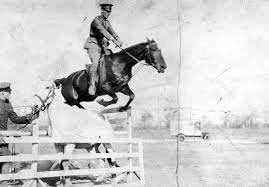
“Leaping through rings of fire, then bowing shamelessly for applause, the celebrated jumping horse “Whiskey” was a star attraction at Fort Snelling and throughout the Northwest.” *

Below are a few fun snippets from “Smartest Horse in the U. S. Army” by Marilyn L. Slovak.

“He went into training in 1921, reached his peak of popularity in the late 1920s, and retired from performance in 1932. In 1944 Whiskey was buried with full military honors and a government headstone near the present Federal Building at Fort Snelling.

The future initially appeared bleak for this wild horse that reputedly “didn’t even wear shoes” and “could kick a hole in a battle-ship.” Considered unsuitable for the army because of his rebellious spirit, he might have been destroyed were it not for another 1921 arrival at the fort, Lt. William Reuben Hazelrigg. Seeing the possibility of greatness beneath the horse’s unruly exterior, the experienced equestrian selected the chestnut as his assigned mount and, perhaps because of the sway in his walk, named him Whiskey.”**

“Whiskey’s greatest talent was jumping. Combining spectacular jumps with a repertoire of tricks, the horse and his rider did double duty at fort polo games, also supplying the half-time entertainment. No obstacle deterred the fearless, high-flying horse, be it a team of mules hitched to a supply wagon; the white mule, Snelling, standing between two fences; a group of diners seated at a table; a human hurdle; or a blazing jump. When the crowds in the stands clapped and shouted their approval, the Minneapolis Star reported, “it seemed Whiskey knew they were cheering at him.”**

“At night, using a front hoof to maneuver the two-by- four that held the door closed, Whiskey routinely escaped from his stall. “I’d meet this horse in the aisle every night,” recounted Stewart Montgomery, a former sentry and Third Infantry band member. “I’d try to get him back into his stall with no success. Whiskey wasn’t going to follow my instructions. He just didn’t like to be locked up.”**

Today, after reading about the connection between Lt. Hazelrigg and Whiskey, I ponder the significance of the relationship of animals and human beings, Lord. Why is it that animals can play such a crucial role in revealing Your heart to humankind? Why is the Bible so full of revelations that are brought or symbolically taught a lesson through another species?

A brief list of man and beast stories told in the Old Testament off the top of my head, Lord.

The heart of the greatest ruler on earth was tempered by gnats, lice, frogs, and locusts in Exodus 8-10.

The nation of Israel miraculously escapes Egypt by the hand of the Almighty. Then they miss having meat so G-d delivers so much quail they struggle to eat it all in Numbers 11.

Jonah runs away from his destiny and is delivered back to it by the trauma of being swallowed by a whale in Jonah 1. 

Elijah, driven into hiding, was fed by ravens in I Kings 17.

Daniel refused to stop praying, and was thrown into a den of lions as punishment. Yet, he was spared, and his accusers were torn to shreds when they shared the same fate in Daniel 6. 

We see an archetype of animals being agents or messengers of change to specific individuals,tribes, and nations. Our contemporaries scoff at Biblical accounts of the miraculous  interventions of Your creatures. We often rationalize along with them, and have been ashamed of Your word in an era of science. Will You forgive us? 

We have forgotten that the King of Universe can use anything, anywhere, at any time to convey His messages. We train domestic animals, but what do we know about communicating with them, or listening to their speech? We pat ourselves on the back for cloning animals, yet we cannot create a creature as magnificent as Your horse.

I thank You today for the life of Whiskey and Lt. Hazelrigg. I thank You for their example of the redeeming relationship between Your creatures and humans. I thank You for the lessons taught by Bill Hazelrigg to his horse, and by the lessons kindled by Whiskey to him.

I do not want to diminish the value of either human beings or animals in Your kingdom. According to Your word, we are to be the managers and stewards of Your creation, but You are the owner of all.**** I want to acknowledge that Your heart is on display when there is a strong bond between us and the animals we know. 

Can a horse experience joy? Only You know. Does a horse do tricks for anything other than a conditioned response-reward cycle? You also understand this. 

We do thank You for bravery of war horses like Whiskey. We thank You that our animals seem to have sense of humor. We thank You for how we grow to “know” them, and as they may “know” us. We thank You for the heritage of Whiskey, and all creatures that make us better creatures! Amen!

Whiskey’s gravestone marker resides alongside the fallen soldiers of Fort Snelling, Minnesota and reads; “Whiskey / a great horse /a stout heart / 1911–1943.”***

* http://www.mnhs.org/about/dipity_timeline.htm

**“Smartest Horse in the U. S. Army” by Marilyn L. Slovak ibid pp 337-339

http://collections.mnhs.org/mnhistorymagazine/articles/61/v61i08p336-345.pdf

*** http://www.waymarking.com/waymarks/WMRRHP_Whiskey_the_Horse_Fort_Snelling_Minneapolis_MN

**** https://biblehub.com/genesis/1-28.htm and https://biblehub.com/psalms/24-1.htm
^ Lieutenant William Hazelrigg and Whiskey jump the army mule Maud. Creator: Minnesota Historical Society, Photo Lab. 10/21/1922. Courtesy: © Minnesota Historical Society, St. Paul, MN (USA) photo “Donkeyversity” Pinterest


Standard
20th Century, Americana, Communism, History, Judgment & Counter-Judgment Cycle, Minnesota, omnipresent history, poverty, Uncategorized, Unemployment, Unions

Hunger March 1932

tuul_program_structure_method_history_1929

1932

“In the heart of the Depression, hunger marchers in downtown Minneapolis demand an $8 weekly relief grant.” * 

Minnesotans fared better than most during the first wave of the stock market crash due to the longstanding tradition of private charity. Eventually these reserves were depleted by the sheer numbers of the homeless and unemployed. Below is a citation of the intensity and desperation here by historian Raymond L. Koch:

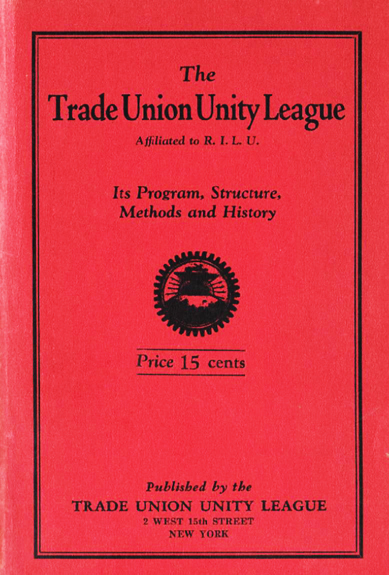
“After the fall elections of 1930, which saw the Farmer-Labor party gain prominence at the state level of politics with the election of Floyd R. Olson as governor, pressure for action on relief needs rapidly increased from organizations of unemployed persons which had sprouted immediately after the great crash. The day after Olson’s first in- augural speech, a group of Twin Cities Communists arranged a march to the Capitol and staged a demonstration for unemployment relief. They were led by Karl Reeve, district organizer of the Communist party in Minneapolis and leader of a local chapter of the Trade Union Unity League, a Communist-front organization. The group distributed a circular that blasted the American Federation of Labor and the Farmer-Labor party and even accused Olson himself of being a “henchman of the Steel Trust.” Several weeks later the Trade Union Unity League scheduled William Z. Foster, a leading national Communist figure, to speak on March 2, 1931, in the Minneapolis Gateway district, a haven for transients and local homeless and jobless individuals. Mayor William F. Kunze banned the speech, but the league tried to hold a meeting anyway. The result was the “Gateway riot,” as it was called the next day after police broke up the assembled group.”**

For further amplification of the situation read the excerpt below:

“The summer relief crisis reached a peak on July 8, 1932, when approximately seven hundred “hunger marchers” demonstrated again in front of City Hall. They demanded a five-million-dollar appropriation for city relief, an eight-dollar-a-week grant to un- employed workers, and a slum clearance program. Invading the city council chambers, the demonstrators listened to two Farmer-Labor aldermen protest Mayor Anderson’s reappointment of one of the conservative members of the board of public welfare — Mrs. H. S. Godfrey — to another four-year term.”**

Lord, in Your mercy, hear our prayer. We seek Your insights into this snapshot of a vitriolic moment in the history of Minneapolis. Will You come and restore us into a right relationship with You and others so we do not replicate its offenses and judgments?

We begin by repenting of self-reliance instead of looking to You. Maybe we forgot the Lord’s prayer; “give us this day our daily bread”? Or the coin did not drop into our hearts until we reached the point of daily and literal hunger? In any case, Minneapolitans have judged You and Your Church as being an incompetent providers. Will You forgive when and where we have denied Your Greatness and clung to our depression?

It also seems apparent that this conflict was not solely about what relief was given, but who would get the credit. Prior to this crisis, it appears we helped the poor by a team effort between the cities’ board of public welfare channeled through the direct care of private charities. Where the politicians sought to convert welfare into votes; have mercy. Where private charities blew their own trumpets, and diverted gratitude rightfully Yours onto themselves; have mercy. Will You restore us as a people so that we are more concerned about aid reaching the needy rather than being publicity greedy?

Another bone of contention between protesters and philanthropies derived from the question how the aid would be given. Some with a Marxist worldview advocated for aid to be in the form of direct cash payments. Traditionalists sought a solution of workfare; those seeking aid could barter their labor for food or other assistance. Will You forgive this offense to You, and the drive to power that couldn’t bear to experiment with both methods?

Ultimately, these events originated a rift still extant: will we be a people who value independence, or dependence? In either case, proponents of both philosophies may deny or contain misbeliefs about the concept of interdependence. 

Communism has some inherent motive conflicts; it wants equality of outcomes but must rely on capitalism to pay for its programs. It has inherent paradoxical beliefs regarding land and personal property. Simultaneously, it advocates the abolition of private property while seizing the property of those “haves” in order to give it to the “have nots”. It is also interesting to note in this context, that the proponents of a system which hates capital (money), simultaneously agitates for relief to be disbursed in cash rather than barter or another type of exchange in kind. Will You forgive these offenses within the Gateway Riot and the collectivists of the period? 

Capitalism of this era also contains perfidy and forms of double-mindedness. Can a market seek a fair price if it is manipulated by its regulators? How can the Federal Reserve system get by without an audit; ever?  Only twenty years after its creation it eliminates the gold standard that facilitates irresponsible investments, public debt, and the stock market bubble? Over 9,000 private banks that it conditioned to act as fractional reserve lenders went bankrupt; yet it had no motive in eliminating competition? If this is not duplicitous, then it appears intentional and criminal. Will You forgive the offenses by those who have manipulated the markets and the value of money? 

Let us not forget the divisiveness of the Depression that was pushed by the spirit of religion. By this, I mean religion that exists for its own growth rather than humbly pointing seekers to G-d. Imagine the charity that could have happened in this time frame if the Protestants religious leaders of Minneapolis had cooperated with the Catholic leadership of Saint Paul? Imagine the magnanimous state of Minnesota if the leaders of the religion of the Farmer Labor Party had not fought the leaders of the religion of the Democratic Party who fought the leaders of the religion of Republicanism? Too often, we have endured hardship because of pride. For too long, we have suffered rather than compromise with a religious or worldview enemy! In Your mercy, will You forgive us the worship of the mechanics of our religion rather than You? Will You forgive us the bitter judgments of our religious enemies in Minnesota? Will You heal our double-mindedness as a society? We have demanded a gift rather than asked for it from You and our neighbor. Will You make us poor in spirit so we can be rich in love?


There is no fear in love, but perfect love drives out fear, because fear involves punishment. The one who fears has not been perfected in love. Whoever claims to love God yet hates a brother or sister is a liar. For whoever does not love their brother and sister, whom they have seen, cannot love God, whom they have not seen. And he has given us this command: Anyone who loves God must also love their brother and sister.*** I John 4:19-21 NIV

* http://www.mnhs.org/about/dipity_timeline.htm

** Raymond L. Koch.“The Development of Public Relief Programs in Minnesota, 1929-1941.” University of Minnesota, 1968.

http://collections.mnhs.org/MNHistoryMagazine/articles/41/v41i04p153-170.pdf

*** http://biblehub.com/1_john/4-19.htm


Standard
20th Century, government, Governors, History, Intercession, Judgment & Counter-Judgment Cycle, Labor, Minnesota, omnipresent history, Politics, poverty, Uncategorized, Unions

Olson Becomes Governor 1931

Unknown

January 6, 1931

“Floyd B. Olson takes office as the state’s 22nd governor.” *

Governor Olson was many things to many people, but perhaps he is most known as the leader of the Farmer Labor Party. Why is this so critical to Minnesota, and our collective memory? After Olson’s victory, “the Farmer-Labor Party would emerge as the dominant political force in Minnesota. It became one of the country’s most successful third-party movements.” **

This famed reformer wore his Progressive Socialist agenda on his sleeve, and was happy to distinguish his movement from either Republican or Democratic thought previously known in the North Star state. He clearly advocated for the minimum wage. As a former Industrial Workers of the World unionist, he proudly supported trade unions and their most prized reform; collective bargaining. To properly finance his progressive view of social justice he proposed a progressive income tax. (A progressive tax is simply a plan based on the idea that if you earn more, you should pay more.)

How then would his policy stack up against historic economic theory regarding the utility of the minimum wage? “In economic theory, a price floor creates a surplus in the market place because there is more supply than demand at the set price. This theory applies to the market for labor as well. Some argue that when the minimum wage is raised, more people want jobs because now they are more lucrative. However new jobs are not necessarily created. Based on this standard economic model, when demand for labor is greater than the supply, a labor surplus results, creating unemployment.” *** To interpret, higher wages may attract more to the job market, new jobs are not necessarily created, and based on historical data; there is more unemployment.

Further, what are the strengths and weaknesses of unionism and collective bargaining as proposed by our Governor? Below is a quote by Labor Economics expert James Sherk.

“A union’s monopoly over bargaining makes it a cartel that prevents employers from hiring workers who would do the same job for less than union wages. That benefits union members at the expense of their potential competitors. It also means that state and local governments must pay more to have the same work done. Without providing financing for the mandate, the act will force these governments to either cut services or raise taxes.” **** By definition, a monopoly is the exclusive possession or control over something. So, perhaps it could be more accurately construed as “monopoly bargaining”?

According to the ideals of Governor Olson, for society to progress, it must have the tax base to right social wrongs and lift up the oppressed by the hand of government. “The income tax is the most just tax thus far devised because it is the most equitable tax; it is based on ability to pay,” he added.

Maybe this is why he borrowed from the collectivist visions of Karl Marx? Below are the first five planks of the original German interpretation of the “Manifesto of the Communist Party”, please note plank #2.

“1. Abolition of property in land and application of all rents of land to public purposes. 

 2. A heavy progressive or graduated income tax. 

 3. Abolition of all rights of inheritance. 

 4. Confiscation of the property of all emigrants and rebels. 

 5. Centralization of credit in the hands of the state, by means of a national bank with    State capital and an exclusive monopoly.” ******

Shall we pray? G-d, we give You honor as the Authority of Authorities, Provider of All to All, and Justice to all forms of Justice. We remember that Your Dominion is not a matter of talk, but of power. You are the Only Arbiter of Grace and Truth. You are the Only One who perfectly balances Justice and Mercy! 

We acknowledge our separations from You through the leadership of Governor Olson. We chose to follow the false god of Progressivism. We admit that we cannot bring a utopia through humanistic means. We are not able to grant unalienable rights or take them away for that is Your work; Your mystery. Though we try through the ages, we cannot improve upon the Shema of Deuteronomy 6, or by it recitation by Christ in Matthew 22:37.

“Jesus replied: “‘Love the Lord your God with all your heart and with all your soul and with all your mind.’ “ *******

Will You forgive us where we failed to love You in this era, and where we failed to receive Your love in return? Our hands hold so tightly to power that we cannot grasp the manna You are giving us today. 

We acknowledge our separations from You in our trust in the minimum wage during the Great Depression. We have limited our neighbor’s right to negotiate a wage with their employer, and infringed upon that individual’s will. Though we try through the ages, we cannot improve upon the divine positive laws of the 10 Commandments. 

To paraphrase, the seventh and tenth commandments tell us to respect and honor the property of others, and to be content with our property. How can we simultaneously respect and honor an employer whom we force to pay us more? How can we respect and honor our neighbor’s will if we interfere with it? Father, where allowed the real pain and discontent of the 1930’s cloud our boundaries and honor for other Minnesotans; will You have mercy?

We acknowledge our offenses to You and our neighbor in putting faith in collective bargaining and unions. (I do not condemn either of these ideas per se.) Chosen collectivism is beautiful and admirable. Look at the example of the early Church

found in Acts 2:44.

“All the believers were together and had everything in common.” ********

Where collectivism breaks with Your example, perhaps, is that it may negate the will of its’ neighbor. Why should a worker be required to join a union to work? If labor is the possession of each laborer, then forced collectivization could become extortion or ultimatum.

Why should an employer be required by a third party or law to negotiate with his employees on a collective basis? For example, the words ‘labor strike’ do not imply mutual submission with a boss towards a mutually defined goal, but a choice to break that relationship. Where we have broken faith with You, our neighbor, or our leaders through forced unionism or collective bargaining; will You have mercy?

We acknowledge our offense to You and our neighbor through our faith in a graduated income tax. We, as a State, may have required more of our neighbor’s wealth than You. Below, the prophet Malachi reports to the peoples of Judah to give to G-d the 10% flat tax He required.

“You are under a curse–your whole nation–because you are robbing me. Bring the whole tithe into the storehouse, that there may be food in my house. Test me in this,” says the LORD Almighty, “and see if I will not throw open the floodgates of heaven and pour out so much blessing that there will not be room enough to store it.”

If this is to be Your example to us, then is it true that those who fail to participate actually rob You and their neighbor? I’m not thinking here in terms of money, but of themselves. Those who do not invest in society may not develop an interest in society, or experience the gratitude of an unmerited gift from one who invests heavily. The relationship between giver and receiver is broken when it is required instead of choice. Further, for a progressive tax model to be truly even, could it require a non-monetary investment of time in lieu of a financial contribution? Will You have mercy on the uneven nature of our remedies to inequality?

In spite of these pondering prayers, will You bless the heritage of Floyd B. Olson? Will You remember his attempts to relate and create policies that contribute towards a better life for regular Minnesotans? Will You give honor and favor to those who labor at the minimum wage? Will You come to the aid of those who belong to a union, employ union labor, and collectively bargain in good faith? We want society to mature without acknowledging the revenge, envy, and discontent inside? Jesus, Son of David, have mercy on Minnesota! Will You perfect the progress of our inner lives? 

“I will give you a new heart and put a new spirit in you; I will remove from you your heart of stone and give you a heart of flesh.” *********

* http://www.mnhs.org/about/dipity_timeline.htm

** http://www.mnopedia.org/person/olson-floyd-b-1891-1936

***  https://edgewortheconomics.com/experience-and-news/edgewords-blogs/edgewords/article:02-28-2013-a-9-minimum-wage-and-a-lesson-in-price-floors/

**** Article by James Sherk, Research Fellow, Labor Economics https://www.heritage.org/markets-and-finance/report/mandatory-collective-bargaining-creates-more-problems-itsolves

***** https://www.minnpost.com/minnesota-history/2013/01/gov-olson-80-years-ago-proposed-progressive-taxes-and-unemployment-insuran

*******  Quote of “Manifesto of the Communist Party” Chapter 2 (German original) https://www.marxists.org/archive/marx/works/1848/communist-manifesto/ch02.htm

******** http://biblehub.com/matthew/22-37.htm

******** http://biblehub.com/acts/2-44.htm

********* http://biblehub.com/malachi/3-9.htm

********** http://biblehub.com/ezekiel/36-26.htm


Standard
20th Century, authors, History, Intercession, Minnesota, omnipresent history, Uncategorized

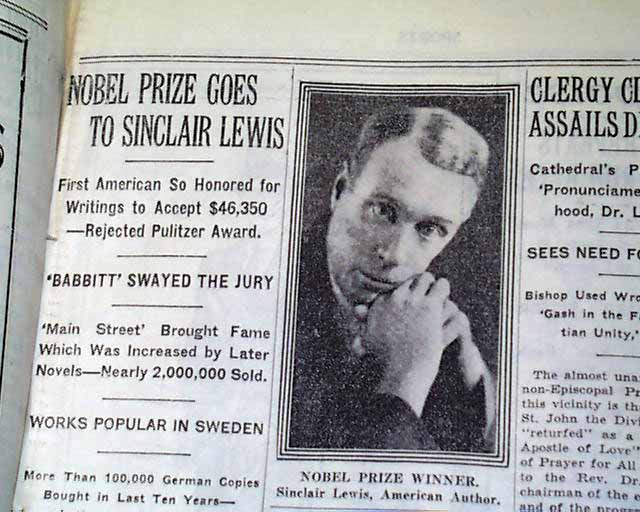
Lewis Receives Nobel Prize 1930

image001

December 10, 1930

“Sauk Centre’s Sinclair Lewis, who satirized small-town complacency and back-slapping boosterism in such novels as Main Street, Babbitt, and Elmer Gantry, becomes the first American to win the Nobel Prize for Literature in 1930.” *

Sinclair Lewis may well have had great insight into small town Midwestern life, but did he have a great outlook? Help me ponder this man and the impact of the Nobel prize on Minnesota and the outside world. What is the blessing of this event, and how could this impact future generations of those outside the immediate influence of cities and suburbs?

We give You thanks today for the life and writings of Mr. Lewis! We remember what he got right about the Midwest, and the authenticity of his observations. We commend to You the fact that his characters, even heroes, were a balanced with positive and negative characteristics; human just like us! Maybe even the boring middle of “Main Street” could have been a stylistic choice to emulate the stillness of a remote village. We give You thanks that, though critical, he still put the spotlight on the burgs, settlements, and unincorporated townships across Minnesota and the greater Midwest.

Conversely, we observe with You the things he may have overlooked, or gotten wrong. His critics find that “Main Street” is one of the most merciless novels in American history, and posit that it was motivated by revenge. Surely, he latched onto all that he saw as negative in Midwestern life in this story: narrow-mindedness, hypocrisy, and resistance to change.

Will You forgive his bitterness, and his literal and figurative children that chafe against a simple, small town life? Will You forgive his judgments based`on his intellectual intelligence that could not recognize the practical intelligence of farmers, housewives, and tradesmen? Truth be told, the Midwestern farmer, both then and now, cannot be a pushover in the brains department. He needs to know: agriculture, machines, weather, sales, and transportation. But further, he needs a tremendous work ethic and energy to get it all done! 

Did he misconstrue the common sense libertarianism of Main Street because he spent too many hours in the salons pondering Fabian versions of utopia H.G. Wells? What if these folks were resistant to change simply because they were content? Is it wrong to desire autonomy after being pushed, prodded, and starved out of Europe? What if the greater hypocrisy was on his part, and he was agitated by their inner peace? Forgive us all, Lord, where we have judged, or disrespected another’s pursuit of happiness. 

Will You be the balance of 61 Petty France, K Street, Wall Street, and Main Street? Will You temper our designs for contentment and advancement? Will You help us love and understand our small town neighbor? Will You take the judgments rooted in the false gods of education, culture, and elitism up, out, and onto the Cross of Christ? Will You remove their counter-judgments coming from outstate towards the cities of Minnesota? 

We thank You for the Nobel Prize of Sinclair Lewis. We thank You for all future writers that dare to go against the grain, to speak the truth as they see it. Will You give them a sense of humility as one’s with a louder voice? Will You bless the contentment of our citizens, wherever they live? We are all the recipients of Your eternal noblesse oblige!


Bless those who persecute you. Bless and do not curse.

Rejoice with those who rejoice; mourn with those who mourn.

Live in harmony with one another. Do not be proud, but be willing to associate with people of low position. Do not be conceited. Romans 12:14-16 NIV **

* http://www.mnhs.org/about/dipity_timeline.htm

** http://biblehub.com/romans/12-16.htm


Standard
20th Century, Architecture, Economics, History, Intercession, Judgment & Counter-Judgment Cycle, Minnesota, omnipresent history, poverty, Uncategorized, Unemployment

Unemployment and the Gateway District

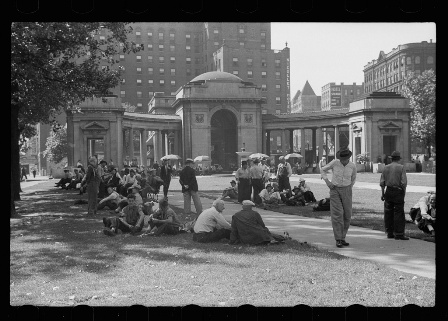
jshiffer_1323895792_vachongateway

1930 to 1935

“In the depth of the Great Depression, unemployed transients loiter in the Gateway district of downtown Minneapolis.” *

Many great cities are renowned for their entrances: Paris has the Arc d’ Triumph, India has the Buland Darwaza, and Jerusalem has the Golden Gate (Sha’ar HaRachamim). Minneapolis wanted to create a beautiful structure to welcome visitors into Minneapolis as they came from the train station. In 1915, the city built a gateway pavilion, flanked by curving colonades, that surrounded a Civil War memorial fountain and flagpole and pathway. Known as Gateway Park, the surrounding area adopted the title of the Gateway District.**The Gateway District of Minneapolis was centered at the convergence of Hennepin Avenue, Nicollet Avenue, and Washington Avenue.***

So, how did this this transition from fabulous to flophouse happen in the next two decades? Author David L. Rosheim did extensive research into the decay of this neighborhood in his book; “The Other Minneapolis or The Rise and Fall of the Gateway, The Old Minneapolis Skid Row”.****

“According to Rosheim, as unemployment rose, so did the hobo population. A new demographic of this drifter population was youth, driven away from home by poverty, or perhaps in pursuit of better opportunities.

Public relief rose drastically during this period. In 1930, an estimated $215,000 was spent on Minneapolis Poor Relief. Charities such as the Union City Mission continued to serve free meals if the visitor listened to a sermon. The Minneapolis City Council raised funds through bond issues to begin construction on public projects, in hopes of making a dent in the massive unemployment rate.” ***

What can be said about poverty that has not been said? What were the judgments of these primarily male vagabonds against Minneapolis, society, and themselves? What cultural transference resulted from the relationships in the Gateway District?

Will You bless both those who wish to beautify the public spaces of the city, and those who wish to make use of those places? Will You forgive the judgments of those who took too much pride in the sanctity of this park, and the judgments of those who take too little pride in themselves or their public conduct? We have failed You on both ends to see the message brought by those who have different motives than ours. Have mercy.

Will You forgive, where it applies, the pridefulness of the alcoholics, and addicts of this era? We are guilty of trying to solve our problems on our own, and have rejected the help that comes from being open to new relationships because we would rather hold onto our pain. When and where Minneapolitans have suffered foolishly rather than accepting kind and useful input into our bad choices; have mercy!

Will You forgive both the misogyny and misandry of the sex trafficking of this era? We have sexualized the need for touch, and have rejected true affection. We have chosen either to take money to submit to abuse, or pay money to be the abuser. 

We have judged the opposite sex falsely in the transaction of prostitution. Our men have wanted women for sex, but not considered them worthy of relationship. Our women have viewed men as incapable of love, so they might as well be an open wallet. Will You forgive the sexual sins that result in sex trafficking then, now and future?

Will You forgive the shame of these men for being poor and alone? The Great Depression was so very costly to many, and its pain lives in the false self assessment that we are what we do and own. Will You lift this pain and shame up, out, and onto the Cross of Christ?

Will You forgive “functional” society its judgments of these men, and this District? Many of us live under the premise; “it’s not what you know, but who you know.” This maxim recognizes the benefits of mutually beneficial relationships. But what is one to do when those relationships are gone, and basic trust of society is broken? Have mercy on our judgments of Your broken sons and daughters of the Great Depression, as well as their children, and their grandchildren. 

Will You forgive the “dysfunctional” portion of society its judgments of those outside the Gateway? A criminal or debaucherous subculture often makes a mockery of the culture of innocence and lawfulness. Will You forgive any defiance that took place in the geography of the Gateway District against the laws of Minnesota, and more importantly, the laws of the Only Just One? 

We ask Your blessing on Minneapolis, the former grounds of Gateway Park, and the Gateway District to replace the curses we’ve sown. Will You bless those in our state experiencing poverty of mind, body, spirit, and property to turn to You for help? Will You grant the spirit of gratitude to replace the spirit of entitlement? Will You help givers to be humble? Will You help those receiving charity to give respect and honor due to those who give freely? We invite You to be the Gatekeeper of Minneapolis! 

“It is not for kings, O Lemuel- not for kings to drink wine, not for rulers to crave beer, lest they drink and forget what the law decrees, and deprive all the oppressed of their rights.

Give beer to those who are perishing, wine to those who are in anguish; let them drink and forget their poverty and remember their misery no more.

Speak up for those who cannot speak for themselves, for the rights of all who are destitute.

Speak up and judge fairly; defend the rights of the poor and needy.” Proverbs 31:4-9 NIV*****

* http://www.mnhs.org/about/dipity_timeline.htm

** https://en.wikipedia.org/wiki/Gateway_District_(Minneapolis)

*** http://www.placeography.org/index.php/Gateway_District

**** Rosheim, David L. The Other Minneapolis or The Rise and Fall of the Gateway, The Old Minneapolis Skid Row. Maquoketa, IA: The Andromeda Press, 1978.

***** http://biblehub.com/context/proverbs/31-3.htm


Standard
20th Century, Americana, Architecture, Business, Energy, History, Intercession, Minnesota, omnipresent history, Uncategorized

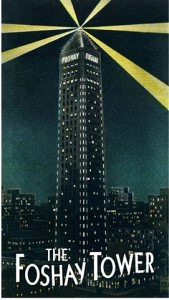
Foshay Tower 1929

Foshay_Tower_Poster-169x300


1929

“Wilbur B. Foshay builds a 32-floor headquarters for his utilities empire in downtown Minneapolis. The Foshay Tower is the tallest building in Minnesota for half a century. 

The stock market crash, scarcely a month after the tower’s dedication, puts an end to Foshay’s fortune and the giddy speculation of the 1920s. The next year, the tower is put on the auction block. There are no buyers.” * 

Foshay was a vigorous young man who started as a gas pipefitter and electrician. By 1916, he worked his way up to owning a public utilities holding company. (A holding company is created to buy and possess the shares of other companies, which it then controls.) *** “By 1928, he was a prosperous man, at least on paper. His company owned utilities in thirty states, the then-territory of Alaska, Canada, and Central America.” **

“Foshay built the Foshay Tower in Minneapolis, Minnesota, which opened in August 1929. In 1932 he was convicted of conducting a “pyramid scheme” with shares of his own stock. He was sentenced to 15 years in prison. President Franklin Roosevelt commuted 10 years from Foshay’s sentence, but Foshay only actually served three years in Leavenworth because of “good behavior.” President Harry Truman granted Foshay a full and unconditional pardon in 1947.” ****

What do You wish to say through Foshay’s tower story, Eternal Father? Let us listen and reflect with You, and more completely know Your heart. What is it that You affirm about this man and his age, and what is it that You wish to correct?

To begin, I see a man who started simply working hard in the field he loved; providing utilities. It seems to fit his character as an entrepreneur and a man of enthusiasm. Was it this same vitality that created the conditions for his downfall? 

Like Foshay, we are drawn to play to our strengths, but sometimes are blinded by our own glory. We lose our ability to harness our zeal, and do not operate with the self- control required to better use our giftings. Will You forgive Foshay the excesses of his spiritedness against Your will? Will You forgive us where we resist You today, not yielding an inch to be called out of the comforts of our best attributes if it means humbling ourselves before You or others? 

Conversely, will You forgive the judgements of Foshay’s detractors? Will You forgive any jealousies of his competitors in public utilities? Will You forgive those who modeled or endorsed the corrupt practices of his “pyramid scheme”? 

All of us, high to low, have fallen prey to greed at some level. Men like Foshay  inflate the value of their stock, bankers and politicians hide debt by devaluing currency, and the poor commit fraud against all kinds of social services overdrawing on the charity of society. We have negated fair rules and have sought a deck stacked for us and against our neighbor; have mercy!

  All of us, low to high, have taken the bait of envy. We have made ourselves look better than we really are, and have underscored the flaws of our equals to get ahead. Will You forgive us this debt to give honor back to our peers? Will You forgive our lack of gratitude for our competitors, or the awareness that You have uniquely positioned them (by Your wisdom) in our lives?

Regardless of internal motives, we acknowledge the work of Mr. Foshay, and the iconic tower still bearing his name. We are grateful that You understand us: whether we build empires with bad hearts, or have a poor work ethic with good hearts. We honor Your acceptance as the highest tower over our city. You are the Master Builder. Amen!

And then he told them this parable: “The ground of a certain rich man produced a good crop. He thought to himself, ‘What shall I do? I have no place to store my crops.’

Then he said, ‘This is what I’ll do. I will tear down my barns and build bigger ones, and there I’ll store all my grain and goods. And I’ll say to myself, “You have plenty of good things laid up for many years. Take life easy; eat drink and be merry.” ‘

But G-d said to him, ‘You fool! this very night your life will be demanded from you. Then who will get what you have prepared for yourself?’

“This is how it will be with anyone who stores up things for himself but is not rich toward G-d.” ***** Luke 12:16-21 NIV

* http://www.mnhs.org/about/dipity_timeline.htm

** An excellent summary of Foshay’s life by Britt Aamodt. http://www.mnopedia.org/person/foshay-wilbur-1881-1957
*** https://www.bing.com/search?q=definition+of+holding+company&form=APMCS1&PC=APMC

**** Excerpt from the Salida, Colorado museum where Foshay palyed a key role in the Chamber of Commerce after pardon. https://salidamuseum.org/history/wibur-foshay/

***** http://biblehub.com/context/luke/12-16.htm


Standard
20th Century, Agriculture, farming, Food, History, Minnesota, omnipresent history, Uncategorized

Canning Corn Innovation 1929

a57d7168-a41d-4bdc-805a-ba1f5352e8c3_d

1929

“Big Stone Canning Company introduces its Butter Kernel brand of whole canned corn. A local innovation perfects the process of cutting whole kernels off the cob, bringing canned corn to kitchen tables in addition to the creamed corn previously available.” * 

“Minnesota Canneries

Early settlers grew bumper wheat crops on south Minnesota’s fertile prairies, land that today supplies produce for a thriving 270-million-dollar-a-year canning industry.

Sweet corn canneries opened in Austin and Mankato in the early 1880s, followed soon after by similar factories in Faribault, Owatonna, and LeSueur.  Soon Minnesota’s canners were experimenting with new technologies and new products, and in 1903 the automated Big Stone Cannery Company founded by F.W. Douthitt changed the industry nationwide.  Douthitt’s plant in Ortonville had a conveyor system, mechanical corn husking machines, and a power driven cutter that produced the first whole kernel canned corn.  The Green Giant Company, introduced golden cream-style corn in 1924 and the first vacuum packed corn in 1929.

Corn is still the major canning crop in Minnesota.  The state’s more than thirty plants also freeze and can peas, beans, carrots, tomatoes, pork, beef, chicken products, and such unusual items as rutabagas.  Mankato was the site of the nation’s first carp cannery in 1946.” (text of highway marker WM2R64) **

The goal of canning fresh vegetables is long life. The problem with canning, if done or sealed improperly is disease and death. Success in preservation largely hinges on maintaining an airtight seal.

What was it like to be a farmer who knew he had a delicious crop of beautiful sweet corn, yet was at the mercy of the market and the railroad to sell before it spoiled? Surely they dreamed of a way to share this blessing that would take the pressure off to panic sell. How could they sell sweet corn all year instead of dumping all their crop in a few weeks?

F.W. Douthitt created a process that gave sweet whole kernel corn a long shelf life. He had an imagination that overcame the obstacles of the sweet corn industry’s woes. Further, he streamlined the process do a degree that it was affordable for all.

So we pray to the Lord, thank You for the gift of sweet corn to Minnesota! Thank You that You introduced this crop to Native Americans who introduced this crop to the world! We give You thanks for sharing the inspiration of hybridization with those who found varieties fit for human and animal consumption.

We give thanks for F.W. Douthitt and his gifts of processing corn to Minnesota and the world. We ask your blessing on him and his generations, both in his family and in the field of food processing. We thank You for the example of Your word that good business is in the service and betterment of our neighbor as well as ourselves. We thank You for the countless family farms that were saved because they had a new and local market to sell to!

Will You help us, like Douthitt, see our worthiness being part of the process? Open our eyes to the value any aspect of any job adds to the lives of our neighbors? Whether we grow something, chop something, can something, ship something, or design a better can, may we see and know Your pleasure in our labor? May we forever seek feed our neighbor that we too are fed!

Labor not for the food which perishes, but for that food which endures unto everlasting life, which the Son of man shall give unto you: for on him has God the Father set his seal. John 6:27 KJV ****

* http://www.mnhs.org/about/dipity_timeline.htm

** http://www.waymarking.com/waymarks/WM2R64_Minnesota_Canneries

*** https://www.butterkernel.com/our-story/

**** http://biblehub.com/john/6-27.htm


Standard
20th Century, Agriculture, Business, Food, Food Science, History, Intercession, Minnesota, omnipresent history

A Jolly Green Giant in MN

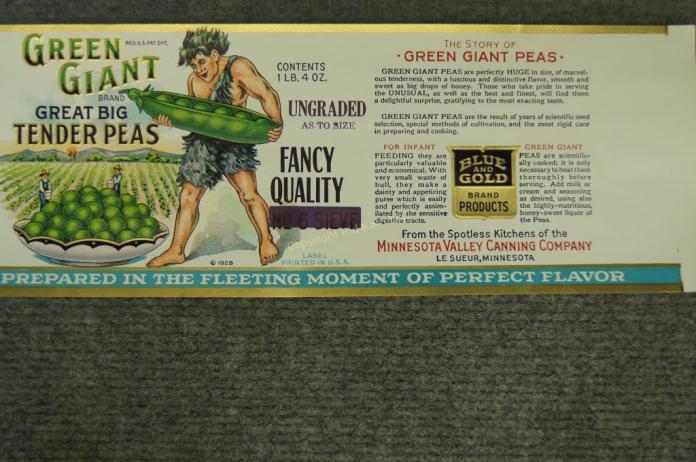
55813449

1928

“Described by Advertising Age as “a fugitive from a Grimm’s fairy tale,” a hulking green giant becomes the symbol of the Minnesota Valley Canning Company in Le Sueur. The giant gets jollier and more handsome as time goes on.” * 

To provide some backstory, the Minnesota Valley Canning Company was born of the collaboration of 14 merchants in LeSeur, Minnesota in 1903. They initially only sold Early June peas, but sought to market a new variety of a much larger and sweeter pea from England around 1925. “At the time, the company couldn’t legally trademark the name Green Giant to describe the peas, so they created a mascot named Green Giant and sold the new type of peas under that name.” **

We thank You for humble beginnings. We thank you for the vision of the originators of Minnesota Valley Canning Company; canning vegetables means more people can access them. We are grateful for the introduction of the “Green Giant” variety of peas to the diet of Minnesota and much of North America. 

We give You thanks for the technology of canning and vacuum packing! Canning existed long before the MVCC, Louis Appert of France by 1809 had invented a way of sealing cooked food in jars that fed their armies during the Napoleonic Wars.*** Yet, Green Giant would supply multitudes with vegetables that: kept for years, traveled well, were affordable, and quick to prepare. 

Further, psychologically and spiritually icons connect our heads to our hearts; we comprehend information and feel its’ meaning. We remember, Jesus Christ, that Your storytelling, parables, and use of imagery taught both the minds and hearts of mankind. For example, Jesus confronted the religious folks of his day and their masks. He confronted the idea of doing the right things with a wrong heart. 

“What sorrow awaits you teachers of religious law and you Pharisees. Hypocrites! For you are so careful to clean the outside of the cup and the dish, but inside you are filthy–full of greed and self-indulgence! You blind Pharisee! First wash the inside of the cup and the dish, and then the outside will become clean, too.” **** Matthew 23:25,26 NLT

So, we give You thanks for the humble tin can and its’ inner cleanliness. Will You clean us on the inside, too, so we don’t spoil quickly. We give You thanks for those farmers, packers, and owners who sought to serve their neighbors vegetables through a tin can made famous by a Green Giant! Amen!

* http://www.mnhs.org/about/dipity_timeline.htm

** http://mentalfloss.com/article/75472/11-hulking-facts-about-green-giant

*** https://en.wikipedia.org/wiki/Canning

**** http://biblehub.com/matthew/23-26.htm


Standard
20th Century, African American, Black History, History, Minnesota, omnipresent history

Credjafawn Social Club Forms

Unknown

October 16, 1927

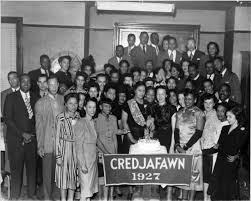
“The Credjafawn Social Club was formed the evening of October 16, 1927, by ten young adults who sensed the lack of social activities for persons in their age bracket. The name was devised from a letter out of each of the names of the ten charter members.” *

Although conceived as a social/recreational club, the Credjafawns initiated some outstanding projects of importance for the Twin Cities Black community—opening a cooperative food outlet and a credit union, offering college scholarships, and working to integrate hotels. **

What a pleasure to hear of this group of African-American teens committing themselves to each other, and in writing no less!?! How insightful of them to be proactive with their concerns and wants. They refused to be bored because they realized that they had the power to make and attain goals! 

We thank thank You for this example of covenant  (contractual) relationships in St. Paul. Your Word underscores the importance of covenant: Noahic, Abramic, Mosaic, Davidic, and Messianic. We remember Credjafawn today, and ask Your blessing on Minnesota’s teens to replicate such committed covenant friendships, then, now, and always. 

We thank You for their example to the ages! This group of young adults, at first, just wanted something fun to do and a group to do it with. We do not diminish the need or importance of fun. Perhaps it was this happiness and contentment, well ordained by You, that gave them the inspiration to better the lives of others? We commend to You their accomplishments: in providing healthy food through a co-op, in lending through their credit union, in impacting the marketplace through integration, and enabling higher education through scholarships! ***,****

G-d of Abraham, Isaac, and Jacob, we remember today that You, though G-d of gods, chose to commit in writing to human beings. Every commitment of friendship You have made to the human race has, is, and will be kept! We scarcely can entertain the thought that, though Infinite, You have humbled Yourself to relate to us so very personally. How do I grasp that the King of the Universe has committed himself in writing, to be forever remembered, to me?

Will You forgive us our preoccupation with ourselves? We are bowled over when we focus on the problems of society on our own. Will You forgive the fears, loneliness, and passivity of teens? Will You forgive us the parental roots of these sins, and our failure to have an answer for the longings of our youth?

Will You give us the grace to establish committed relationships? Will You give us the desire to live for the betterment of others? Will You remove our blindness caused by having so many focal points that we can’t see the one friend we can bless today? Will You bless Minnesota with Credjafawnic Covenants, so we also will bless our generations?

“Nevertheless, I will remember My covenant with you in the days of your youth, and I will establish an everlasting covenant with you.” Ezekiel 16:60 NASB******

* http://www.mnhs.org/about/dipity_timeline.htm

**”The Power of Education” by Patricia Anita Young. https://saintpaulalmanac.org/saint-paul-stories/people/the-power-of-education/

***”Commemorating Cradjafawn Co-op” by Matt Frank.  http://msmarket.coop/2018/02/commemorating-credjafawn-co-op/

****Credjafawn impact on the Rondo neighborhood of Saint Paul, MN. “Rondo Neighborhood, St. Paul” by Ehsan Alam. http://www.mnopedia.org/place/rondo-neighborhood-st-paul

*****”Five Great Bible Covenants” by David Padfield. http://www.padfield.com/2004/covenants.html

******http://biblehub.com/ezekiel/16-60.htm


Standard