20th Century, baseball, History, Intercession, Judgment & Counter-Judgment Cycle, Minnesota, omnipresent history, sports

Professional Baseball 1902: Minneapolis Millers and the St. Paul Saints

Unknown-1

images

1902

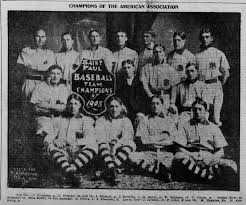
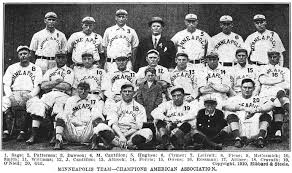
“The Minneapolis Millers and the St. Paul Saints join teams from six other Midwest cities to form the American Association. Baseball became the first professional sport in Minnesota back in the 1890’s.” * 

Thank You for this joining of teams to form the American Association! Specifically, thank You for the Millers and the Saints who saw the future benefit of this league. Thank You that we have enjoyed the freedom of association in this place for so long!

Thank You for the blessings of the sport of baseball: teamwork, diligent practice, exercise, and the fun and challenge of competition! Thank you for the comraderie grown here by the simple act of belonging to a team. Wow! That’s a big one! Every kid needs somewhere they belong, and to feel that they have something to contribute to the group!

Thank You that for the low entry cost of participation in baseball: a bat, a ball, and a glove. Thank You that success in this game is not dependent on physical attributes to the degree it is in other sports. Baseball players represent just about every body type: thick guys can hit the ball a mile, tall guys can stretch farther when they pitch, thin guys guy use their agility for fielding and stealing bases, etc. Thank You for the lack of contact in baseball, and the focus on sportsmanship and skill!

It is amazing to live in a place where a passion can become a career! These few teams believed in their sport enough to enable the dedicated to carve new occupations out of thin air. The notion of being paid to play a sport to the average Minnesotan three generations ago who lived and worked on a farm must have seemed new and strange.

May it always feel like a privilege to play professional baseball!

* http://www.mnhs.org/about/dipity_timeline.htm

**Complete record of the Millers vs. the Saints 1902-1960. http://millers-saints.com


Standard
20th Century, Conservation, Environment, Exploration, History, Intercession, Judgment & Counter-Judgment Cycle, Logging, Minnesota, Natural Science, omnipresent history

Minnesota Forest Reserve 1902

living-legacy

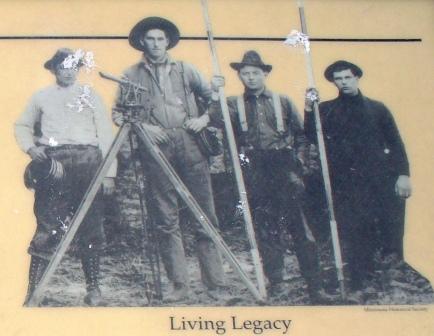
Surveyor Josiah A. King and crew.****

1902

“Conservationists win a long fight to establish a 225,000-acre forest reserve where logging will be supervised by the U.S. Bureau of Forestry. In 1928 the reserve’s name is changed to the Chippewa National Forest. 

One of the treasures of Northern Minnesota is an area of Chippewa National forest known as “the Lost Forty’. Actually, it is an area of 144 acres that were somehow missed by surveyor Josiah A. King in 1882. His three man crew faced chilling weather, slogged through swamps, and it is not unlikely they were missed in exhaustion.” *

“In 1882, a land surveyor by the name of Josiah A. King, and his three-man crew, traveled 40 miles from the nearest white settlement called “the Grand Rapids of the Mississippi.” For a month, canvas tents were their homes, and flour, pork, beans, and dried apples their rations. Josiah and his crew were finishing the last of three contracted townships in one of the first land surveys of Minnesota’s north woods.

As the November winds blew around the crew, they surveyed a six square mile area between Moose and Coddington Lakes. Perhaps it was the chilling weather, or all of the desolate swamps around them, but the crew became confused, and they ended up plotting Coddington Lake about a half mile further northwest than it was actually located. Josiah’s crew’s error is Minnesota’s great fortune.

As a result, these towering pines were mapped as a body of water, and the virgin pine in this area was overlooked by the hungry logging companies. Afterall, what logging company would want to pay for swamp land. This parcel of land became known as “The Lost Forty” and went untouched by loggers. It is now managed by the Minnesota Department of Natural Resources under their Scientific & Natural Areas Program.”**

Father, You have encouraged us to have places of rest, and even have commanded that the land should be given rest. Parts of the Pentateuch that are despised as being outdated, finicky, and overly legalistic by some are the same verses that declare a Sabbath for the land and animals. Scientists in the 20th century were able to confirm the wisdom of these books of “myth”. Elements and minerals in the soil are depleted by overuse; giving the land a rest actually increases yields in the long run. Again, You already made us this promise in antiquity, and science finally has caught up. 

Lord, I see the Chippewa Forest as a reflection of this heart of rest. Within this forest, the Lost Forty, are like a time capsule giving testimony to what existed in Your natural balance. Thank You for holy, set-aside places like these! Thank You that the error of the surveyors may well have been Your providence and plan to show off Your handiwork to their progeny.

We see what the forest could continue to yield if harvested within Your boundaries. Will You forgive the impatience demonstrated in the harvesting of these northern forests of Minnesota? Will You give wisdom and balance to those who have an interest in these forests, whether political, environmental, economical, or spiritual? Will You give us this day a reserve of energy, of time, of thought to relax with our Creator? Will You forgive us where we are resistant to solitude, to quietness, to contemplation of our lives in the state of Minnesota? Will You help us hear Your voice calling from antiquity, ‘Your harvest’s aftergrowth you shall not reap, and your grapes of untrimmed vines you shall not gather; the land shall have a sabbatical year.” NASB Leviticus 25:5 ***

* http://www.mnhs.org/about/dipity_timeline.htm

**http://www.minnesotafunfacts.com/minnesota-geography/the-lost-40-a-minnesota-forest-legacy/

***http://biblehub.com/leviticus/25-5.htm


Standard
20th Century, Crime, government, History, Intercession, Judgment & Counter-Judgment Cycle, Mayors, Minnesota, omnipresent history, Politics

“Shame of Minneapolis” 1901

por 12709 r2

January 1901 to February 1903

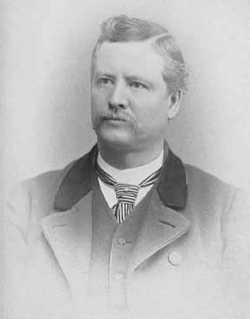
“Dr. Albert Alonzo “Doc” Ames served four terms as mayor of Minneapolis. His fourth term began in January 1901 and ended with his resignation in August 1902 after a grand jury exposed the corruption in his administration.

In January 1903 McClure’s magazine published an article by nationally-known muckraking journalist Lincoln Steffens**** on the fight against corruption in Minneapolis. The story focused on Mayor Ames’ regime and how the work of the courageous grand jury led to his fall. He was convicted of bribery in February 1903.” * 

 “Also, seek the peace and prosperity of the city to which I have carried you into exile. Pray to the LORD for it, because if it prospers, you too will prosper.” 

Jeremiah 29:7 NIV **

Minneapolitans in 1901-1903 may not have been “carried into exile” like the children of Abraham, but they likely felt that Justice abandoned them. What does one do, when their hometown becomes corrupt? Even more accurate, what response should the public have when their leadership targets them for abuse, and opens the doors of the city welcoming crime?

“Mayor Ames’ actions lead to the conclusion that he was single-minded in his pursuit of control, and hungry for bribery. He made his brother Fred chief of police. He fired law-abiding police and replaced them with unqualified and criminally-minded officers. He released criminals from jail. He accepted and encouraged organized crime of all kinds in return for payment.” ***

Lord, hear our prayer! Our forbearers failed to see the character of Mayor Ames, or those he appointed. Some of our citizens participated in activities that enabled corruption. Will You forgive these offenses? 

Will You forgive the lust that welcomed and expanded prostitution in the city of Minneapolis? Will You forgive us our willingness to objectify women? Will You forgive us our impatience to find sexual oneness and satisfaction apart from a real relationship? 

The “johns” have given themselves over to misogyny, and the prostitutes have given themselves to misandry in response. We have accepted money for the denigration of our bodies. We have divided our spirits with strangers. We have divided our minds by making judgements that it is fine to pay women for sexual abuse, and conversely, to accept sexual abuse in exchange for cash. Forgive us these misbeliefs that do not honor ourselves, others, or You. As Your child shown mercy for his own lust, I disinvite the misogyny and misandry welcomed into Minneapolis during Mayor Ames era, and invite Your Spirit to free us to accept ourselves as men and women, and so become able to love the other gender in the present and future.

Lord, we are also party to another form of misplaced affection; the love of money.       

Gambling is the expectation of reward apart from work. In it, we participate in the self-injurious behaviors of excitement addiction and greed. Work informs our character with persistence, delayed gratification, and the reward that we produce or are part of a team that gives something of worth to society. We stunt our own growth by believing we should get something for nothing.

Mayor Ames opened our city to this form of greed. Will You forgive those who have loved reward apart from work both past and present? As Your son who has been shown mercy for his own hatred of work, I disinvite gambling from the city of Minneapolis. I invite Your Spirit into our labor. Let us receive the gifts of character in store for us! Let us be glad in how our work gives and serves and benefits others! Let the innovations of our work in Minnesota bring a better life to all humanity, and be a reflection of Your Mind and Muscle! Will You be our unfailing Justice?

* http://www.mnhs.org/about/dipity_timeline.htm

**http://biblehub.net/search.php?q=jeremiah+29%3A7

*** http://en.wikipedia.org/wiki/A._A._Ames 

****An excellent article by Iric Nathanson about the man who brought Ames down; Mr. Lincoln Steffens. https://www.minnpost.com/politics-policy/2013/12/goodwin-s-bully-pulpit-spotlights-shame-minneapolis

***** How does gambling affects the brain? https://www.ncbi.nlm.nih.gov/pmc/articles/PMC2933850/


Standard
20th Century, government, Governors, History, Intercession, Judgment & Counter-Judgment Cycle, law, Minnesota, monopoly, omnipresent history, Politics, railroad, State Government

Van Sant Becomes Governor 1901

Unknown-1

January 7, 1901 to January 4, 1905

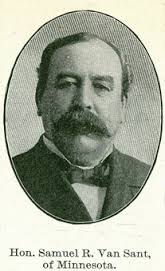
“Samuel R. Van Sant takes office as the state’s 15th governor on January 7, 1901. He began his career as a riverboat builder on the Upper Mississippi. As Minnesota’s fifteenth governor, he led the fight to brake the runaway powers of the railroads.” * 

Read an excerpt of what it meant to be a “trustbuster” in his era?

“The second was the establishment of the State Board of Control to take on the railroad monopolies. The old riverboat captain didn’t have much love for his main competition on the iron rails. He particularly detested the Northern Securities Company run by James J. Hill and J.P. Morgan. The jovial riverboat captain turned out to be a very determined trustbuster. Van Sant’s battle soon turned into one of the biggest court dramas to ever come out of Minnesota in this suit to dissolve the Hill-Morgan railroad monopoly. He soon won the backing of President Teddy Roosevelt under the newly passed Sherman Antitrust Act. In 1904 the Supreme Court, by a vote of 5 to 4, upheld the determination that the Northern Securities Company was an illegal restraint of trade and the trust was broken up.” **

Father, thank you that Van Sant fought the monopolist powers of Minnesota in his term. His experience with the Northern Securities Company underscores an achilles heel of free markets; highly successful companies may eventually eliminate the competition in their fields and form monopolies or oligarchies. The most sought after form of land transportation of the North Star state was controlled by just two men; James J. Hill and J. P. Morgan. 

You have given us clues in the Bible regarding property rights and ownership. Tribal allotment of specific geographic territories are described in the book of Joshua. All  descendants of the sons of Jacob had land based on birthright. Land could be bought and sold, more like leased, but only for a fixed number of years until the Jubilee.

The Year of Jubilee described in Leviticus 25:8-13 is a year of pardon, for personal sins, debts, release of slaves, and a return of tribal property. So, we currently practice ownership of property, but do not have a system for forgiveness whether personal, labor, or property-based. Some may argue that bankruptcy fulfills this role, but is incomplete when compared to the model of the Pentateuch.

Although the Supreme Court upheld the position of the people regarding the railroad monopolies, we have no universal reset button for society like You describe! How do we enact Your standards in modern society? We hold property, but are not tied to specific geography on the basis of our tribes unless we are Native Minnesotans. We are disconnected from the land, and from each other! Is it because there is so little forgiveness in our modern system based not on wealth, but debt? 

That said, Merciful One, do not let us be vain towards the successful, or return shrewdness with the counter-judgment of punishment! Will You forgive Minnesota its bitterness towards Morgan and Hill, and their company? Will You forgive them their “drive to power”? Most cannot relate to the unchecked influence of men like Morgan and Hill, but perhaps they can relate in a smaller way. If we have the power to change everyday situations in our favor, will we use it? Or misuse it? 

Father, will You forgive us when we look expectantly and only to our system for justice? We are vapors that dissipate in a day! You are the only unchangeable personality in the universe. You are self-content and not subject to bribery. Your integrity allows us to enter into justice if we are open to self-examination as well as other-examination! 

* http://www.mnhs.org/about/dipity_timeline.htm

**Tuma, John. “Let’s Not Go Backward.” Conservation Minnesota March 2012 Web. 22 Jun. 2013. http://www.conservationminnesota.org/news/headlines/lets-not-go-backward/

*** More flavor on Governor Van Sant? https://www.nga.org/cms/home/governors/past-governors-bios/page_minnesota/col2-content/main-content-list/title_van-sant_samuel.default.html


Standard
19th Century, 20th Century, History, Intercession, Judgment & Counter-Judgment Cycle, Logging, Men, Minnesota, omnipresent history

Lumbering Maximum 1900

Unknown

1900

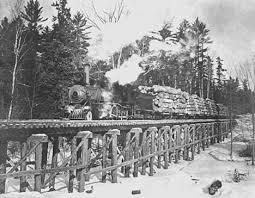
“At the height of the lumbering era, 40,000 lumberjacks are cutting timber in the north woods. Minneapolis is the sawmill capital of the world, cutting enough lumber to fill 65,000 freight cars. But Minnesota is running out of pine; within twenty years the lumber industry will be dead in Minneapolis.” *

This interesting oral history by Jim and Bernard Pearson describes the day-to-day lives of the men logging in Northern Minnesota during this era. 

“The Pearsons showed their audience old tools of the logging camps.  There was the pickaroon the camp blacksmith made from a worn-out ax which was used to pull logs by hand.  There was also a grub hoe for removing brush by hand, a broad as to square up logs for building log structures, a cant hook for turning logs, and a come-a-long for lifting logs by hand.

The cutting of the logs was done in the winter when sleds could be used to pull the logs from the woods to a river to float them downstream to a sawmill in the spring when the water ran fast.

Loggers didn’t rely just on the frozen ground to sled out the logs, according to the Pearsons, but constructed troughs of ice for the runners.  The troughs were made by hooking a plow to the side of a sled to make troughs in the snow in which water was poured to form ice.  These troughs had to be continuously built up throughout the winter, the Pearsons said.

The Pearsons also talked about the care of horses, which were vital to the logging.  Jim told how some of the loggers would carry a ballpeen hammer to tap snow out of horseshoes.

“My uncle especially loved animals, and his horses were very big,” Jim recalled.  “If any teamster (driver) mistreated his horses, they went down the road (were fired) so fast they didn’t now what happened.”

(Jim) described the lumberjacks as hard working and very honest individuals, who had always given their best. But Bernard, during the interview last week, also portrayed some of the lumberjacks and logging camp operators as not so honest.

Bernard said, for example, that in the worst camps, the operator would hire someone to gather up workers for the winter season that included dropping a knock-out pill into a man’s drink in a saloon.  “The next thing the man would know he was in a logging camp way up north,” said Bernard.  “There were rascals on both sides.” “ **

Father, a lot of time and thought has gone into recording the history of the wealthy and powerful “lumber barons”, but it seems not much is known about the men who actually did the work. Will You guide the author into the stream of Your thoughts on the subject? Will You give us a new frame of reference for these Minnesota loggers, and the effect of this massive harvest of trees?

As for the workers, the physicality of their respective jobs inspires awe: cutting huge trees down by saw or axe, squaring logs by hand, loading them on sleds, and moving them to the river. Once at the river, prepped logs were managed on their journey south by the “river pigs”. These were crews of men men who were responsible to float the logs to their proper destination at a plethora of sawmills. 

As with many things, logging seems simple in principle, but requires incredible endurance, skill, and risk in practice. Eternal Father, will You honor those who poured their soul into this labor? Will You remember their broken blisters, and aching backs? Will You remember those who took joy in working outside, all day, in the numbing cold? 

Will You bless them and their inheritance from this era, to the present, and on to the future? 

Another thought, men often feel validated in their masculinity by performing an epic task together. They sail into the unknown, each man privately harboring reservations, but going beyond those self-imposed limitations by the strength that comes when men are part of a team. Lord, thank You for past loggers’ example of this teamwork. Will You strengthen the bonds of men, and forgive us for emasculating our brothers?

In the present, we may sit in judgement of these people for their contribution to exhausting magnificent forests through clear-cutting. “What were they thinking? Didn’t they know they were acting like shock troops executing millions of innocents? Why would you kill mother earth over a job?” However, we have the historical vantage point of witnessing that natural resources can be used up, and that human interaction with the environment may yield unseen and unintended consequences.

As a witness to such present attitudes, the author wishes to address with You our use of the term “exploitation” as it applies to past Minnesota logging. Will You forgive us the casual use of this label? Will You forgive us if we unfairly apply present environmental and economic standards on our forbearers? Will You forgive our common humanity in Minnesota of viewing Your forests, that You graciously allow us rights of temporary stewardship, as “our forests” or “our property”? We do not often think of property rights as a continuum of which we are a temporary subset. 

Truly, we all are parties in “exploiting” Your forests! We breathe air daily! We live in houses of wood. We write with pencils of wood on paper of cellulose. We use toilet paper, and simultaneously write graffiti on the walls criticizing the “exploiters” of the environment! We apply standards to others that we do not apply to ourselves! We fail to see the log in our own eye, and browbeat others about the speck of sawdust in theirs! 

Furthermore, contemporary history does not often enter the mindset of these predecessors. Perhaps in their age, in the late 19th and early 20th centuries, people exercised a different logic than ours. They had a much stronger sense of agriculture than those who buy 2×4’s at the lumberyard, or food from a grocery store. If they wanted food, they had to plant it, tend it, and harvest it. 

When their corn reached fruition, they harvested it, and took everything. When they saw forests full of mature trees, they brought in the harvest. Is it possible that they trusted that such a generous yield would surely supply their generation? 

In the life experience of most of these workmen, most commodities gathered locally were used locally. Is it possible that such workmen did not conceive of the national or international cravings for the White Pine of Minnesota? Were the men working in these logging camps aware that they tree they just felled was to become a floor joist in an English factory? If they were aware, did that make their labor’s reclassify from “sustainable” to “exploitive”? Hear my questions, Lord, and forgive us all our attempted harvests without Sabbaths of Your forests!

* http://www.mnhs.org/about/dipity_timeline.htm

**  Stottrup, Joel. “Logging White Pine.” Princeton Union-Eagle, May 1993. Web. 20 June 2013. http://www.baldwintownship.govoffice.com/index.asp?



Standard
18th Century, 19th Century, 20th Century, 21st Century, African American, Anglican, Canada, Christian, education, Evangelism, Great Britain, History, Indian, Intercession, Jesus, justice, Lutheran, Minnesota, Native Americans

Church Missionary Society founded in Minnesota

images-2

August 25, 1851
“The Church Missionary Society for Minnesota was founded on August 25, 1851.

G-d, I’m not entirely sure which Church or who composed this society, but most likely it was the work of Josiah Pratt who dedicated his life to reach the ends of the earth with the Gospel. Minnesota Territory, in this context, qualified as the extremity and meeting place of Western civilization and North American Native cultures. The Society reached out to Canadian and Midwestern First Nations through a branch known as the North West America Mission. **

Please read and enjoy this brief summary of the Church Missionary Society and it’s profound impact on the 19th Century.

“Our story began more than 200 years ago with a group of Christians whose hearts were stirred to put their call into action.
This group included people like William Wilberforce, John Venn, and John Newton. Together they worked to abolish the slave trade, they fought for the rights of oppressed people at home and they launched out on dangerous seas to share Jesus with the world.
The effects of their efforts – as well as the work of thousands of men and women who have followed in their footsteps – are still seen and felt across the globe today.

A brief history of Church Mission Society
The Society was founded in Aldersgate Street in the City of London on 12 April 1799. Most of the founders were members of the Clapham Sect, a group of activist evangelical Christians. They included Henry Thornton MP and William Wilberforce MP. The founders of CMS were committed to three great enterprises: abolition of the slave trade, social reform at home and world evangelisation.

Wilberforce was asked to be the first president of the Society but he declined due to his workload but took on the office of vice president. Thornton became the first treasurer. The Rev Josiah Pratt, curate of St John, Bedford Row (London) soon emerged in a proto-chief executive role.

The spiritual background to the emergence of CMS was the great outpouring of energy in Western Europe now called The Great Awakening. John Wesley, an Anglican priest and failed missionary, became a key player in the UK version of the story. Not all those influenced by the revival left the Anglican Church to become Methodists. One such was John Venn, the saintly rector of Clapham.

Members of the second and third generation following the revival saw many opportunities to consolidate its effects. Alongside the main Clapham agenda they sponsored Sunday Schools for evangelism and education, founded Bible Societies and much more.

The Reformation and the abolition of monasteries and religious orders left the Church of England without vehicles for mission, especially for outreach to the non-Christian world. This new membership society agreed to be loyal to the leadership of bishops and an Anglican pattern of liturgy, but not dominated by clergy and emphasised the role of laymen and women. Much of what we call the Anglican Communion today traces its origins to CMS work. However CMS today is not confined just to Anglicanism, both in terms of people it sends out in mission or ally agencies and projects around the world.

It was expected that Church of England clergy would quickly come forward to be missionaries. When this didn’t materialise CMS turned towards mainland Europe and the earliest missionaries were German Lutherans. For over a century CMS enjoyed rich work relations with the Churches and seminaries of Western Europe. Sadly this was gradually eroded as the European superpowers vied with each other in the race for colonial expansion. Even so we can say the 20th-century quest for Christian unity began through the experience of mission.” **
G-d, regretfully I haven’t yet located primary sources for the founding of CMS in Minnesota Territory, but I thank you for it. May the full number of Minnesotans see You in all Your beauty, and know and fulfill the mission you have created for them! May we follow in their paths to abolish slavery, take just and practical actions to better our State, and give away the happy news of the Gospel; Jesus loves us, wants us, forgives us, and helps us practice living free! Forgive our purposeless living! Forgive our fears of chasing the Wild Goose! (An ancient Celtic image for the Holy Spirit.) May we be blessed to fly, and under Your authority serve to heal all nations!

http://www.mnhs.org/about/dipity_timeline.htm
** “The Church Missionary Atlas (Canada)”. Adam Matthew Digital. 1896. pp. 220–226. Retrieved 19 October 2015.
*** https://churchmissionsociety.org/about/our-history/

Standard
19th Century, 20th Century, 21st Century, Faith, History, Indian, Intercession, Minnesota, Native Americans, Treaties

Treaty of Mendota

0_0_3236_5041

August 5, 1851
“In August the commissioners begin negotiations with the Lower Bands at Mendota. The Mdewakanton and Wahpekute are pressured into agreeing to terms similar to those forced on the Upper Bands, including $220,000 in upfront cash to the fur traders. Both treaties promise the Dakota new reservations along the Minnesota River “in perpetuity,” a pledge that will not be kept.” *
Lord, forgive the human desire to ‘work the system’ and pad our own nests! Will You forgive this heinous offense of the fur traders towards the Mdewakanton and Wahpekute within the Treaty of Mendota? Even greater, will You forgive this breech of justice committed against You through the deception of these two tribes?

Per contra, will You forgive the shame and anger of the Mdewakanton and Wahpekute towards: Lea, Sibley, Ramsey, Minnesota Territory, the U.S. Bureau of Indian Affairs, the U.S. Federal Government, and all unnamed parties participating in their deception? Sweet Jesus, it’s always so hard for the victims of injustice to let go of their righteous anger; will You give this gift to the Mdewakanton and Wahpekute Nations? Will You kindly and gently take this generational curse which has bound them to their historic offenders up, out, and onto the Cross of Christ? Will You restore what the enemy has taken from them, and bring Your Healing Presence to the peoples and lands involved? This land is Your property, may we view it as such both now and “in perpetuity”!

We, in the present, are angered by the deception of the Upper and Lower Dakota Bands at the hands of Luke Lea, and Alexander Ramsey through the trustful signing of the “Trader’ Papers”!!! The desire to disconnect ourselves from this event is powerful, yet Your Word gives us no escape when we offend You by accusing our neighbors. You do not yield the spirit of the law to comply with the letter of the law. You are both Grace and Truth! Help us remember this example spoken to self-righteous human accusers so many centuries ago?

“They said this to test Him, in order to have a basis for accusing Him. But Jesus bent down and began to write on the ground with His finger. When they continued to question Him, He straightened up and said to them, “Let him who is without sin among you be the first to cast a stone at her.” Berean Study Bible, John 8:6-7 **

Will You give us the merciful eyes of Christ today, and into the eternal future of Minnesota? Help us see the humanity within victim and victimizer, the accuser and the accused, and to stand humbly with You against evil and for the good? May we become agents of humanity against the division and deception of the Evil One; the Author of All Grudges. Amen!

http://www.mnhs.org/about/dipity_timeline.htm
** https://biblehub.com/john/8-7.htm

Standard