19th Century, Agriculture, farming, Food, History, Intercession, Minnesota, Natural Disaster, omnipresent history, Science

Rust Plagues Crops 1878

unknown

1878

“Rust, a parasite growing on barberry bushes brought west by settlers, severely damages wheat crops. Later epidemics of wheat rust lead to the outlawing of barberry bushes in 1918.

Epidemics occur again in 1904 and 1916 before the state outlaws the culprit carriers. The problem is eradicated over the next decades through the efforts of “Barberry Bees,” organized to dig up bushes, “Rust Busters Clubs” in schools, and bounties paid for reporting barberry in the 1940s.” *

Some days it is burdensome to read chapters of history like the Rust Plague. It feels like human perception of reality, myself included of course, is a one-trick pony. We fail over and over to see cause and effect relationships though surrounded with personal and practical examples.
When confronted with the tragic, we react with externalizing our pain. “It must be someone else’s fault that I have this problem”, we say to ourselves. Moreover, You are a convenient target for our misuse or overuse of natural resources.
Creator of All Nature, this is the ray of light I see in this Rust Plague; eventually the curious among us found a relationship. We found that transporting plants, namely berberis vulgaris, from their origins resulted in creating an undesired effect when they reached our desired destinations.** We loved progress, but lacked the knowledge and wisdom to enact it in this case.

Lord, was there something to this parasite outbreak other than nature? I believe that You are far more merciful to us than our sins deserve, but simultaneously maintain justice and enact wise judgments. You remain in perfect balance; neither favoring grace or truth. Our separation from You and our fellow man has its consequences. I can think of several events that happened in this time frame that caused massive unrest:
the creation of the Federal Reserve -1913
the negation of the Nicaragua Canal
the first foray into US nation-building that created the nation of Panama
the opening of the Panama Canal – 1914
sinking of the Lusitania – May 7, 1915
Poncho Villa raids US – 1916
President Wilson commits our troops to WWI, in spite of his campaign promise; “He kept us out of the war.” – 1917
Wilson “14 Point of Peace” – 1918
and extensive upheavals between labor and the industrialists.
Lord Jesus, will You enter into this chapter of our history again? Will You, by Your kind Holy Spirit, point out offenses that we may have made towards You? Did we curse the ground, or more specifically the wheat crops of Minnesota? Were You just maturing us to trust You in difficult times? Was a disease necessary to place nature in proper balance?

Jesus, please forgive us any root judgments that contributed to the rust epidemic. Will You heal our land and our hearts, to receive You where our ancestors may have missed You? Will You make us capable of self-examination, observant of our surroundings, and shield us from the temptation to only look for external targets of our wrath and blame rather than responsibility, reason, and relationship?

*P.T.H. cites timeline formerly at this URL: mnhs.org/about/dipity_timeline.htm
The Minnesota Historical Society Web site, http://www.mnhs.org , is fantastic! Check it out! Images are from https://images.google.com/?gws_rd=ssl; again, an amazing resource!

**https://www.ars.usda.gov/midwest-area/st-paul-mn/cereal-disease-lab/docs/barberry/barberry-situation-past-present-future/


Standard
19th Century, education, Governors, History, Intercession, Minnesota, Natural Disaster, Social Studies, State Government

Pillsbury Becomes Governor

george_alfred_pillsbury


January 7, 1876 to January 10, 1882

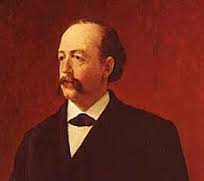
“John S. Pillsbury became the state’s 8th governor. As Minnesota’s eighth governor, Pillsbury was a practical and compassionate administrator, finally resolving a sensitive railroad bond issue and increasing aid to those ravaged by the grasshopper plague. He also encouraged legislators to create the office of public examiner to detect and purge corruption in public office.” * 

Lord, thanks that You have chosen to spread Your gifts out among us so we are aware of our need for each other! Thanks for John S. Pillsbury and the benefits of his governorship.  It appears that he was skilled in mediation and negotiation. Will You forgive the bitter roots that come from even his best negotiations? 

Will You again kindly watch between the railroad interests, ( or any major future economic power), and the people and Minnesota? Will You forgive  us when we expect the State to rescue us, and do not see the provision that You have for us? Will You sanctify the suffering caused by: the grasshopper plague, the corruption of the government, and the dominance of the railroads? Forgive us our flippant and well-forged assessments as we forgive our assessors!


Standard
19th Century, Agriculture, Business, farming, Food, History, Intercession, Minnesota, State Government

Bonanza Farms 1875

423478855

1875
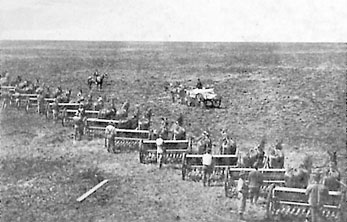
“Investors grow wheat on a grand scale in the Red River Valley. Their “bonanza farms” cover thousands of acres and are harvested by huge crews and the latest machinery.
A financial panic in 1873 stopped the construction of the Northern Pacific Railroad to the Red River Valley. In order to pay back its Eastern investors, the bankrupt company allowed its investors to exchange their bonds for land. As a result, large urban investors immediately became owners of thousands of acres of land (unlike homesteaders who had to live on the land for five years to get 160 acres). The new owners turn the land into large-scale commercial farms run by hired managers with cheap labor and expensive machinery.” *

Lord, You hate corruption of any sort in any relationship. “The LORD detests dishonest scales, but accurate weights find favor with him.” Proverbs 11:1** This Panic of 1873, again at the hands of the railroads under federal authority, really stole land from the homesteaders. (The principle of sowing and reaping? The homesteaders just years before may have been party to land being swindled from the Dakota.) Anyway, we are people capable of both sharing and defrauding land from our neighbors.

Will You forgive us this debt? Will You cause restoration and repentance to grow in the heart of this State and Nation? Will You forgive Minnesotans’ resentments against the Federal Government? Will You forgive the Railroads for manipulating the Panic of 1873 to their benefit? Will You remove this curse from our land, skies, waters, and hearts? Thank you that You deal with us in such a generous manner!

http://www.mnhs.org/about/dipity_timeline.htm
**http://biblehub.com/proverbs/11-1.htm


Standard
19th Century, Agriculture, farming, Governors, History, Intercession, Jesus, Leadership, Minnesota, Natural Disaster, Politics, State Government

Cushman Becomes Governor

unknown

January 7, 1874 to January 7, 1876

“Cushman K. Davis takes office as the state’s seventh governor. During his single term as Minnesota’s seventh governor, Cushman K. Davis confronted a menace that threatened to ruin the state’s farm economy. A five-year-long grasshopper plague began in 1873, and Davis’s offer of aid to farmers whose crops had been devoured by invading locusts represented an early form of state-sponsored disaster relief.” * 

“The state, governed by three different men during the grasshopper plague years, also failed to provide adequate relief to affected farmers. Under governors Horace Austin and Cushman K. Davis, the state provided small sums of direct, state-funded relief, but the governors focused their efforts on encouraging charitable giving to the cause. Unlike his predecessors, Governor John S. Pillsbury did not call for any direct, state-funded relief for farmers. Elected in 1876, Pillsbury believed that poverty was a fact of life on the frontier and that providing relief would make farmers dependent on the state. Instead, Pillsbury focused on efforts to eradicate the grasshoppers. This included a controversial bounty measure that required every able-bodied man in affected counties to destroy grasshopper eggs for one day a week, for five straight weeks.

In the summer of 1877, the grasshoppers left just as quickly as they had arrived. An April snowstorm damaged many of their eggs, which encouraged farmers to redouble their efforts to destroy the grasshoppers. The surviving grasshopper eggs hatched, but by August, the grasshoppers had flown away. Many attributed the end of the grasshopper plague to divine intervention, since Governor Pillsbury had proclaimed April 26 a day of prayer, after receiving many requests to do so.” **

I’m first thunderstruck by two facts jumping off the page at me: that Cushman spearheaded state charity, and that a day of prayer is recorded as an action point. Will You guide me to ponder these notions? Will You give some insights as to how to intercede?

To the first point, it seems quite unusual for a Republican of this era to use state-funded relief. Cushman appears to be a man of principals, but not so rigid that he fails his constituents during such dire times of need. Will You bless him, and his commitment to the survival of his fellow man? Will You keep balance in this constant teeter-totter of public versus private charity within the souls of our leaders? If taxes were gifts, we would give them for Christmas. If charity is coerced, the heart disengages, and it no longer is charity but, perhaps, extortion. Have mercy on our “mercy”! 

It’s curious to me that politicians sometimes endorse prayer as an action point. Many leaders currently would see the endorsement of prayer as a failure to adequately separate “Church and State”. (Help me probe this a little longer!) Yet we condition our minds and spirits through repetitive thoughts daily; we listen to songs over and over, view movies again and again, and repeat instructions internally to project us past sales objections. (I know these are quite random, but perhaps they are also a form of prayer?)

I’m grateful to You, the masterful inventor of every grasshopper, for Your beautiful destruction of our security. Will You forgive our barriers to seeing the heart and mind conditioning, (aka “prayer”), as a legitimate response to the plagues of our lives? Will You make us flexibly rigid in our principals enough to love our neighbor as they experience heartache and misfortune?

** https://www.minnpost.com/mnopedia/2013/06/winged-menace-minnesota-grasshopper-plagues-1873-1877


Standard
19th Century, Agriculture, Architecture, Business, Civics, Energy, History, Industry, Intercession, Labor, Minnesota, Mississippi River

Industry at St. Anthony Falls 1872

640px-Stanthonyrecession.jpg

1872

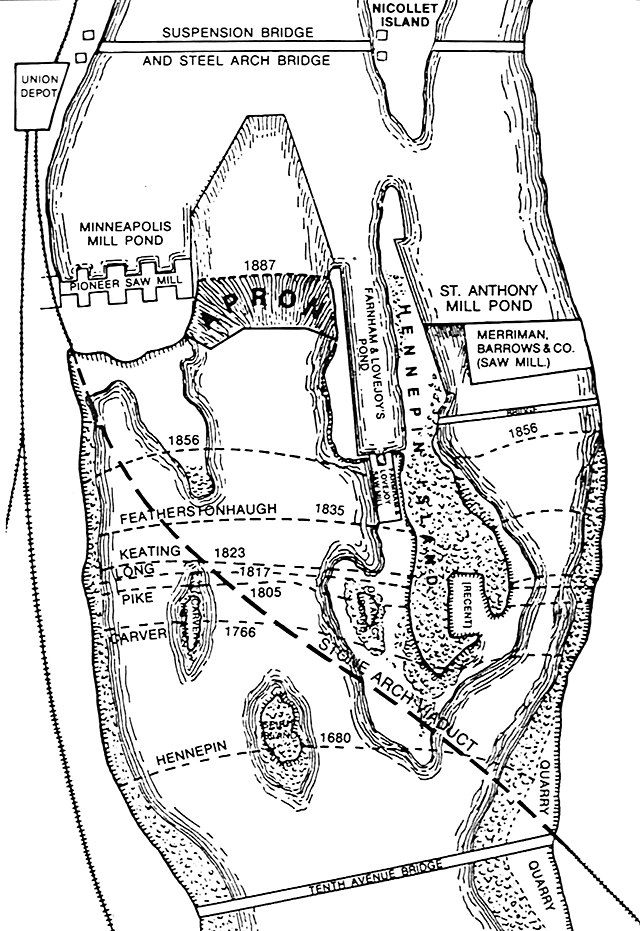
Minneapolis industries cluster around the power of St. Anthony Falls. The Minneapolis Board of Trade estimates that the 95 waterwheels at the falls produce 6,000 horsepower.*

Lord, thank You for the gift of the Mississippi and those who harnessed its power. Thank You for the individuals and groups that contributed to its’ planning and investment? You work through those who skillfully manage money! Will You bless the entrepreneur? You work through those who take major risks to create business?

Too often we are guilty of failing to properly acknowledge the reflection of Your glory through the wonderful skills of tradesmen and women! Do You enjoy watching your people build? Will You bless these and their generations’: the cement worker, the engineer, the steel worker, the electrician, the riggers, the teamsters, and any other who labored on these projects?

Lord forgive us the sin of loving ‘science’ while simultaneously negating your creation. You had a plan for this city far before we began to envision what was possible. You created many electrical systems as well as the principals of hydraulics and physics in nature long before we were alerted to their existence.

How many more mysteries do You have to reveal to us? Forgive this root of ‘scientific pride’ in Minnesota. Will You replace it with humility and eternal curiosity that makes us better stewards of Your creation, technological advancement, and more receptivity to Your ideas?

*P.T.H. cites timeline formerly at this URL: mnhs.org/about/dipity_timeline.htm
The Minnesota Historical Society Web site, http://www.mnhs.org , is fantastic! Check it out! Images are from https://images.google.com/?gws_rd=ssl; again, an amazing resource!

Standard
19th Century, Agriculture, Business, Current Events, Energy, farming, Food, History, horses, Intercession, Medicine, Minnesota, Natural Disaster, Transportation

Energy Crisis 1872

unknown

1872

“Epizootic fever strikes horses throughout the Midwest. The three-month sickness plunges horse-powered Minnesota into its first energy crisis.” *

I need to let this one simmer for a bit; “the three-month sickness plunges horse-powered Minnesota into its first energy crisis.” It’s hard to relate to this not-so-distant past when “horse-power” really meant the labor of a workhorse. I believe it was as late as W. W. II  when the majority of Minnesotans still lived on farms, and felt this connection to living “horse-power. (I still need to let this steep.)

There’s something good about the connection between human and horse. Your draft animal as a precious commodity, means of production, and even friend?! A car with a face? A tractor with a face? A companion who saw the same sights, and explored the same paths as its master?

Below is some documentation of the breadth and width of this epizootic fever.

“Beginning in Toronto, Canada, in the late summer of 1872, in only three days the disease hit nearly all the livery stables and the horses used to pull streetcars in that city. By mid-October, horses in all of Canada, Michigan and the New England states were infected. By the beginning of November the disease had spread to Illinois, Ohio and South Carolina. By the end of the month, Florida and Louisiana reported cases.” **

Holy Spirit, today I remember the I remember this equine flu epidemic of 1872. I accede to You in the relationship between the suffering of animals and the people of this state. I acknowledge the contribution of veterinarians to the well-being of these individual animals, and indirectly to our state.  

Will You forgive us any judgments made against Your goodness or holiness because of this chapter of epizootic fever?  You care about each detail of our lives, and of each creature in Your world. We give You thanks for these horses past, and sincerely thank You for Minnesota’s present stock. We ask Your blessings on each colt, filly, mare, stallion, bronco, foal, and gelding that will walk the North Star state in perpetuity!

** http://www.heritagebarns.com/the-great-epizootic-of-1872/#.V9s-fmPSfVo


Standard
19th Century, Civics, Democrat, Governors, History, Intercession, Leadership, Minnesota, Politics, Prayer, railroad, Republican, State Government

Austin Becomes Governor

candidate37119

January 9, 1870 to January 7, 1874
“Horace Austin takes office as the state’s sixth governor.

A reputation for clearheaded objectivity and disdain for contentious party politics enhanced the appeal of Judge Horace Austin as a gubernatorial candidate in 1869. Minnesota’s sixth governor was determined to bring legislative power to bear against the railroad barons. His advocacy of strictly regulated passenger and freight rates and his opposition to the wholesale allocation of state lands to railroad development earned him a second term. But he was unable to resolve completely the problems inherent in controlling a booming transportation industry and curbing the excesses of its owners.” *

Lord, thanks that You are our shield! To my knowledge, our people have suffered much through the over-reaching hands of the railroad. (Especially the farmers!) Thank You for providing a governor that would stand up to these barons; even if partially successful.

Will You forgive the judgements between us all: Minnesotans’, the railroad barons’, the U. S. Government, and our state government? We know that You have told us in Leviticus 19:35,36 to use “honest scales and honest weights”. Because You have forgiven us our debts, we forgive the numerous injustices perpetuated by all railroads, their employees, their owners, financiers, and any other party unnamed that have been bound in this unforgiveness.

Will You return us to a right relationships from where they skewed off in Austin’s term? Will You restore the lands that have been cursed through the contention between Indian Nations, citizens, and the railroad companies? There’s enough freedom for all in Your kingdom; help us to receive and give honor and freedom to our neighbor today! Thank You that Governor Horace Austin looked for solutions between the Democrats and Republicans! May we have more Governors and leaders like him who see and think in the areas of our common humanity. Amen!

* http://www.mnhs.org/about/dipity_timeline.htm


Standard
19th Century, Americana, History, Immigration, Intercession, Minnesota, omnipresent history, Real Estate, State Government

Nininger City Fails

unknown-2

1869
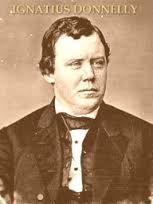
“The Panic of 1857 and the decision of the steamboats to use Hastings instead of Nininger as a river port doom Nininger City, the dream town of Ignatius Donnelly.

Nininger declines steadily after the financial panic of 1857 that causes banks across the country to call in loans. Donnelly tries to put a positive spin on the eastern bank failures by issuing a handbill entitled “Cure for the Panic. Emigrate to Minnesota! Where no Banks exist.

People move away anyway. By the 8th U.S. census in 1860, only 469 remain. Buildings disappear and by 1869 no other buildings remain besides Ignatius Donnelly’s house. The town eventually disappears from the map.” *

Have mercy on us! We make our dreams into idols, and are heartbroken and bitter when they fail us! Thank you for Donnelly and bless Your heart within his dreams! How bitter for him it must have been to see Hastings thrive?!

Lord, will You forgive any judgments that Donnelly had against Hastings, and vice versa? Will you make us free in the present from this bitter root? Will You bless the river and the lands involved? Will You preserve Nininger and Hastings in the season of flooding? Will You cause us to bless the town next door as much as our own?

http://www.mnhs.org/about/dipity_timeline.htm

Standard
19th Century, Culture, History, Indian, Intercession, Minnesota, Native Americans, State Government, Treaties

Sisseton Wahpeton Reservations Established

Unknown-2

February 19, 1867
“The Sisseton (or Lake Traverse) Reservation in northeastern South Dakota and the Devil’s Lake Reservation in central North Dakota are established for the Sisseton and Wahpeton bands, originally from Minnesota. These two bands had argued for the restoration of their treaty rights on the grounds that they had not fully participated in the war of 1862.” *

Lord Jesus, I ask that You enter this negotiation of February 19 so long ago. Will You bring Your justice into this situation? Will You free the Minnesotan and tribal members from the sins of their generations? Will You bring a new peace between Sisseton Wahpeton and our State?

http://www.mnhs.org/about/dipity_timeline.htm

Standard
19th Century, Americana, History, Immigration, Intercession, Minnesota, Politics, State Government

Attracting Settlers

Unknown

1867
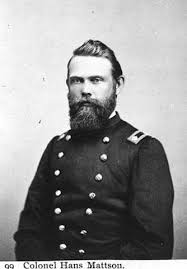
“People mean progress and prosperity to the new state. Minnesota establishes a board of immigration to attract settlers. Hans Mattson, secretary of the board, makes several trips to Sweden to recruit immigrants. Mattson had been a founder of Goodhue County’s Vasa colony in the 1850s. Now he encourages newly-immigrated Swedes to farm mainly in the central part of the state, with great successes in Wright, Meeker, and Kandiyohi counties.” *

Thanks for the establishment of a board of immigration! Thank You for Hans Mattson and his work to advertise Minnesota. Thank You that this state could be a shelter for many Europeans, but in this case, especially Swedish immigrants.

May any bitter root judgments between Wright, Meeker, Kandiyohi, Mattson, Minnesota, or Sweden be broken in the name of the Lord Jesus Christ! Will You soothe the burning frustrations between citizens of Minnesota and illegal immigrants past? Will You show our nation how to resolve the problems of having a population of perhaps 20 million non-citizens in the present? Will You forgive our sins against You and our fellow human beings through this issue into the future?

http://www.mnhs.org/about/dipity_timeline.htm

Standard