17th Century, Exploration, France, History, Intercession, maps, Minnesota, Native Americans

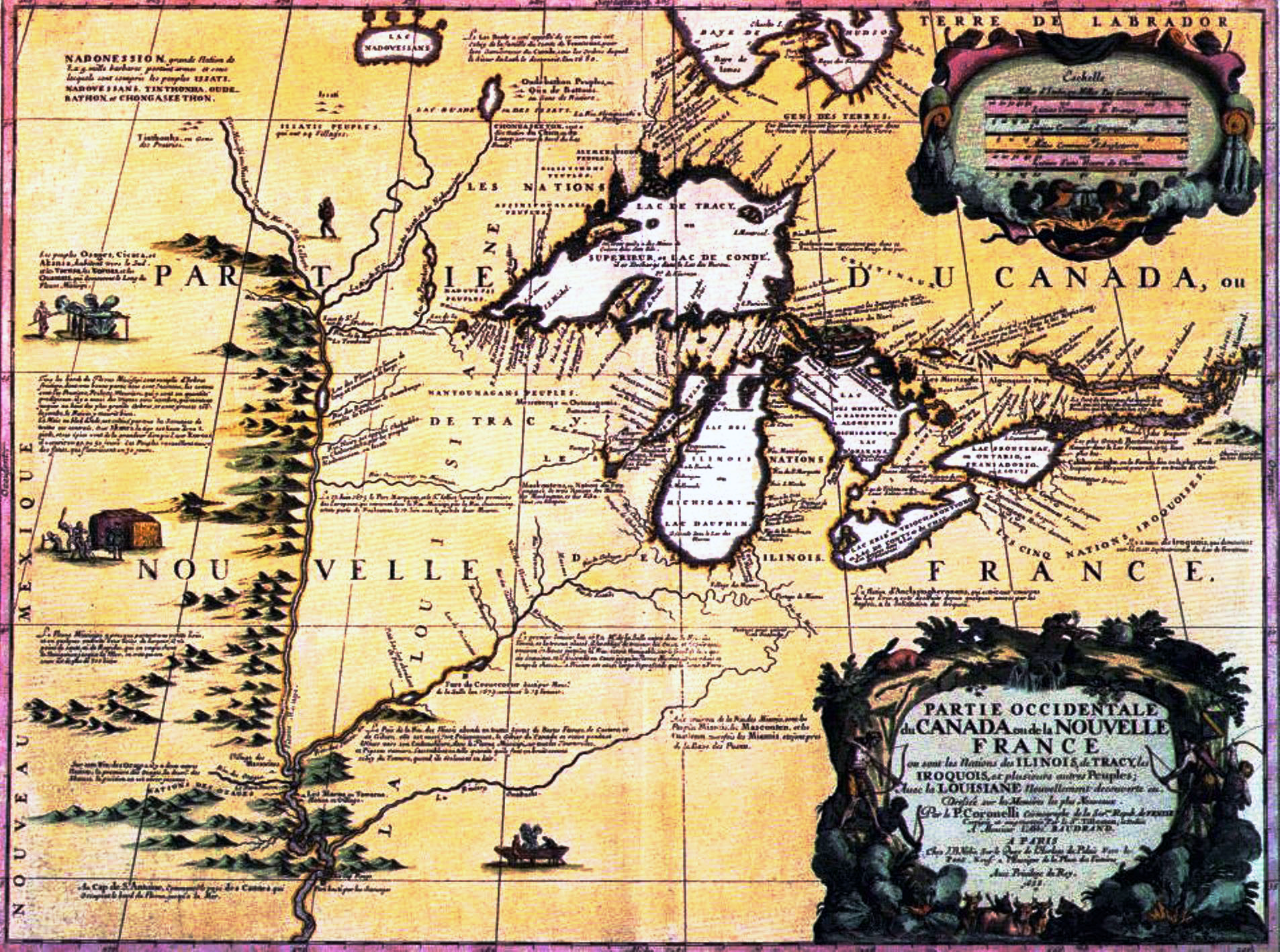
Allouez Creates Map of Lake Superior 1671

Vincenzo_Coronelli_Partie_occidentale_du_Canada_1688

“Partie Occidentale du Canada ou de la Nouvelle France ou sont les Nations des Ilinois, de Tracy, les Iroquois, et Plusieurs autres Peuples; avec la Louisiane Nouvellement Decouverte etc. . . . 1688” Vincenzo Maria Coronelli / Jean-Baptiste Nolin. raremaps.com


“Claude Allouez, a missionary on Madeline Island in the 1660s, explores the western and northern shores of Lake Superior. In 1671, he produces one of the best early maps of the lake, indicating the first European awareness of Minnesota.” *

Lord Jesus, thank You that You are the Way! Thank You for the roadmap of forgiveness that restores broken hearts and relationship! Thank You for the discipline of map-making and bless Allouez, his generations, and dwellings for this gift! Will You bless all future Minnesotans who are committed to showing us the way?

*Note – PrayThroughHistory uses the timeline located for several years at the Minnesota Historical Society Web site, at this URL: mnhs.org/about/dipity_timeline.htm .  Currently the timeline seems to be unavailable. I am hopeful that it will be back up in the future, as it was a valuable, user-friendly tool for anyone wishing to explore Minnesota history.

Standard
17th Century, Culture, History, Intercession, Minnesota, Native Americans

Ojibwe arrived in Minnesota 1650 to 1700

OLYMPUS DIGITAL CAMERA

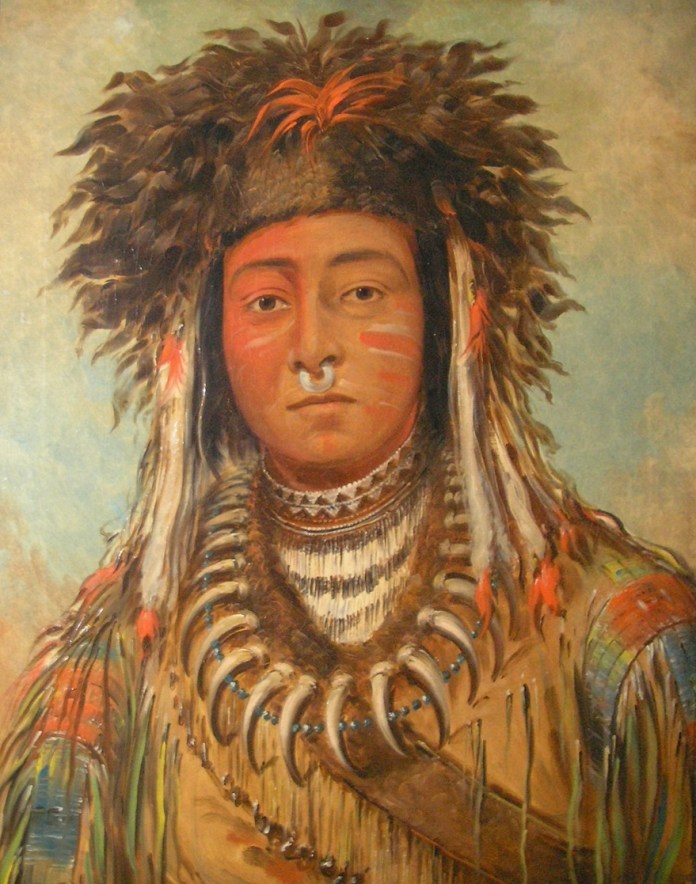
“Boy Chief” ca. 1835 George Catlin. https://en.wikipedia.org/wiki/Ojibwe

“The Ojibwe Indians, who have been moving westward for generations, reach the land we now call Minnesota. They encounter forest-dwelling Dakota people already here. The Ojibwe have gradually moved west from the region near the mouth of the St. Lawrence River, north of present-day Maine. By 1680, they have divided into three groups; the northern and southwestern groups have traveled west along the shores of Lake Superior. They have been involved in the fur trade for generations and possess guns. Like the Dakota, the Ojibwe are nature-based hunters, fishers, and horticulturalists.” *

Lord Jesus, thank You for using Minnesota as a meeting grounds for the Ojibwe and Dakota tribes! What good was in Your heart in this season for these tribes? Again, a migration of peoples from east to west, but this time Native Americans meeting Native Americans. Thank You for the potential released through the gift of new friendships.

I ask for the continuation and refreshment of this alliance begun in 1650 between these two tribes. If there were any bitter seeds planted then, will You kindly uproot them and release Your peace in its place? Will You retake any legal ground the Enemy may hold through this event, and specifically as it affects these tribal lands? Will You send your grace and truth into any contentious areas? May all Dakota and Ojibwe be blessed by You; Exalted Chief of the hunter, the fisherman, and the planter!

*Note – PrayThroughHistory uses the timeline located for several years at the Minnesota Historical Society Web site, at this URL: mnhs.org/about/dipity_timeline.htm .  Currently the timeline seems to be unavailable. I am hopeful that it will be back up in the future, as it was a valuable, user-friendly tool for anyone wishing to explore Minnesota history.


Standard
History, Intercession, Jesus, Minnesota, Uncategorized

What is PTH? Why pray about the past?

I freely confess that the following outline is a work in progress. I simply want to share the framework and rationale of why praying through history is pertinent to me. Everyone who names the name of Jesus is called to be a minister of reconciliation, and this is just one man’s attempt to practice.

I. There are specific “moments of separation” in human history. Our perceptions lead to thoughts that overlook or take offense. I will call these “thought-judgments”.

For example, the Seljuk Turks attack and overcome the city of Jerusalem.

II. Action-based judgments at the moment of the offense.

  • Jews to Seljuks, Jews to all Turks, Jews of Jerusalem towards any outsider.
  • Seljuks to Jerusalem’s Jews, Seljuks to all Jews, Seljuk’s towards all enemies.

III. Future judgments are formed based on memory and perception; bitter root judgments are formed.

  • Transference on a cultural scale.
  • Perpetuation of a past offense.
  • Walking backward into our future.

IV. Parties are held responsible for their actions and judgments in the Lord’s justice.

  • Even righteous anger betrays the victim. Perhaps even more so if the victim is a city, culture, tribe, or nation. Under the dominion of the Lord Jesus Christ, all have been forgiven all, and therefore must seek and practice to forgive all to remain true to His example. (This is not easy, but perhaps impossible apart from His mercy. The decision of the will may be simple, but the maintaining a heart of forgiveness is divine. )
  • This is not an endorsement of living without boundaries, especially personal boundaries. This is not an endorsement to submit to an abuser. Rather, it is a challenge of the rights of a human being to hold another prisoner by the maintenance of an offense.

V. We can representationally acknowledge historical sin before our Lord.

  • Through Christ we have access to his Omniscience, Omnipotence, and Omnipresence. He is present to all history, the present, and future events. He is within time, and beyond our comprehension of time. He knows all and can guide us to pray representationally, (intercession) for events of history, the present, and the future. He truly has unlimited power to forgive, heal, restore any human condition!
  • His only limitation is self-imposed: He is a gentleman with boundaries. He believes in good and evil, justice and injustice, lightness and darkness, separateness and relationship. Isaiah 5:20 “Woe to those who call evil good and good evil, who put darkness for light and light for darkness, who put bitter for sweet and sweet for bitter.” We can trust in distinctions because he trusts in distinctions. Denial of sin within the context of our relationship with Him or others offends God because it denies our condition of separateness, or that we may have a need to address. Denial allows us to keep our pride, hold a grudge, or maintain anger. To use an old Baptist analogy, “The whole world stands under the Niagara Falls of the Lord’s love. Some have their cups turned up and are filled. Others, though under a deluge of love, can’t seem to keep a drop because their cups are turned upside down.”

VI. Through acknowledgement of historical sins, we set the process of restoration in motion. It is a first step in a process, but is important because it removes the legal grounds of the accusations of the Enemy.

  • We become aware of sin. Often by conscience, or reading or hearing of history.
  • We confess it to the Lord. This is a legal admission of guilt.
  • We pronounce the Lord’s forgiveness of confessed sin. (1 John 1: 8-10)
  • He will guide it through the full process of restoration.
    1. Confession leads to remorse.
    2. Remorse leads to repentance.
    3. Repentance leads to reconciliation.
    4. Reconciliation leads to restoration.
  • We cannot change past events, but replace a heritage cursed relationships with a ray of blessed ones; a change beginning at a fixed point in time, but continuing into eternity.

VII. Additional scriptural principles or mandates that outline our authority under Christ to pray through history.

1. Author Derek Prince sheds light on several key passages of scripture:

  • “It is never the will of God that the judgment due the wicked should come upon the righteous.” Genesis 18: 23,25 NIV
  • “Will you sweep away the righteous with the wicked?” v. 23 Abraham asks.
  • ”Far be it from you to do such a thing — to kill the righteous with the wicked, treating the righteous and the wicked alike. Far be it from you! Will not the Judge of all the earth do right?” v. 25
  • On Christians’ dual citizenship: “By natural birth [the apostle Paul, like any Christian] is a citizen of an earthly nation, and he is subject to all the ordinances and requirements of his nation’s lawful government. But by spiritual rebirth through faith in Christ, he is also a citizen of God’s heavenly kingdom. This is the basis of Paul’s statement, … “We…are citizens of heaven.” Philippians 3:20 NEB
  • Another example, Jeremiah 1: 5,10 NIV – ”I appointed you as a prophet to the nations.” v.5
  • ”See, today I appoint you over nations and kingdoms to uproot and tear down, to destroy and overthrow, to build and to plant.” v.10
  • Jeremiah was subject as a citizen of Judah: he did not “preach or practice political subversion or anarchy. Nor did he ever seek to evade or resist decrees made by the government concerning him, even though these were at times arbitrary and unjust. Yet on the spiritual plane to which God elevated him through his prophetic ministry, Jeremiah exercised authority over the very rulers to whom he was in subjection on the natural plane.”
    – Derek Prince, Shaping History Through Prayer and Fasting,
     (Springdale, PA: Whittaker House,1973)  [Bolded emphasis mine.]

2. Theologian Timothy Tennent speaks to Christians’ God-given ability to express forgiveness from God.

  • Mark 2:1-12 NIV v 5. When Jesus saw their faith, he said to the paralytic, “ Son, your sins are forgiven.” v 10.
  • “But that you may know that the Son of Man has authority on earth to forgive sins…”He said to the paralytic, v11.
  • “I tell you, get up, take your mat and go home.” “It is interesting to note that in John 20:22-23, Jesus breathes upon his disciples to receive the Holy Spirit, and then pronounces, “If you forgive anyone his sins, they are forgiven; if you do not forgive them, they are not forgiven.”  Jesus is giving the church the authority to announce His forgiveness in the lives of those who come to Him in faith.
  • We do not have the innate ability to forgive anyone’s sins against God, or to withhold God’s forgiveness of sins from anybody.  But Jesus has given the Church the authority to act as His regents or representatives in the world, and to speak on His behalf.  We can declare that “God forgives you” with all the authority of Jesus, because we are not declaring our forgiveness, but rather His forgiveness in Christ.  We are merely pronouncing the forgiveness made possible by the sacrifice of Christ.”-Timothy Tennent, President, Asbury Theological Seminary http://blogs.asburyseminary.edu/global-talk/the-temple-is-here-mark-21-12/ [Bolded emphasis mine]

3.  His Holiness John Paul II, First Sunday of Lent “Day of Pardon” Presentation Vatican Basilica, 12 March 2000:

  • The meaning of the celebration of Lent: “…Christians are invited to acknowledge, before God and before those offended by their actions, the faults which they have committed. Let them do so without seeking anything in return, but strengthened only by the ‘love of God which has been poured finto our hearts’ (Rom 5:5)” (Incarnationis Mysterium, 11; cf. Terno Millennio Adveniente, 33).
  • …The Lord has been living and present in his Church, and through the Saints he has demonstrated that he continues to be at work in human history, in the midst of his community. Certainly, Christians, as pilgrims and wayfarers towards the Kingdom, remain sinners, frail, weak and subject to the temptations of Satan, the Prince of this world, despite their incorporation into the Body of Christ. In every generation the holiness of the Church has shone forth, witnessed by countless numbers of her sons and daughters; yet this holiness has been contradicted by the continuing presence of sin which burdens the journey of God’s People. The Church can sing both the Magnificat for what God has accomplished within her and the Miserere for the sins of Christians, for which she stands in need of purification, penance and renewal (cf. Lumen Gentium, 8).
  • “The Church cannot cross the threshold of the new millennium without encouraging her children to purify themselves through repentance of past errors and instances of infidelity, inconsistency and slowness to act” (Tertio Millennio Adveniente, 33). Consequently, a liturgy seeking pardon from God for the sins committed by Christians down the centuries is not only legitimate; it is also the most fitting means of expressing repentance and gaining purification.  Pope John Paul II, in a primatial act, confesses the sins of Christians over the centuries down to our own time, conscious that the Church is a unique subject in history, “a single mystical person”. The Church is a communion of saints, but a solidarity in sin also exists among all the members of the People of God: the bearers of the Petrine ministry, Bishops, priests, religious and lay faithful.– Source: http://www.catholiclinks.org/sacramentoperdondiadelperdon.htm  [Bolded emphasis mine.]

In Closing

Not all, but many, stories of the past are characterized by an antagonist/ protagonist relationship. I want to get beyond that broken record! I want to remember that I am just like them both; a human being with a heart filled with mixed motives! Perhaps one day we will learn to let the other guy off the hook, and create a just and merciful analytical model for history that will foster future generations in their struggles to ‘love their enemies, and do good to those who persecute them.’ May we, by the authority of the King of the Universe, practice to: heal the past, free the present, and bless the future. Amen!

James D. Orvis


Standard
Uncategorized

Welcome!

In the summer of 2010, I was invited to be support person for a friend’s counseling session. Discovering an area of unresolved pain, the counselor suggested that my friend recount and forgive the exact words and phrases used by his father to control or manipulate him, and his gut responses to them. My friend chose to do so, releasing his dad with great specificity for these long past offenses, and acknowledging his own choice to respond with hatred. Imagine his shock when moments after this prayer, his estranged father calls him up to invite him to a baseball game?! We were all in awe of the moment!

For weeks after this amazing session, I wrestled with God about it — at first on a personal level, but as time passed I found it meshing with my lifelong interest in history. A larger picture began to take shape.

Over and over I prayed, “If this principle works on an individual basis, can it work on a larger one: families, cultures, tribes, states or nations? If it does, who will confess the sins and separations of the past? What right does one have to confess conflicts of another?” His still quiet answer came over time, “Come and see. Watch history with me.”

So here I am. I am on a journey to watch and pray through a timeline of some major events of my home state, Minnesota, from about 1650 to the present. I move forward, wanting to practice looking at the past as the Master sees it; through the merciful lens of the Eternal Now.

I want to encourage site visitors to view the past in terms of how we as a people have broken with the Lord, often through our dealings with one another — and to acknowledge those points of separation, live more freely in the present, and pass blessings to future generations of Minnesotans instead of curses.

I am deeply indebted to the wonderful and comprehensive work of the Minnesota Historical Society. When I discovered their timeline tool* at http://www.mnhs.org/about/dipity_timeline.htm, I was inspired to meditate on Minnesota’s history. The timeline provided an essential framework for the ideas and expressions posted here.

Welcome to all, from curious to serious, who want to encounter some significant stories and events of Minnesota history as they occurred in the past, impact the present, and inform the future!

– James Orvis

*(NOTE – the timeline tool may not be currently available. I will update the timeline link if a new address exists.)

 

Standard