19th Century, education, History, Intercession, justice, Minnesota, omnipresent history, State Government

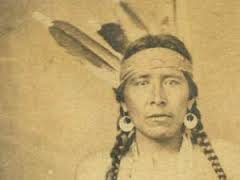
Deaf School 1863

Fariba13

1863
“A state-supported school for the deaf opens in Faribault. Instruction for blind students begins the next year. Classes are aimed at making students productive members of society: boys learn trades such as printing and girls learn homemaking.” *
“Bear in Mind!”
“I. This is not an asylum, but an Educational Institution, and is specially designed to give every deaf and dumb, and every blind child in the State a free education and a knowledge of a useful trade.”

“II. The Common Schools and the University are not looked upon as a public charity, neither should this Institution be so regarded. And education is even more important for these children than for those who can see, hear and speak. Without it they are doomed to a life of ignorance and dependence, but with it they may become intelligent, useful and independent citizens…”
-From Application, 1884. Minnesota School for the Deaf.
Minnesota State Archives Collection, 117.J.9.2

G-d, I’m proud of this moment in my state, and its choice to act in accordance with Your profound interest in every detail of every life! I relish that both our government and individuals saw the hope and promise in these sons and daughters! How good it is when we see through the eyes of our hearts, and commit to the work necessary to fulfill those visions!

Will You bless the city of Faribault for their faithfulness in donating the land for this school? Will You bless its time of waiting, five years, during the Civil War? Will You remember the individuals like Rodney A. Mott and Roswell H. Kinney who had both the vision and persistence required to actuate this delayed dream? **
Lord, we are Your creatures! We are Your people! We have sometimes assumed that because someone does not have a gift that we hold dear that they are limited and defective. Help our unbeliefs and misbeliefs! In You, truly, we are all perfected within our imperfections! Help us to view each other as fully worthy of love and respect!

Further, sweet Ruah Ha-Qodesh, because we are in covenant, I ask this day of that You bring glory to Yourself in bringing mass healings of deafness and blindness in Minnesota. Will You open the people of our state for mass healings or restorations of any kind whether: mental loss of hearing, emotional astigmatism, spiritual tinnitus, or historical cataracts? Will You forgive our shortsighted hearts? Will You forgive our deafness of soul to Your kind voice? Will You bring revelation to Minnesota in a way that only You can get the honor?

*http://www.mnhs.org/about/dipity_timeline.htm
** http://www.msad.state.mn.us/About/history/thebeginning.asp

Standard
19th Century, Culture, History, Indian, Intercession, law, Minnesota, Native Americans, State Government, Treaties, U.S. Government, war

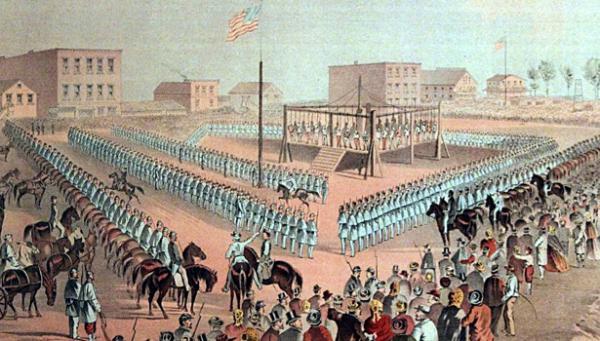
Trials and execution of Dakota at Mankato

dakota-38-mankato-massacre

December 26, 1862
“Of the hundreds of Dakota people who surrendered or were captured during the U.S.-Dakota War, 303 men are tried in a military court and convicted of rape and murder. At the urging of missionary Henry Whipple, President Abraham Lincoln reviews the convictions and commutes the sentences of 264 prisoners. Lincoln then signs the order condemning the remaining men to death by hanging. One prisoner is reprieved just before the sentencing is carried out. The remaining 38 men are hanged at Mankato on December 26, 1862—the largest mass execution in U.S. history.” *

Wow! That’s a sad title we own: “Minnesota, home of the largest mass execution in U.S. history.” Thank you for the merciful actions of Henry Whipple and President Lincoln. As a human being, I admit that I have the potential for hate, rape, and murder in my heart. All have offended Your perfection, yet we feel comforted by ranking our offense as lesser than our neighbor’s.

Will You forgive these hanged ones like You’ve forgiven all humanity? Will You restore them? Their generations? Their dwellings? Their lands? Their belief in the law and justice? Will You restore those who acted treacherously to foment this war: politicians, chiefs, business leaders, soldiers of the U.S. army or of the Dakota Nation, men, women, and children?

Will You forgive them for taking the bait of the enemy; the first offense? Will You forgive their offenders their profound lack of judgment by first executing their will to execute?Will You bring us all into chesed with You and as Minnesotans?

*P.T.H. cites timeline formerly at this URL: mnhs.org/about/dipity_timeline.htm
The Minnesota Historical Society Web site, http://www.mnhs.org , is fantastic! Check it out!

Standard
19th Century, cultural transference, History, Indian, Intercession, Minnesota, Native Americans, State Government, Treaties, war

Removal of Dakota Survivors

Sam Brown_0

November 7, 1862
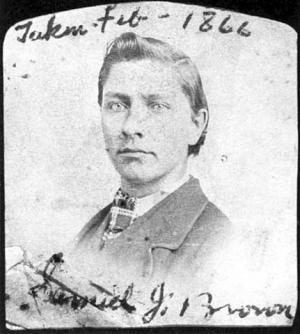
“Minnesota governor Alexander Ramsey declares that “the Sioux Indians of Minnesota must be exterminated or driven forever beyond the borders of the state.” Dakota women, children, and older men are marched from the Lower Sioux Agency to Fort Snelling. Along the route they are attacked by mobs of angry settlers. Witness Samuel Brown recalled that the streets of Henderson, Minnesota, were ‘crowded with an angry and excited populace, cursing, shouting, and crying. Men, women, and children armed with guns, knives, clubs, and stones rushed upon the Indians.’ “ *

Most of us haven’t experienced “street justice”! We cannot relate to being attacked simply for existing, and being in the wrong place at the wrong time. For those of us who have, the anxiety, panic, and sheer terror of being pursued by a mob are hard to erase.

Jesus, will You forgive the city of Henderson, and all those who participated in these actions on members of the Lower Bands of Dakota? May the hatred and fear projected from this town to the Dakota at this time be turned into direct blessing and healing words. Will You give gifts to all Dakota Bands to forgive this bitter chapter?

Will You cover the offenses of the Dakota towards Henderson, and all the lands where their conflict took place? Will You forgive the Dakota their attacks on innocents, and their property? Will You forgive the Dakota their counter-projection of hate and fear onto their neighbors?

Will You forgive those who sowed the seeds of this reaction? Will You forgive those who sowed the root offense of this conflict? Will You teach us to resolve its gross offenses, even deaths, in a life-giving way?

Kind Judge, in this act we have denied, and even attempted to usurp Your justice. We, in common, have acted as agent provocateurs against Your laws and order. We have submitted ourselves to injustice, and participated in base laws governed by revenge-filled hearts.

May the nation of Minnesota here represented, Dakotan, American, Euro-Minnesotan begin the path of blessing: from November 7th, 1862 through to the present. May we receive from You riot-proof hearts; whether against You or our fellow man. May you shield us from the misbelief that we can act as judge, jury, and executioner.

May we practice repentance before You first, and create habits of restoration towards our brothers and sisters for whom You died and rose again. Jesus, we love so poorly and incompletely because we do not grasp Your selfless love. Have pity on us whether Native Minnesotan, or Adoptive Minnesotan!

* http://www.mnhs.org/about/dipity_timeline.htm

Standard
19th Century, History, Indian, Intercession, Minnesota, Native Americans, State Government, war

U.S.-Dakota War Battle at Wood Lake

300px-Battle_Of_Wood_Lake

“For what reason we have commenced this war I will tell you it is on account of Major Galbraith. . . .” Taoyateduta (Little Crow), September 7, 1862

September 23, 1862

In early September, Col. Henry Sibley tries to negotiate a settlement with Taoyateduta (Little Crow). Sibley hopes to exploit major disagreements within the Dakota community about continuing the war. But Taoyateduta is not ready to quit. He explains why the Dakota started the war, and states that he is willing to release prisoners. Sibley demands surrender. Taoyateduta refuses.

The Dakota leaders reconvene and decide to ambush the U.S. troops. They hide in the prairie grass overnight, anticipating the Army troops’ morning moves. At 7:00 a.m. on the 23th, a group of U.S. soldiers approach an abandoned Dakota village, in search of food. “They came on over the prairie,” said Wamditanka (Big Eagle), “right where part of our line was. At last they came so close that our men had to rise up and fire. This brought the fight on, but not according to the way we had planned it. Taoyateduta saw it and felt very badly.” Some of the U.S. soldiers run back to camp to get help. A fierce fight ensues. The reinforcements fire a cannon non-stop, forcing the Dakota to retreat. In two hours the battle is over, and with it all hopes of Dakota victory.*

This event is a classic, “us versus them” conflict. It is clear that Sibley and Little Crow are the representational heads of the parties of this conflict. We cannot know the hearts of these men, but can see some of it in their actions.

Lord, we are like Sibley. We draw battle lines, and attempt to divide the camp of our enemy. We do battle and demand surrender of those whom we oppose. Will You forgive Sibley the errors of his judgments in this moment? Will You forgive His blood offense to You for the acts of injustice in this battle committed by U.S. troops?

Master, we are like Taoyateduta (Little Crow). We offer concessions to our enemy, yet cannot surrender. We make our stands in conflicts for both just and unjust motives. We reach the point of abandonment where we accept we either live victorious, or die fighting. Will You forgive Taoyateduta (Little Crow) this very understandable and human assessment? Will You forgive His blood offense to You for the acts of injustice in this battle committed by the Dakota?

Give us Your eyes of compassion for these men; they are but leaders trying to the best for their people. We are no different or better than them. The same potential to squelch our offender lives in us. The same potential to make a brave “last stand” is in our hearts today. Have mercy on our conflicts today. May we remember You, the Author of Mercy and Justice, before we demand surrender or fight to the death this day.

Will You take up these mutual offenses, though long past, up from this battlefield, out of the hearts and memories of all ancestors of the Battle of Wood Lake, and onto the Cross of Christ?

*P.T.H. cites timeline formerly at this URL: mnhs.org/about/dipity_timeline.htm
The Minnesota Historical Society Web site, http://www.mnhs.org , is fantastic! Check it out!


Standard
19th Century, cultural transference, government, History, Indian, Intercession, Minnesota, Native Americans, State Government, U.S. Government, war

U.S.-Dakota War, First Strike on New Ulm Aug 19, 1862

hqdefault

August 19, 1862
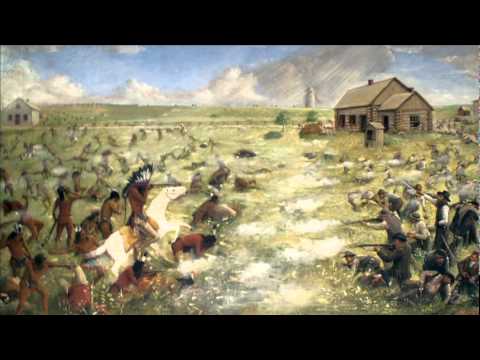
“On hearing about the Dakota “uprising,” the men of New Ulm quickly go about erecting barricades in the center of town. About 100 Dakota soldiers attack New Ulm at 3:00 p.m. After almost two hours of fierce fighting, the Dakota break off the attack due to torrential rains. Word of the attacks reaches St. Paul. Governor Alexander Ramsey commissions Henry Sibley to lead the response against the Dakota. Sibley gathers his forces, mostly untrained civilians, and heads up the valley in pursuit of the Dakota.” *

Jesus, I recognize the root separations that started this war. Over all, the prime motive for war seems to be broken trust. Often in human history, when the agreements of leaders fail, the innocent’s of their tribe, nation, or state bear the bloodguilt. Their leaders began the cycle of murder with their words, thoughts and actions. Yet, the kind, the unknowing, the innocent pay for their heart-murder!

Lord, will forgive us this offense against You! Forgive how good people on both sides of this issue were emotionally whipped up into an unnecessary frenzy that resulted in sickening cruelties! May town of New Ulm forgive the aggression of the estimated 100 Dakota soldiers. May the Dakota forgive the response of New Ulm and Henry Sibley.

Jesus, I invite You into this attack to remind all of true, self-sacrificing justice. Will You give revelation from this date of August 19, 1862 forward to all the participants, witnesses, and ancestors of the battle, their generations, and their property? We still fail to trust each other. We still do battle when something of ours is threatened. We hate our fellow human and are far from Your forbearing Spirit! Heal us, give us faith in each other, and heal this battle-scarred land!

http://www.mnhs.org/about/dipity_timeline.htm

Standard
19th Century, Civil War, cultural transference, History, Indian, Intercession, Minnesota, Native Americans, Politics, State Government, U.S. Government, war

U.S. – Dakota War Begins

Unknown

August 18, 1862

“See the white men are like locusts when they fly so thick that the whole sky is a snow storm. . . . Count your fingers all day long and white men will come faster than you can count.” Taoyateduta (Little Crow) By the summer of 1862, life on the Upper and Lower Sioux reservations is unpleasant and getting worse. Assimilation policies mandated by the U.S. government use the withholding of food and other supplies as a means of forcing the Dakota to conform to white ideals. “The whites were always trying to make the Indians give up their life and live like white men,” said Dakota leader Wamditanka (Big Eagle). “The Indians wanted to live as they did before. . . . If the Indians had tried to make the whites live like them, the whites would have resisted, and it was the same way with many Indians.” The appointment of Thomas J. Galbraith as Indian Agent at Upper and Lower Sioux exacerbates the situation. Galbraith, a political appointee who knows nothing about Indians, is considered arrogant, emotionally unstable, and rigid in his adherence to rules. By the summer of 1862 tensions on the reservation are unbearable. Annuity payments are late again, and the traders refuse to extend further credit. The Dakota “Soldiers’ Lodge” advocates the use of force to acquire food for the Dakota people. The situation falls apart in mid-August, when four young Dakota men kill five settlers near Acton. The Soldiers’ Lodge gains power and convinces a reluctant Taoyateduta (Little Crow) to lead the fight against the traders and settlers. Dakota warriors attack the Lower Sioux Agency in the early morning of August 18, killing traders and government employees. The Dakota then attack settlements along the Minnesota River valley, killing hundreds of white settlers in the first few days. A U.S. Army force sent up from Fort Ridgely is ambushed at Redwood Ferry; 24 soldiers are killed. The Dakota forces are primarily young men, mostly from the Mdewakanton band, led by Chiefs Sakpe (Shakopee), Medicine Bottle, Taoyateduta (Little Crow), Wamditanka (Big Eagle), and Mankato. Most Dakota, however, choose not to fight.” *
Unknown

When another group of Indians appeared at the Lower Sioux stores on August 15, Indian Agent Thomas Galbraith wouldn’t let them take any food since they didn’t have any money. Payments to the Indians had not been made, partly because of delays caused by the American Civil War. When the tribesmen appealed to Myrick to allow them to take food on credit, he said, “So far as I am concerned, if they are hungry let them eat grass or their own dung.” **
Eternal Father, first of all, let me confess the harsh words of Andrew Myrick as sin against You first, and secondly to the Sioux and Dakota nations. “So far as I am concerned, if they are so hungry let them eat grass or their own dung.” I can only imagine the parental protectiveness in Your heart; “You said what to my starving kids?!” We don’t often ponder the depths of emotional pain a foolish action causes You. As the author of all emotions, will You forgive this heartache caused in the name of our state and nation?
We are guilty of speaking harsh words against our brothers made in Your image! Forgive us this offense! Jesus, will You bring Your healing presence into this meeting on August 15, 1862? Will You replace the curses, spoken and unspoken, between Sioux, Dakota, Galbraith, Myrick, the State of Minnesota, the United States, the parties unknown, and heal the land with Your blessing?

As Your child, I want to extend forgiveness to the Mdewakanton and Dakota tribes, the chiefs Sakpe, Medicine Bottle, Taoyateduta, Wamditanka, and Mankato for responding to this horrible offense in violence and bloodshed. Will You replace this specific curse with a blessing on them, their generations, their dwellings and property? As Your child and a citizen of Minnesota, I want to ask forgiveness of You and the aforementioned parties for the deadly counter-response to this conflict committed in its name, and the name of the United States. Forgive the haste, and the unwillingness of our government to assess if we, indeed, had not kept our promise to pay annuity payments on schedule! Have mercy on us Jesus! Keep bringing us to full restoration with You and each other in response to this event!

Conversely, will You forgive the youthful responses of the warriors that pushed a violent solution to a practical problem? Granted, these tribes had just endured years of deprivation of their lands at the hands of our government and its’ associates. Those that had mistreated the tribes, in a better world, should have been morally and legally liable for ensuring the sustenance of the Mdewakanton Band.

This event shows the cycle of judgment and counter-judgment more clearly than most in the history of Minnesota. For example?
Myrick harshly judges the young Mdewankanton, and cannot see his atrocity of withholding food and provisions to the displaced peoples in front of his eyes. He also commits the sin of “just following orders” instead of using his common sense, and shows no interest in truly assessing the pain of the Mdewankanton who were legally swindled out of their homeland by the US. Government and its’ agents. In effect, their people were transferred from a state of independence to dependence on government for their provisions.
Young Mdewankanton warriors harshly judge their non-Native neighbors and transfer their righteous anger on the wrong recipients. They make the same mistake as Myrick; they cannot recognize the innocent, and viciously attack neighbors who did not agrees towards them.

Lord, will You forgive this transference of shame and rage at the hands of the young Mdewankanton towards those neighbors who did not oppose them? Will You forgive both parties their: inability or lack of communication, their lack of curiosity to know their neighbors, and profound lack of empathy? Will You bring healing to this bitter root grown in this era, free us to hear the needs of our neighbors in the present, and live in Your blessing and abundance in the future?

“Lord Jesus, we enthrone You, we proclaim You our King. Standing here in the midst of us, we raise You up with our praise…” ***

*http://www.mnhs.org/about/dipity_timeline.htm
** Folwell, William Watts. “A history of Minnesota.” St. Paul, Minnesota: St. Paul, Minnesota Historical Society. P 233. Internet. http://en.wikipedia.org/wiki/Andrew_Myrick
*** For the rest of the lyrics of this beautiful song by Paul Kyle, follow the link. http://higherpraise.com/lyrics/love/love853214.htm

Standard
19th Century, Culture, Emigration, farming, History, Immigration, Intercession, Minnesota

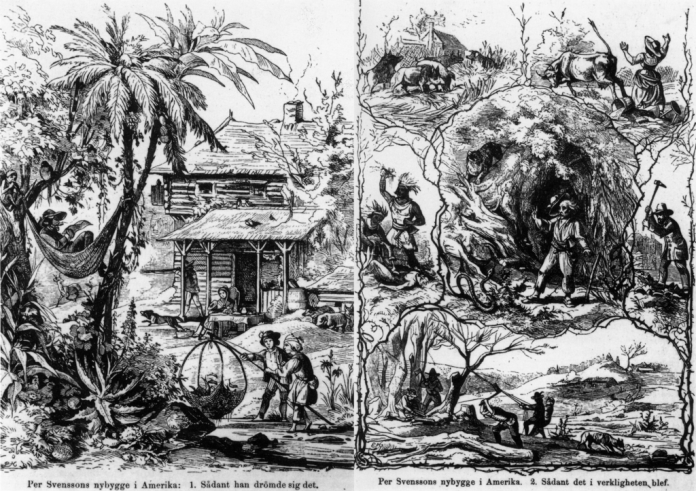
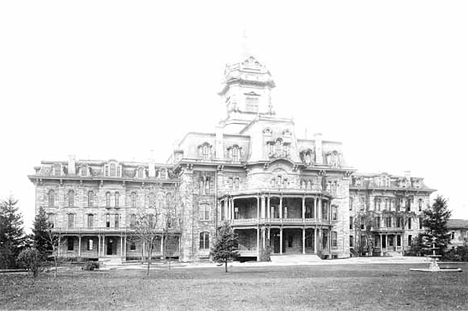
Swedish Immigration 1862

1024px-Anti-emigration.propaganda.1869

Left side: Dreams of America Right side: Realities of America

Over the next 30 years more than 350 families from the province of Dalarna in Sweden pick up and move to Isanti County. They recongregate around their parish churches.
This emigration represents a second wave from Sweden, driven by hunger during lean years (1863-1877) in their native land.*

There were many reasons Swedes were disenchanted with life in their homeland in this era. Norway and Sweden were ruled by a shared aristocracy and common people allegedly despised the arrogance of monarch Charles XV and his tone-deaf response to their plights. Uppsala graduate Gustaf Unonius left Sweden for the Midwest, and his writings in the Swedish newspaper “Aftonbladet” drew interest in places like Wisconsin and Minnesota.**

Though this wave came from Dalarna, many future Minnesotans came from Smaland (Southern Sweden) where the poor soil and small plots made it difficult to survive. Imagine their surprise when one could buy an acre of excellent land for $1.25?! The climate of Midwest was familiar and pleasant to these northern peoples.

Numerous other factors tipped the scales towards them in the eyes of their American neighbors. “They are not peddlers, nor organ grinders, nor beggars; they do not sell ready-made clothing nor keep pawn shops, they do not seek the shelter of the American flag merely to introduce and foster among us … socialism, nihilism, etc … they are more like Americans than are any other foreign peoples.” ***

Lord, thank you for the gift that Swedes have been to our state! Thank you that they could find this new place to begin again! Will You bless every Minnesotan of Swedish ancestry; them, their generations, and their dwellings by the authority of the Lord Jesus Christ?

Jesus, forgive our judgments of these immigrants. Forgive us when we do not remember the trials of their homeland. Most Minnesotans’ of today do not realize that our Swedish ancestors fought starvation, various forms of slavery, political disenfranchisement, and religious persecution.

Lord, will You forgive our bitter judgments of Swedish-Americans! Forgive any counter judgments that enslave them! May we be Your forgiving and free people! Ljuset skringrar varje morker! Gud valsigne Sverige!

*P.T.H. cites timeline formerly at this URL: mnhs.org/about/dipity_timeline.htm
The Minnesota Historical Society Web site, http://www.mnhs.org , is fantastic! Check it out!


Standard
19th Century, Business, History, Minnesota, railroad, Transportation

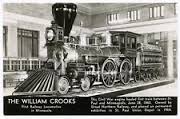
Railroad Introduction

images-15

“Minnesota’s first railroad line begins operation when the William Crooks travels ten miles from St. Paul to the village of St. Anthony (present-day Minneapolis). Within ten years the state is laced with railroad lines, opening up vast inland regions to farming and lumber.

To get here, the William Crooks rode on tracks to LaCrosse, Wisconsin then was shipped by steamboat to St. Paul. Until the railroads, steamboats and the rivers they ride are the most efficient way to move goods in and grain and logs out.” *

Thanks for the innovations that led to the railways in MInnesota! We have been blessed with excellent passenger and freight transportation here for about 150 years! I bless the changes the William Crooks brought to this generation by the authority of Jesus. May these rails continue to be a blessing to this state in perpetuity!

Good Dad, as I meditate today with You on the subject of trains, I feel a bit of melancholy. Like any good father, You relish the growth, achievements, and inventions of Your kids as they play. You “play trains” with us, and relish as we delight in building, connecting, and traveling.

While this snapshot of time, the coming of the William Crooks, was born peaceably, our methodology and timing in building many future rail lines left much to be desired. What would a dad say to a kid, who when playing with his siblings, demanded that they sign numerous deeds or legal contracts that gave him dominance of their shared playroom or basement? What would a dad say to a daughter who demanded that her brother be permanently removed from the premises because she needed more room for her elaborate train set?

Granted, the real-life complexities of building these lines in 1862 were much more severe than the basement scenario. How does one negotiate a deal between two parties that share little commonality in their definitions of property and ownership? How does one reach resolution when each parties’ land needs or transportation needs are so different?

Lord, forgive and heal Minnesota of every bad fruit and judgment that sprung from the dissonance of these deals. Will You forgive railway companies, their land agents, or any other parties in authority their sins against Native Americans stemming from the land granted them by the federal, state, or local government? We still bear their burden of having sinned against You when we take land or property from one, and give it to another without price! Will You forgive tribes, though often truly wronged, the maintenance of this offense into the present era? (May they receive justice, but be free from transference in their hearts.) How will You heal these broken hearts? Bind us up, Lord!

Hear my prayer, may all forms of coercive redistribution of wealth and property cease in the state of Minnesota! May your Holy Spirit so move on our state and people that we would give and share our land and property, our selves, and our time according to Your pleasure! In many ways, we have lost the joy of giving because our much of our charity is routed through faceless government institutions rather than through human relationships. Help us solve this problem too.

Holy Spirit, will You enable us to give the unlimited resources of heaven to our fellow man through prayer and fasting! May You fill internal chasms of heart that sometimes drive our reckless consumption and fuel our frenetic needs for doing, and cut us off from being. Change what we desire; what we want! In the words of David in Psalms 23:1, “The Lord is my shepherd, I shall not be in want.”

*P.T.H. cites timeline formerly at this URL: mnhs.org/about/dipity_timeline.htm
The Minnesota Historical Society Web site, http://www.mnhs.org , is fantastic! Check it out!


Standard
19th Century, Agriculture, farming, History, Indian, Intercession, Minnesota, Native Americans

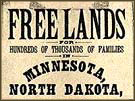
Homestead Act 1862

9-2

“Congress passes the Homestead Act, offering millions of acres of free land to settlers who stay on the land for five years. Lumber companies acquire valuable timber lands through fraudulent claims.

“A Homestead Bill Passed. Minnesota will derive great benefit from the passage of this act. Not only will it afford relief to thousands of settlers at present upon our public domain, but offer additional inducements for emigrants from the east and the old country to settle among us.” -Mankato Record, June 26, 1862

The act brings 75,000 people to Minnesota over 3 years. To qualify for 160 free acres, settlers have to live on it for five years, farm, and build a permanent dwelling. Those able to spend the money can buy the 160 acres at $1.25 an acre after living on it for six months.” *

I am a witness to this truth this morning: Minnesota is the property of the Lord Jesus Christ. Thank you for the heart of the Homestead Act to offer a place for the emigrant: “exile, expatriate, emigre, colonist, migrant, displaced person, D.P., traveler, foreigner, pilgrim, refugee, fugitive, wayfarer, wanderer, immigrant, alien, outcast, man without a country.” (p.136, “Webster’s New World Thesaurus” by Charlton Laird) This is an honorable motive, to be a place of refuge, consistent through Minnesota’s history.

However, there is a heritage of mixed fruit. Some land given away by the state was “acquired” or unjustly taken from Native Americans. We see the continuation of the root sins of greed for land by the fraudulent claims of special interests: lumber companies, railroads, land speculators, and corrupted government agencies. Lord will You be the arbiter of justice over these parties to mass theft, deception, or at least self-interest? Will You specifically restore the Native American to his land(s), or find a path to reasonable compensation? Will You meet this bitter root of land greed today?

Under the the authority of the Lord Jesus Christ, I announce to the spirit and attitude of land greed that your reign in Minnesota from the Homestead Act of 1862 through the present and into the eternal future is broken. Land and property, be reassigned according to the will of the Lord, to the stewards whom He may choose. O land of Minnesota, all below, and sky above, I declare a “Year of Jubilee”: a year of returning and rest, a year of the favor of the Lord!

*P.T.H. cites timeline formerly at this URL: mnhs.org/about/dipity_timeline.htm
The Minnesota Historical Society Web site, http://www.mnhs.org , is fantastic! Check it out!

Standard
19th Century, authors, Books, Culture, education, Environment, History, Intercession, Minnesota, omnipresent history

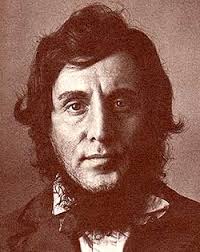
Thoreau Visits 1861  

images-14

Henry David Thoreau

1861

“Hoping western air will cure his consumption, Henry David Thoreau makes a trip to Minnesota. But the author of Walden is so sick that he returns to Massachusetts far earlier than planned.”*

Thank You for Thoreau and his desire to learn what living means. His book touched so many lives with the idea of being content and living simply. Sometimes, learning what we don’t need is the best gift we receive.

Jesus, will You remember him in this sickness? Jesus, will You dissolve any bitter root thoughts that may have formed from the disappointment of this visit and leave a blessing for Thoreau’s lineage and philosophical heritage? G-d, it’s a hard lesson when one goes from self-help to becoming dependent. Will You teach us to help dependents in our lives, and remember what its like to be humbled like Henry today?

*P.T.H. cites timeline formerly at this URL: mnhs.org/about/dipity_timeline.htm
The Minnesota Historical Society Web site, http://www.mnhs.org , is fantastic! Check it out!


Standard